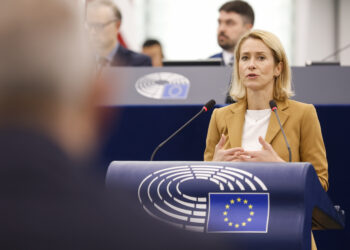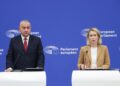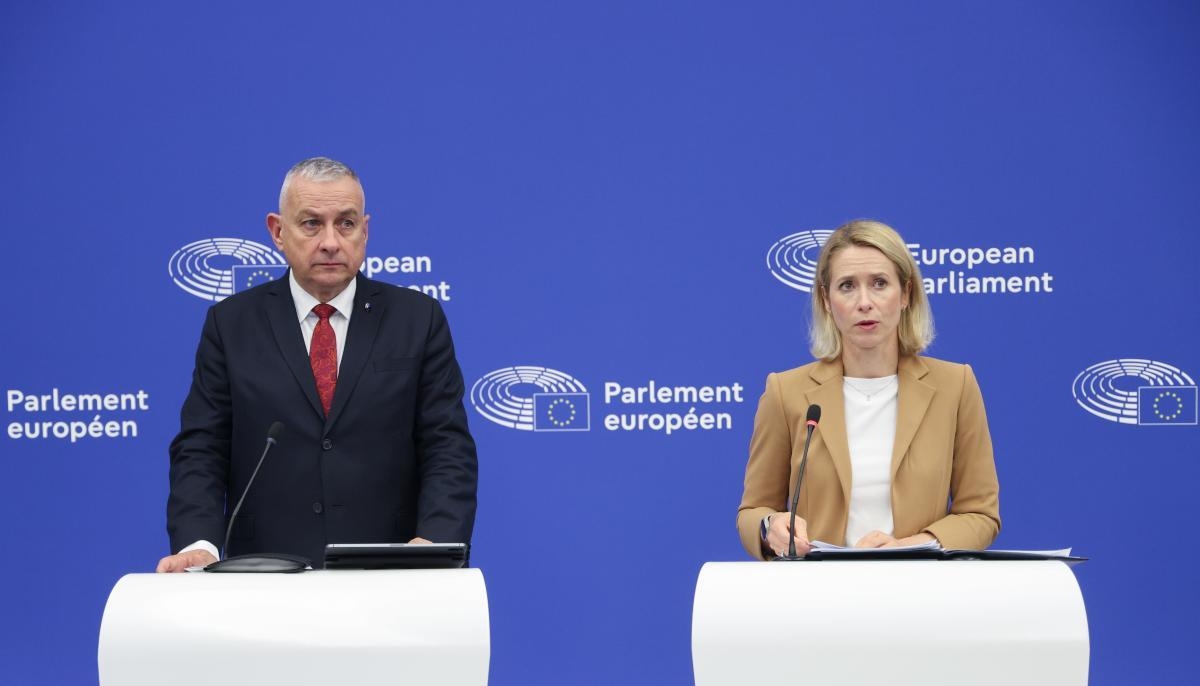
Strasbourg – The pleas of the twelve European countries calling for a greater presence in the Arctic have been heeded. Climate change and growing geopolitical rivalries in the region have led the European Commission and the High Representative for the EU’s Foreign Affairs and Security Policy, Kaja Kallas, to adopt today (20 October), at the College of Commissioners, the Union’s new Arctic strategy. The aim: to protect a region that is now “no longer immune to global geopolitical tensions,” as the High Representative emphasised at a press conference in Strasbourg. “The Arctic is a place where the tectonic plates of geopolitics collide; it is not a distant frontier that concerns others: it is part of the European Union,” stated the President of the European Commission, Ursula von der Leyen. For the President of the EU Commission, this is a region that is “close, interconnected, and of crucial importance for the future” of the EU, not least because “the fact that Russia is rebuilding its military presence in the Arctic, implementing hybrid strategies against neighbouring countries and reshaping the region’s security, has repercussions for the entire European Union.”
In the Arctic, “the list of challenges is long,” said Kallas. In a region that is warming almost four times faster than the global average, the adopted text sets out a new framework for cooperation based on four strategic priorities: strengthening security, tackling climate change, economic prosperity and opportunities for local communities. With over 500,000 EU citizens living in the region and three Arctic Member States (Denmark, Finland, and Sweden), Europe reaffirms the importance of the High North. But “we are not drawing borders on a map, nor are we making any specific geographical or territorial claims,” emphasises a European official. “Rather, it is a question of defining a broader shared space, where we see a convergence of interests with other partners, with whom we intend to collaborate,” he adds.
As highlighted by High Representative Kaja Kallas, in the face of growing activism by Russia and China, “Arctic security is European security.” These are what Kallas describes as the challenges that “stand out.” On the one hand, Russia is “expanding its military presence in the far north, has restored Soviet-era bases and is testing new weapons in the region.” On the other hand, Chinese activities “require close scrutiny.” All this is happening because “the retreat of the ice is opening up access to resources and sea routes and intensifying competition for control over them.” This context “makes Arctic security and European security a fundamental aspect in defining our interests,” explained the High Representative. “We plan to step up investment in surveillance infrastructure, transport and military capabilities,” she stated.
In terms of resilience and defence, the EU will work in a complementary manner with NATO to boost Europe’s icebreaker capacity and protect critical infrastructure. Key operational developments include the establishment of a Maritime Security Hub (a new centre for maritime security) and an Arctic Cable Hub (a centre dedicated to submarine cables), designed to monitor the submarine cable network, combat illegal fishing, track vessels belonging to the so-called “shadow fleet”, identify illegal fishing activities and instances of pollution, and improve the coordination of search and rescue operations, including through investment in smart technologies to detect potential threats to critical infrastructure.
To tackle the environmental emergency, the EU is renewing its commitment to keeping oil, coal, and gas in the ground, while maintaining the position already set out in its previous 2021 Communication not to increase the extraction of mineral and fossil resources from the Arctic. “We will not carry out drilling in the Arctic, and we will not purchase hydrocarbons from that region. This position continues to be based on climate and environmental considerations, which remain unchanged,” reiterates a senior EU official. This is also because it would take at least a decade to launch extraction activities, and “during this time, we will not need such resources, and certainly not those from the Arctic.” New scientific and ocean monitoring platforms are also being launched, including the OceanEye initiative and the new EU Polar Research Hub, designed to strengthen the link between scientific research and policy-making. Meanwhile, from an economic and infrastructural perspective, the strategy focuses on renewable energy, critical raw materials, and the strengthening of dual-use routes, including military mobility, by accelerating key projects such as the Nordic Rail, the IRIS² satellite coverage to establish secure connections, and the Pan-Arctic Cable, which will be “a segment of an infrastructure linking Europe, Greenland, and Canada, and continuing to Japan,” with “feasibility studies already underway for this project,” as a senior European official explains. On the energy front, on the other hand, the EU is examining the Aurora power line project, which would link the electricity grids of Finland and Sweden, with a view to harnessing the region’s potential for hydropower, geothermal energy, wind power, and renewable hydrogen.
Finally, the issue of young people and indigenous peoples. In addition to support for regional development – provided by more than €1 billion in cohesion funds (2021–2027) – Erasmus+ exchanges are being expanded, a Youth Sounding Board has been established in Greenland, and specific measures have been launched to combat information manipulation and foreign disinformation.
The new document updates the action framework established in 2021 to respond to the profound geopolitical and environmental changes of recent years. However, as Kallas clarified, “since our previous Arctic strategy of 2021, we have been facing a much more challenging security environment.” The EU’s aim is to strengthen cooperation with partners in the region – in particular Norway, Iceland, the United Kingdom, Canada and the United States – and with local bodies such as the Arctic Mayors’ Forum. As noted by the Commissioner for International Partnerships, Jozef Síkela, the Arctic represents Europe’s “northern neighbourhood,” the stability of which has a direct impact on the continent’s security.
English version by the Translation Service of Withub