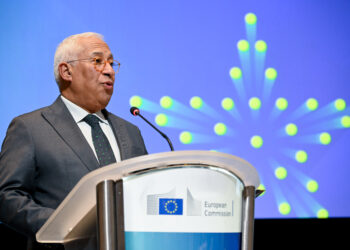


Brussels – “We’re not there yet.” This is the phrase most frequently used by EU heads of state and government to sum up the negotiations on the next multiannual financial framework (MFF 2028–2034). “We’re not there yet” is the refrain that opens proceedings at the European Council summit, which was theoretically convened to reach an agreement that does not exist and does not appear to be within reach – so much so that, even before the leaders entered the room, the office of the President of the European Council, Antonio Costa, was already considering the possibility of another extraordinary summit in early December, ahead of the actual one scheduled just before Christmas (17 and 18 December).
The positions, moreover, appear irreconcilable: the so-called frugal countries – those calling for even deeper cuts – insist on reducing the budget even further than Costa’s proposal. Sweden and the Netherlands are leading this front. On the opposite side, however, are those calling for more resources, co-ordinated by Italy and Romania: the Czech Republic on cohesion, Lithuania on interconnections and major networks, and Estonia on defence.
This is the situation, and it is not a promising one. Alongside those calling for more funding and those calling for less, there are also those calling for aid to Ukraine to be decoupled from the negotiations on the European Union budget. This is the case with Luxembourg, whose Prime Minister Luc Frieden points out: “Ukraine needs aid now, but our budget doesn’t come into effect until 2028…”
The leaders of the Baltic states remain optimistic, however: “If we put on our EU hats rather than our national ones, we can reach an agreement”, says the Prime Minister of Latvia, Andris Kulbers. Meanwhile, the President of Lithuania, Gitanas Nauseda, remains convinced that “the idea of finalising the process by the end of the year is still on the table”.
Reaching a budget agreement by 2026 remains Antonio Costa’s objective, and for this reason his staff is considering a further summit in addition to the one that has just begun. The Swedish Prime Minister, Ulf Kristersson, however, appears determined to call the bluff: “We have never spoken of a December deadline. I appreciate the idea, but we cannot accept a budget we do not believe in simply because there are deadlines”.
It is against this backdrop that the EU is gathering round the table. Costa will first have to consider whether it makes sense to call another summit so soon. Perhaps the divisions are such that it is not justified, or perhaps they are. What is certain is that the leaders are more divided and at loggerheads than ever before. The Dutch Prime Minister, Rob Jetten, has given the press a preview of this weekend’s summit: “Further negotiations will also be needed in December”. This confirms the fact that, as virtually everyone has reiterated, we are “nowhere near an agreement” on the multiannual budget.
English version by the Translation Service of Withub