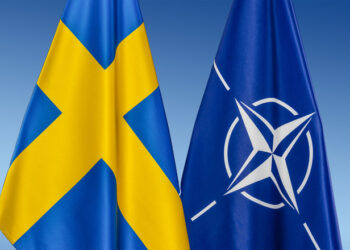
Brussels – And now 32 flags are flying outside NATO headquarters in Brussels. With the flag-raising ceremony held today (March 11), Sweden made its first official appearance as a new member of the North Atlantic Treaty Organization, bringing to fruition the latest phase of Atlantic Alliance enlargement in the 75th anniversary year since the treaty was signed in Washington in 1949. “NATO membership is good for Sweden, for the stability of the North, and for the security of the entire Alliance,” made it clear the Secretary-General of the intergovernmental military organization, Jens Stoltenberg, welcoming Sweden’s Prime Minister, Ulf Kristersson, to the headquarters in Brussels, three days after the completion of Stockholm’s membership process.

In less than a year, Stoltenberg saw two new flags hoisted, the Swedish and the Finnish (on April 4 2023), just before the end of his term as secretary-general in October this year: “Sweden’s membership proves once again that NATO’s door remains open. No one can close it. Every nation has the right to choose its own path.” This is a clear response to accusations by Russia’s autocrat, Vladimir Putin, and to the controversy over the issue of enlargement of the Atlantic Alliance itself in reference to the aspiration of Ukraine to join it in the future. “When Putin launched his full-scale invasion two years ago, he wanted less NATO and more control over his neighbours. He wanted to destroy Ukraine as a
sovereign state, but he failed,” Stoltenberg emphatically stressed at the press conference, “NATO is now bigger and stronger. Ukraine is closer to NATO than ever
before, and as the brave Ukrainians continue to fight for their freedom,
we stand by their side.”

From left: Prime Minister of Sweden, Ulf Kristersson, and NATO Secretary General Jens Stoltenberg (March 11, 2024)
On the subject of the 32 allies’ support for Kyiv, Stoltenberg reiterated that “surrender is not peace”—putting a period to NATO’s position concerning the weekend words of the head of the Catholic Church, Pope Francis—and “we will continue to strengthen Ukraine to show Putin that he will not get what he wants on the battlefield,” because “Putin started this war and he could end it today. But Ukraine does not have that option.” On the same wavelength is the Swedish premier: “The security situation in our region has not been this serious since World War II, and Russia will continue to pose a threat to Euro-Atlantic security for the foreseeable future.” That is why Sweden has applied to join the Alliance “to achieve security, but also to ensure it,” Kristersson assured, although he ruled out the need to host nuclear weapons or permanent bases on national territory: “There are no plans to expand the number of NATO allied countries with nuclear weapons.” Sweden’s accession protocol was signed (along with Finland) on July 5, 2022, after a strategic historic turn of the national security policy traditionally linked to non-alignment. Since then, it has been an uphill road for Stockholm. More than 19 months after the Madrid summit, Hungary had remained earlier this year the only member country not to have formally approved Stockholm’s entry into the Atlantic Alliance, when Turkey had also put an end to its very strong blockade. A month and a half ago, the Hungarian premier, Viktor Orbán, had formally dropped his short obstructionism but his Fidesz party had not, boycotting the extraordinary session earlier this month. Finding himself under pressure from the other members—and cornered by Kristersson’s visit—the Hungarian premier finally pushed his party members to drop the resistance. The go-ahead from Budapest finally came last February 26, after the meeting in the Hungarian capital between Prime Ministers Orbán and Kristersson to discuss defence and security cooperation.
Sweden and Finland, the latest members of NATO
To become a member of NATO, a country must send a formal application previously approved by its national parliament. This opens two stages of discussions with the Alliance, which do not necessarily pave the way for membership: the first, the “Intensified Dialogue”, delves into the country’s rationale for applying; the second, the “Membership Action Plan”, prepares the potential candidate to meet the necessary political, economic, military, and legal requirements (democratic system, market economy, respect for the rule of law and fundamental rights, standards of intelligence and contribution to military operations, aptitude for peaceful conflict resolution). This second round of discussions was introduced in 1999 after the accession of Poland, Hungary, and the Czech Republic to address the process with would-be members with political systems other than those of the Alliance’s founding countries, such as the former Soviet countries.

NATO Secretary General Jens Stoltenberg
The accession procedure formally begins with the application of Article 10 of the North Atlantic Treaty, which provides that “the parties may, by unanimous agreement, invite for accession any other European state capable of furthering the development of the principles of this Treaty and contributing to the security of the North Atlantic region.” The resolution must be voted on unanimously by all member countries. At this point, the accession talks open at headquarters in Brussels to confirm the candidate’s willingness and ability to meet the obligations of membership: political and military issues first, security and economic issues second. After the accession talks, which are, in effect, a phase of negotiations, the candidate country’s foreign minister sends a letter of intent to the Alliance Secretary General.
The accession process ends with the Protocol of Accession, which is prepared by an amendment to the Washington Treaty, the founding text of the Alliance. This Protocol must be ratified by all members, with procedures varying by country: in Italy, the vote of the Parliament in a joint session is required to authorize the President of the Republic to ratify the international treaty. Once the Accession Protocol has been amended, the NATO Secretary General formally invites the candidate country to join the Alliance, and the agreement is deposited at the U.S. State Department headquarters in Washington. At the end of this process, the candidate is officially a North Atlantic Treaty Organization member.
English version by the Translation Service of Withub

![Da sinistra: il presidente del Consiglio europeo, Antonio Costa; il presidente dell'Ucraina, Volodymir Zelensky: la presidente della Commissione europea, Ursula von der Leyen [Bruxelles, 18 giugno 2024. Foto: European Council]](https://www.eunews.it/wp-content/uploads/2026/06/euco_ua260618-120x86.jpg)
![[foto: Saverio De Giglio/imagoeconomica]](https://www.eunews.it/wp-content/uploads/2026/10/cpt-120x86.png)