- Europe, like you've never read before -
Saturday, 4 July 2026
No Result
View All Result
  • it ITA
  • en ENG
Eunews
  • Politics
  • World
  • Business
  • News
  • Defence
  • Health
  • Agrifood
  • Other sections
    • Culture
    • Rights
    • Energy
    • Green Economy
    • Finance & Insurance
    • Industry & Markets
    • Media
    • Mobility & Logistics
    • Net & Tech
    • Sports
  • Newsletter
  • European 2024
    Eunews
    • Politics
    • World
    • Business
    • News
    • Defence
    • Health
    • Agrifood
    • Other sections
      • Culture
      • Rights
      • Energy
      • Green Economy
      • Finance & Insurance
      • Industry & Markets
      • Media
      • Mobility & Logistics
      • Net & Tech
      • Sports
    No Result
    View All Result
    Eunews
    No Result
    View All Result

    Home » World politics » From CeSpi a tool to check the actual use of European development aid

    From CeSpi a tool to check the actual use of European development aid

    The money the EU pays to third countries to support them for certain purposes does not always have satisfactory effects for those purposes

    Matteo Pedrazzoli</a> <a class="social twitter" href="https://twitter.com/Matteo__Pedra" target="_blank">Matteo__Pedra</a> by Matteo Pedrazzoli Matteo__Pedra
    10 April 2024
    in World politics
    Cespi nuovo strumento investimenti europei S&D

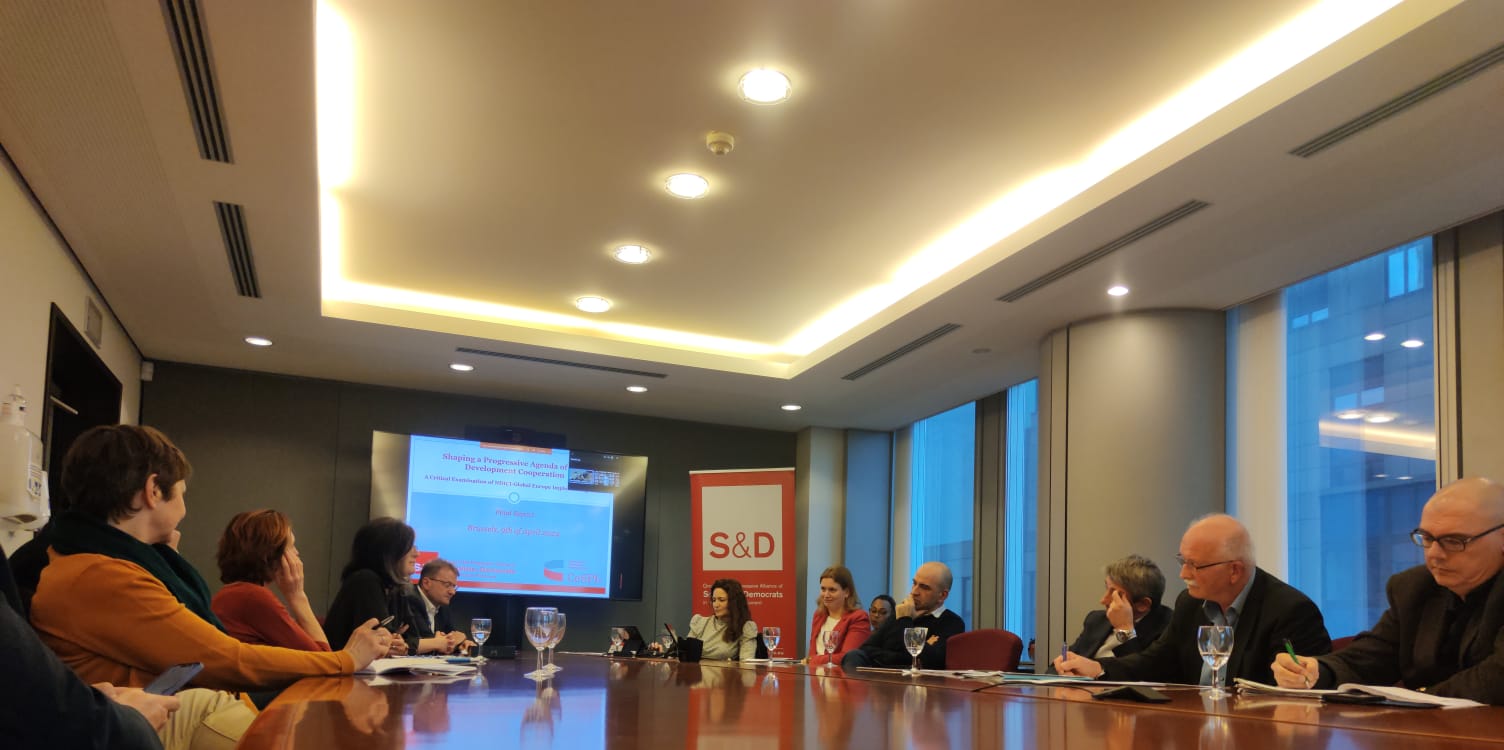
    Brussels – Using machine learning and artificial intelligence to test how European funding for development aid affects recipient states: yesterday, CeSpi (Center for International Policy Studies) Director Daniele Frigeri and MEP Udo Bullmann presented the study carried out for the European Parliamentary Group of Socialists and Democrats (S&D) to have accurate and impartial  data on the effects of European spending in this area.

    The EU finances projects worth billions of euros in third countries through the Commission and the EIB (European Investment Bank) every year, aiming to help them grow or improve living conditions: poverty, health, education, gender equality, and the green transition are areas in which the EU invests. It provides funding for each project to help achieve the intended goals. However, sometimes, the money the EU disburses produces results that are not closely related to the objectives for which it was granted.

    Bullman explains: “The aim was to develop a methodology enabling the European Parliament to fulfil its scrutiny role towards the European Commission and to propose improvements ahead of the NDICI (Neighbourhood, Development and International Cooperation Instrument) mid-term review”.

    Marco Zupi, who coordinated the team and edited the report, with the collaboration of Christian Morabito claims that “by integrating Machine Learning (ML), Artificial Intelligence (AI), and qualitative methodologies, CeSPI aimed to dissect and comprehend EC’s actions within NDICI, their coherence with Sustainable Development Goals (SDGs), and alignment with the Socialists and Democrats (S&D) Group’s priorities”.

    “This innovative approach – Zupi continues – not only modernizes scrutiny of EU development policies but also provides MEPs with a robust framework to evaluate NDICI Annual Action Plans (AAPs). CeSPI’s methodology facilitates informed and impactful policymaking, ensuring alignment with progressive priorities and values”.

    The study scrutinized 176 AAPs, guiding EC’s actions across 89 countries, and conducted a detailed analysis in El Salvador, Jordan, Kenya, Nigeria, and Senegal. Despite AAPs’ professed alignment with SDGs such as human development, poverty reduction, and gender equality, the analysis reveals a discrepancy between professed goals and actual initiatives.

    Recommendations include specifying targets, enhancing coordination, implementing poverty-reduction targets, collaborating for transparency, creating a High-Level Panel, and encouraging further research using TM and ML techniques for effective scrutiny.

    CeSpi’s study shows that the funding area where the actual purpose differs from the planned purpose is most often in education and gender equality. The reason is that they are broad themes and involve various types of possible interventions. For example, if EU money allocated for education is to build schools, its direct impact is on construction, less on education. To test this new tool, CeSpi inserted all available funding documentation for 2021-2023 into the machine. These are exorbitant numbers of papers, thousands of documents, that a person would never be able to verify, but artificial intelligence can. Specifically, The Italian think tank studied the data by global macro areas and state-by-state.

    However, a tool like this would benefit the S&D group, which could strengthen its case when negotiating for funds with the Commission, NGOs, and even the Commission, which would have greater control over its funding.

    Although it is an artificial intelligence-based tool, human support remains crucial. CeSpi pointed out that to implement the operation of this tool, it would need all documents written in a unique format. Another weakness concerns language: for now, the machine can only read documents in English, but as it is still in the early experimental stages, this limitation could be overcome.

    English version by the Translation Service of Withub

    Tags: artificial intelligenceartificial intelligencecespifundingMarco Zupis&d

    Related Posts

    [Foto: Unsplash]
    Agrifood

    One in four EU children at risk of food insecurity; citizens campaign for the right to food

    24 June 2026
    Photo de Punit Kumrasur Unsplash
    Rights

    Child pornography: tougher penalties for cases of child abuse, including those involving AI

    22 June 2026
    IA AI
    Defence & Security

    AI: European Parliament gives the green light to a ban on “nudifier” apps and to simplification measures

    16 June 2026
    Bandiera europea. Crediti: Commissione europea
    Net & Tech

    The EU does not view the activities of the newly appointed special envoy for AI at Siemens as a problem

    5 June 2026
    Gäddede, Sweden. [Foto: unsplash] risorse idriche, CO2
    Net & Tech

    UN warns that AI will “drink” as much water as 1.3 billion people by 2030

    4 June 2026
    Pope Leo XIV , on the right, and Ursula von der Leyen
    Net & Tech

    The EU responds to the Pope’s call on AI: “An effective legal framework is already in place in Europe”

    26 May 2026
    map visualization
    La presidente della Commissione europea a Cork per l'inaugurazione della presidenza irlandese del Consiglio UE. Crediti: Commissione europea

    Von der Leyen: “I will soon present a proposal” on restrictions on products from Israeli settlements

    by Iolanda Cuomo
    3 July 2026

    In Ireland, the Commission President emphasised that it is up to the Member States to decide on the proposal to...

    L'aula plenaria del Parlamento europeo a Strasburgo. Source: Imagoeconomica

    Passenger rights, support for the automotive sector, and an inquiry into the sovereignist party: the topics on the agenda at the Parliament’s plenary session

    by Iolanda Cuomo
    3 July 2026

    MEPs will decide whether to ask the Authority for European Political Parties and Foundations to check whether the sovereigntists are...

    The EU Council imposes sanctions on six people involved in Navalny’s poisoning and death

    by Redazione eunewsit
    3 July 2026

    These are scientists and researchers working in the military sector

    CHRISTINE LAGARDE PRESIDENTE DELLA BANCA CENTRALE EUROPEA

    Lagarde ready to stand in the French presidential election: “I think a European voice needs to be heard in the debate”

    by Redazione eunewsit
    3 July 2026

    The interview with Les Echos: “If a scenario were to emerge that would weaken France’s ties within Europe, I think...

    • Director’s Point of View
    • Opinions
    • About us
    • Contacts
    • Privacy Policy
    • Cookie policy

    Eunews is a registered newspaper
    Press Register of the Court of Turin n° 27


    Copyright © 2025 - WITHUB S.p.a., Via Rubens 19 - 20148 Milan
    VAT number: 10067080969 - ROC registration number n.30628
    Fully paid-up share capital 50.000,00€


    No Result
    View All Result
    • it ITA
    • en ENG
    • Politics
    • Newsletter
    • World politics
    • Business
    • General News
    • Defence & Security
    • Health
    • Agrifood
    • Altre sezioni
      • Culture
      • Rights
      • Energy
      • Green Economy
      • Gallery
      • Finance & Insurance
      • Industry & Markets
      • Media
      • Mobility & Logistics
      • Net & Tech
      • News
      • Opinions
      • Sports
    • Director’s Point of View
    • Draghi Report
    • Eunews Newsletter

    No Result
    View All Result
    • it ITA
    • en ENG
    • Politics
    • Newsletter
    • World politics
    • Business
    • General News
    • Defence & Security
    • Health
    • Agrifood
    • Altre sezioni
      • Culture
      • Rights
      • Energy
      • Green Economy
      • Gallery
      • Finance & Insurance
      • Industry & Markets
      • Media
      • Mobility & Logistics
      • Net & Tech
      • News
      • Opinions
      • Sports
    • Director’s Point of View
    • Draghi Report
    • Eunews Newsletter

    Attention