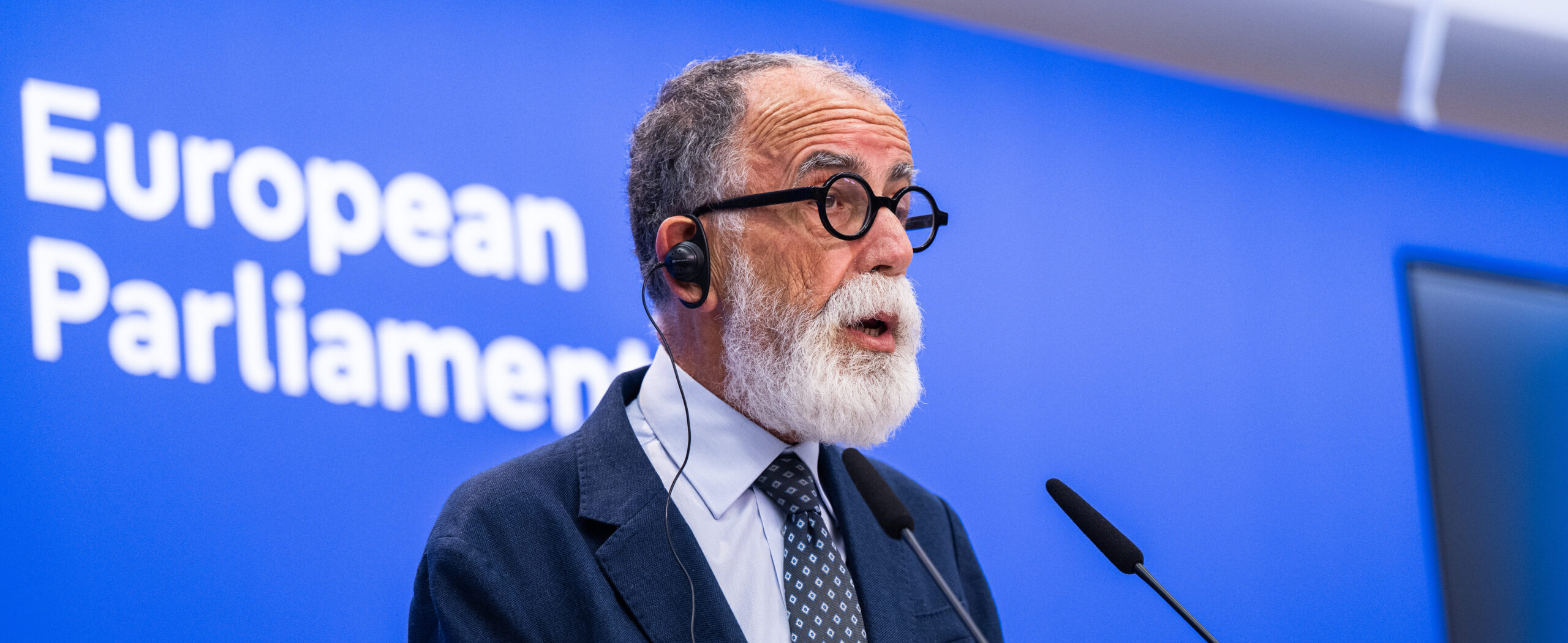
from our correspondent in Strasbourg – There are two objectives, and they go hand in hand: “To protect young people and children online without preventing them from accessing the benefits offered by the internet,” explained yesterday (15 September), at a press conference, the PD (S&D) MEP, Sandro Ruotolo, ahead of tomorrow (17 September) when MEPs, meeting in plenary session, will call on social media platforms to ban addictive practices and mitigate the impact of so-called “persuasive design”; and, on the same day, the President of the European Commission, Ursula von der Leyen, and the Executive Vice-President of the European Commission for Technological Sovereignty, Security and Democracy, Henna Virkkunen, will present the so-called “EU Children’s Act”.
Ruotolo presented the findings of the report, for which he is the rapporteur, on the impact of social media and digital environments on young people, commissioned by the European Parliament’s Committee on Culture. The picture that emerges is of a fragmented Union, where “Member States are already taking action,” but where it is not acceptable “to have 27 age limits, 27 verification systems, 27 different rules.”
The approach that Ruotolo hopes to see reflected in the new EU law is based on shifting responsibility from “families and teachers” to “platforms” – described as “primarily responsible for the safety of the environment they have created.” “With our report, we want to break the mechanisms that turn children’s attention into a product to be sold; we want recommendation systems not to push a child towards increasingly extreme or unsettling content automatically; we want to protect children from grooming, cyberbullying, and manipulative triviality,” he explained. As for age limits on social media use, Ruotolo believes we must await “the experts’ conclusions” from the European Commission before issuing “science” the appropriate recommendations on the matter. But it is obvious that “politicians must take responsibility for making the decision.”
“On 13 July, President von der Leyen had announced that concrete proposals would be forthcoming after the summer,” Ruotolo recalled, emphasising that he was awaiting “a strong political signal, because today Europe faces a choice that affects millions of children and young people, and which ultimately concerns the model of society in which we want them to grow up, their health, their rights, and their well-being.”
In detailing the situation, the MP cited some figures and data. Children “aged between 11 and 14 spend up to 9 hours in front of a screen” and, according to the World Health Organisation, “one in ten teenagers exhibits problematic social media use with symptoms akin to addiction.” More specifically regarding artificial intelligence, between 2023 and 2025 “reports of AI-generated child sexual exploitation material have risen from around 5,000″ to more than one million. In this context, the harm extends to mental health, but also to physical health. “Short-sightedness is rising very sharply,” the Socialist pointed out, to the extent that it could affect “half the world’s population by 2050.” Finally, the report of the experts commissioned by the head of the Berlaymont Building reveals another alarming statistic: “97 per cent of the most popular websites and apps in the European Union use at least one design mechanism capable of influencing users’ choices.”
English version by the Translation Service of Withub