
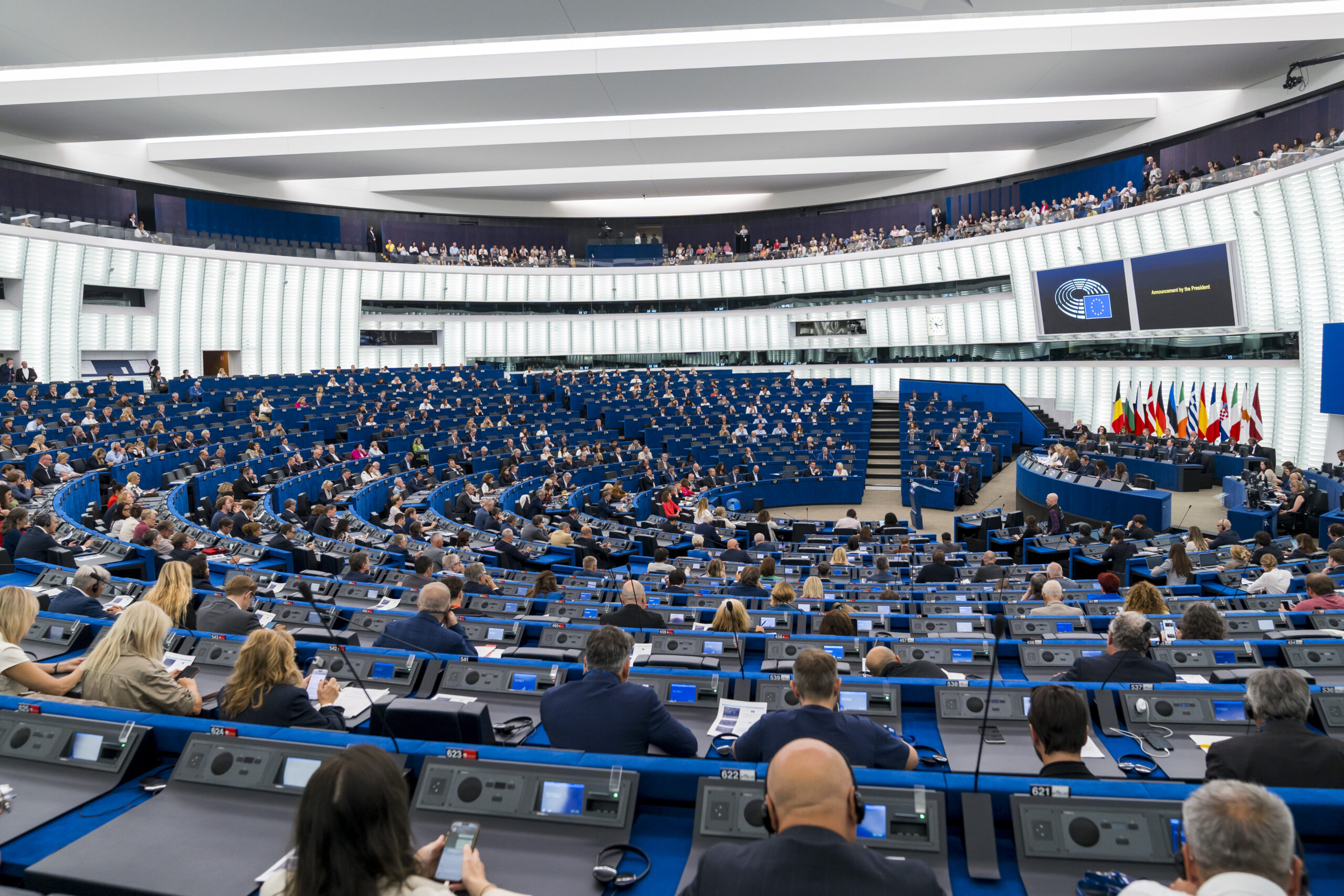
Brussels – European competitiveness, the migration crisis in Ceuta, and wildfires: these are some of the key issues that the political groups in the European Parliament expect Ursula von der Leyen to address tomorrow (16 September) in her speech on the State of the Union (SOTEU), and which the plenary will address during the coming working days. This was explained today (15 September) by the group leaders during the traditional press conferences they hold at the start of each plenary session. In addition to all these issues, there is the speech to be delivered on Thursday by the Canadian Prime Minister Mark Carney—which will reinforce the North American partner’s closeness to the Union, partly motivated by the restlessness of its southern neighbour, the United States—and the protection of the European Union from foreign interference and disinformation.
The September plenary session marks, more than any other event, the return to business for European politics, and the State of the Union address is an unmissable event because it sets the agenda for the coming months and years. The president of the Socialists (S&D), Iratxe García Pérez, stressed that her group’s priorities are “European sovereignty and economic accessibility—in other words, how Europe can respond to the problems citizens face today.” The latter includes “food, housing, affordable energy, quality jobs, climate ambition, and greater sovereignty,” she explained. Pérez lamented that, over the last two years, the Commission has instead had “a single priority: deregulation,” which the MEP described as “an obsession of the European People’s Party and the far right.” This will, therefore, be the issue she raises in the debate following the State of the Union Address, alongside the question of “the need for an agenda to combat climate change.” It is not just a matter of promoting “an adaptation agenda, but also a mitigation agenda,” the Spanish MEP warned. The reason lies in the serious consequences of the wildfires that broke out this summer, “which not only affect the countries of southern Europe” and as a result of which “our economy is also suffering,” she added.
The Greens agree on this issue. The co-leader of the Greens, Terry Reintke, has announced that tomorrow her group “will exert pressure, particularly because the Commission has remained far too silent over the summer.” In this context, it should be noted that the Greens had already this summer “called for an emergency summit so that leaders could make concrete declarations of their intentions” regarding climate change and adaptation. Discontent has, however, been expressed regarding the debate on the PFAS scandal in Croatia, which the Greens had requested and secured “for Thursday afternoon.” The group feels this timing does not give the issue “the prominence it deserves.” Another issue on which Reintke promises to fight is that of the 160 LGBTQIA+ activists arrested in Turkey. On this issue, she stated that she “will put pressure on the Commission to take action” on behalf of those arrested, for whom the European Parliament’s plenary session yesterday amended its agenda to include an urgent debate on the matter.
Opinions differ amongst the right-wing members of the European Parliament. The co-chair of the European Conservatives and Reformists (ECR), Nicola Procaccini, expects that tomorrow “von der Leyen will focus her speech on the climate, climate change and the need for decarbonisation.” However, “if we focus exclusively on decarbonisation, we will be making a serious mistake, both for the European economy—given that we do not have the necessary resources for adaptation—and for the climate, as we will fail to make an effective contribution while the rest of the world is moving in a different direction,” explained the MEP. Procaccini then recalled that he had “already raised” with the head of the European Commission “the issue of critical raw materials,” the shortage of which is not being “addressed in the right way.” Lamenting that the issue is not being treated as a “strategic priority,” Procaccini stated that “Europe is making exactly the same mistakes as it has over the last ten years” with regard to other dependencies, such as energy. Finally, regarding the debate on the situation of migrants in Ceuta, the other co-chair of the Conservatives and Reformists, Patrick Jaky, made “a personal appeal to the Spanish Prime Minister” to resign, accusing him of facilitating the entry of illegal immigrants onto European soil.
Speaking on behalf of Renew Europe, the group’s chair, Valérie Hayer, emphasised that “‘Europe must be the ideal place to turn a good idea into a successful business” and that “this means a single market without barriers,” investing “in technologies and skills for the jobs of the future,” as well as “capital markets union, incentives for businesses and competitiveness.” To this end, her group is calling for the establishment “of a task force on the implementation of the single market to remove” barriers. This initiative should also include “new alliances with like-minded partners in the fields of trade, defence, and raw materials”, such as Canada. In this context, the speech by the Canadian Prime Minister, Mark Carney—who was invited to this plenary session by the President of the European Parliament, Roberta Metsola, last May—“represents a historic opportunity to deepen relations between the EU and Canada.” Therefore, “we call for a significant strengthening of economic, political, and security ties,” as well as “the completion of the ratification of CETA”—the trade agreement between the European Union and Canada, which is still being applied on a provisional basis.
Finally, the co-chair of La Sinistra, Martin Schirdewan, highlighted what, in his view, will be “the major omissions from the SOTEU.” These include “social policies” such as reducing “energy prices for households or at the petrol pump” or “making rents more affordable.” Instead, the German politician argued that what is needed are “taxes on windfall profits for large companies in the arms industry, which are currently being pampered with public money,” as well as “a European digital tax on the big tech giants.”
English version by the Translation Service of Withub





![Il ministro dei Trasporti, Matteo Salvini [Bruxelles, 5 dicembre 2024. Foto: Emanuele Bonini per Eunews]](https://www.eunews.it/wp-content/uploads/2024/12/salvini241205-120x86.jpeg)