- Europe, like you've never read before -
Sunday, 18 January 2026
No Result
View All Result
  • it ITA
  • en ENG
Eunews
  • Politics
  • World
  • Business
  • News
  • Defence
  • Net & Tech
  • Agrifood
  • Other sections
    • Culture
    • Diritti
    • Energy
    • Green Economy
    • Finance & Insurance
    • Industry & Markets
    • Media
    • Mobility & Logistics
    • Sports
  • Newsletter
  • European 2024
    Eunews
    • Politics
    • World
    • Business
    • News
    • Defence
    • Net & Tech
    • Agrifood
    • Other sections
      • Culture
      • Diritti
      • Energy
      • Green Economy
      • Finance & Insurance
      • Industry & Markets
      • Media
      • Mobility & Logistics
      • Sports
    No Result
    View All Result
    Eunews
    No Result
    View All Result

    Home » Business » Revision of the EU free trade agreement advances Ukraine’s path to accession

    Revision of the EU free trade agreement advances Ukraine’s path to accession

    The new version of the 2016 DCFTA fits with Kyiv's rapprochement with the twelve-star club. The alignment of the candidate country to European production standards is central, while the Twenty-Seven will be able to activate a safeguard mechanism in case of need

    Francesco Bortoletto</a> <a class="social twitter" href="https://twitter.com/bortoletto_f" target="_blank">bortoletto_f</a> by Francesco Bortoletto bortoletto_f
    4 July 2025
    in Business
    Christophe Hansen Maros Sefcovic

    Christophe Hansen, on the left, and Maroš Šefčovič

    Brussels – The new EU-Ukraine free trade agreement is taking shape in detail. Having reached the agreement in principle between the negotiating teams, technicians have finalized the figures and quotas that will govern trade relations between Kyiv, Brussels, and the 27 capitals. All that is missing now is the final political green light from the member states to replace the provisional measures ( that have been in place for the past three years) with a revised comprehensive framework, less ambitious but more pragmatic than the previous one, dating back to 2016.

    It was Agriculture Commissioner Christophe Hansen and Trade Commissioner Maroš Šefčovič, who on Monday (30 June) announced the conclusion of the “intensive” negotiations (which lasted around three weeks) on the revision of the EU-Ukraine Free Trade Agreement, which will regulate trade flows between the two economies. Today (4 July), EU sources shed light on some additional technical aspects of the new framework, pending final confirmation by both sides.

    The original version of the pact, with the technical name Deep and Comprehensive Free Trade Agreement (DCFTA), was stipulated in 2014 as one of the pillars of the EU-Ukraine Association Agreement and entered into force in 2016. After the start of the Russian invasion in February 2022, it was replaced by a provisional Autonomous Trade Measures (ATM) framework. Through the ATM, pre-existing tariffs and trade barriers on Ukrainian agricultural exports to the EU were suspended, opening the single market to Kyiv for cereals, maize, eggs, poultry, sugar, dairy products, and more.

    Maros Sefcovic
    Trade Commissioner, Maroš Šefčovič (photo: Xavier Lejeune/European Commission)

    However, these were exceptional instruments introduced unilaterally by Brussels in an emergency circumstance (the Federation’s aggression, precisely) that have been renewed on an annual basis since then. Thus, as the expiry of the last extension in early June approached, the EU executive set to work to update the 2016 DCFTA. Now, the new text provides a long-term perspective, described by insiders as predictable and reciprocal.

    As Hansen himself admits, the revision just concluded is “less ambitious” than the agreement nine years ago, but aims at the “right balance between supporting Ukraine’s trade with the Union and responding to the sensitivities of a number of agricultural sectors” in the 27 member states. Farmers have long been lobbying national governments (especially, but not only, in France and Poland) to rebalance the concessions granted to Kyiv, fearing unfair competition in their own markets. The new agreement is “balanced, fair and realistic,” said Šefčovič.

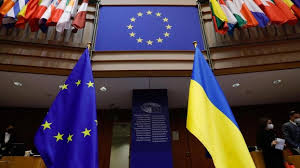
    According to officials, the revision mainly introduces two new features. On the one hand, Ukraine pledges to gradually align its agricultural production standards with those of the EU in several areas (including animal welfare and pesticide use) by 2028, subjecting itself to annual reviews. A mechanism that also reinforces Kyiv’s path towards membership in the twelve-star club, ensuring that the candidate country follows the same rules as member states.

    On the other hand, alongside this conditionality, the agreement provides for safeguard mechanisms to protect European markets, to be activated in the event of severe disruptions at the Community or national level. It will be the Commission that will formally propose the activation of such safeguards at the request of the chancelleries.

    Ursula von der Leyen Volodymyr Zelensky
    The President of the European Commission, Ursula von der Leyen, and Ukrainian President Volodymyr Zelensky (photo: Nikolai Linares via Imagoeconomica)

    Finally, the DCFTA revision adopts a variable-geometry approach regarding the access of Ukrainian goods to the European market. The import quotas will increase substantially for several products exported from Kyiv, while those defined as “sensitive” (such as eggs, sugar, wheat, poultry, and honey) will receive special attention. In this case, the quota increase will be more modest, and the final value will remain below historical trade volumes.

    There will be full liberalization for other types of products (e.g., dairy products, such as whole milk powder and fermented milk, as well as mushrooms and grape juice). The assessment of the sensitivity of a particular export category takes place by analyzing the ATM regime in light of past disruptions from a specific market, as well as the EU’s capacity to absorb additional imports. Conversely, Ukraine commits to significantly increasing import quotas from the Twenty Seven in particular sectors.

    Now, the final steps are missing to reach definitive adoption, which, in theory, should be a formality. The Commission has presented the new text to the co-legislators (the Parliament and the Council), and a decision by a qualified majority of the Member States will be required to proceed. Once the green light has been obtained, the final approval of the DCFTA 2.0 will take place by the EU-Ukraine Association Committee.

    .

    English version by the Translation Service of Withub
    Tags: accession of ukraineaccordo libero scambio Ue-Ucrainachristophe hansenDcftamaros sefcovic

    Related Posts

    Maros Sefcovic
    Business

    Tariffs, Šefčovič in Washington to close deal. EU aims at a 10 per cent “flat” tariff

    3 July 2025
    Business

    Ukraine and EU reach new trade agreement

    30 June 2025
    sanzioni Russia
    World politics

    Ukraine: EU renews sanctions against Russia

    30 June 2025
    map visualization

    Mercosur reshapes Italy’s alliances in Europe: PD with FdI and FI, League with M5S

    by Emanuele Bonini emanuelebonini
    16 January 2026

    The plenary session of the European Parliament has the free trade agreement with South American countries as the main item...

    Defence: Commission approves first SAFE disbursements to eight Member States

    by Emanuele Bonini emanuelebonini
    16 January 2026

    The Council has been asked to authorise disbursement for Belgium, Bulgaria, Cyprus, Croatia, Denmark, Portugal, Romania, and Spain. Von der...

    Migrazione frontiere pushback

    EU, decline in asylum applications continues, down 28 per cent in October compared to 2024

    by Enrico Pascarella
    15 January 2026

    The countries that received the most requests in October were Spain and Italy, but with lower figures than in the...

    Air Canada flights show as cancelled at Pearson International Airport as flight attendants go on strike in Toronto on Saturday, August 16, 2025. Photo by Sammy Kogan/CP/ABACAPRESS.COM

    Flight cancelled, airlines must also reimburse commission costs

    by Ezio Baldari @eziobaldari
    15 January 2026

    This has been established by the Court of Justice of the European Union. When purchasing from a travel agency or...

    • Director’s Point of View
    • Letters to the Editor
    • Opinions
    • About us
    • Contacts
    • Privacy Policy
    • Cookie policy

    Eunews is a registered newspaper
    Press Register of the Court of Turin n° 27


    Copyright © 2025 - WITHUB S.p.a., Via Rubens 19 - 20148 Milan
    VAT number: 10067080969 - ROC registration number n.30628
    Fully paid-up share capital 50.000,00€


    No Result
    View All Result
    • it ITA
    • en ENG
    • Politics
    • Newsletter
    • World politics
    • Business
    • General News
    • Defence & Security
    • Net & Tech
    • Agrifood
    • Altre sezioni
      • European Agenda
      • Culture
      • Diritti
      • Energy
      • Green Economy
      • Gallery
      • Finance & Insurance
      • Industry & Markets
      • Letters to the Editor
      • Media
      • Mobility & Logistics
      • News
      • Opinions
      • Sports
    • Director's Point of View
    • L’Europa come non l’avete mai ascoltata
    • Draghi Report
    • Eventi
    • Eunews Newsletter

    No Result
    View All Result
    • it ITA
    • en ENG
    • Politics
    • Newsletter
    • World politics
    • Business
    • General News
    • Defence & Security
    • Net & Tech
    • Agrifood
    • Altre sezioni
      • European Agenda
      • Culture
      • Diritti
      • Energy
      • Green Economy
      • Gallery
      • Finance & Insurance
      • Industry & Markets
      • Letters to the Editor
      • Media
      • Mobility & Logistics
      • News
      • Opinions
      • Sports
    • Director's Point of View
    • L’Europa come non l’avete mai ascoltata
    • Draghi Report
    • Eventi
    • Eunews Newsletter

    Attention