
Brussels – To urge Bosnia and Herzegovina to push ahead at full speed with pre-accession reforms — that is the mission of Enlargement Commissioner Marta Kos during her three-day visit, which begins today (22 September) in the Balkan country, as tensions with the Serb minority continue to escalate.
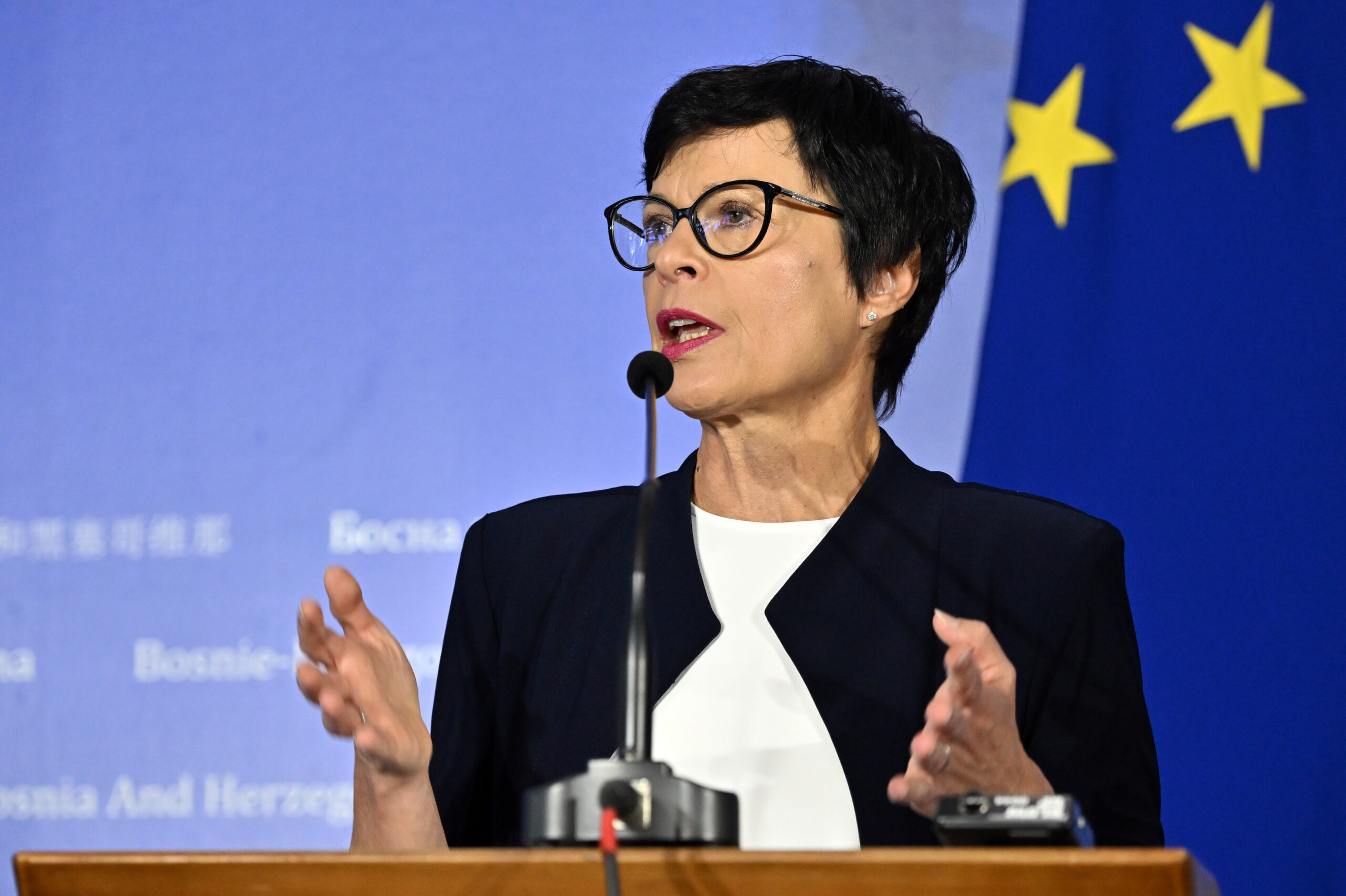
Kos’s tour began this morning in Sarajevo, where she met with Prime Minister Borjana Krišto and the leaders of the tripartite presidency of Bosnia and Herzegovina, i.e., the elected representatives of the three national communities: Bosniacs, Croats, and Serbs. “I believe in the European future of this country,” Kos began, speaking alongside Krišto at a joint press conference.
The Commissioner reiterated Brussels’ support for Sarajevo’s efforts towards joining the twelve-star club, but reaffirmed the need to overcome the opposition of one part of the complex Bosnian state machinery, namely the Serbian one. “We have seen some positive steps,” she continued. However, she warned of the “renewed challenges posed by the unconstitutional and secessionist legislation adopted by the Republika Srpska,” the entity of the Bosnian Serb community that, together with the Federation of Bosnia and Herzegovina – that of the Bosnian and Croatian communities – constitutes the Federal Republic under the 1995 Dayton Agreements.
I met chairwoman @KristoBorjana to discuss how to advance Bosnia and Herzegovina’s EU accession path: judicial reforms, adoption of the Reform Agenda still this month & appointment of a chief negotiator. The EU needs a counterpart in BiH to move forward with technical work. pic.twitter.com/qlHPujQqUn
– Marta Kos (@MartaKosEU) September 22, 2025
“The democratic institutions must be respected,” the Commissioner emphasised before urging the Krišto executive to “return to the path of reform,” starting with that of the judiciary, and to put in place “all the necessary measures” to start the first intergovernmental conference and formally open the first negotiation chapters with the EU.
Sarajevo, she says, “must send the Reform Agenda as soon as possible so as not to lose the funds of the Plan for Growth“, the 6 billion instrument with which the Commission is attempting to stimulate the economy of the Western Balkans to create momentum in preparation for the accession of these candidate countries. The EU executive’s appeal to speed up reforms is not new, as it has already frozen some funds allocated to Bosnia and Herzegovina last year, precisely because of its inability to resolve this point.
Krišto said she was “optimistic” about the possibility of early progress on the reform dossier, but acknowledged that so far the Council of Ministers had failed to reach any agreement. “Reforms are in everyone’s interest,” she noted, “and we must complete them.” Above all, she emphasised, “political representatives must show a responsible and functional approach. We must get rid of alibis, we must take our responsibility in front of our voters,” she remarked.
However, it may not be that simple. Milorad Dodik, former president of the Republika Srpska and leader of the government party SNSD, has announced that he and his party will boycott all meetings with Kos, including the final speech to the bicameral parliament in Sarajevo (scheduled for the day after tomorrow). The Commissioner herself, moreover, considers Dodik a “separatist” and refuses to talk to those who undermine the unity of the Balkan country.
The former Serbian leader was recently caught up in a Bosnian federal court ruling that sentenced him to one year in prison for failing to fulfill his institutional duties in the framework of loyal cooperation between the federated entities, declaring him ineligible for the office of president of Republika Srpska for six years. His mandate has therefore lapsed, and new elections have been called for 23 November.
Last week, Dodik met with Russian Foreign Minister Sergei Lavrov to seek Moscow’s backing in the aim of retaining power. Towards the end of August, the SNSD voted in the national assembly of the Republika Srpska to hold a referendum on the disqualification of the former president from office, as well as his ouster from public office. The popular consultation – which technically could not change the court’s decision – was set for 25 October.
For quite some time now, Bosnia and Herzegovina has been troubled by a political crisis, mainly related to the hardening positions of the Republika Srpska, which is challenging the authority of Sarajevo, thereby jeopardising Bosnia and Herzegovina’s rapprochement with the twelve-star club. In March 2024, the European Council gave the political green light to start negotiations. Still, the first intergovernmental conference for the formal opening of the negotiation chapters has not yet been convened.
English version by the Translation Service of Withub