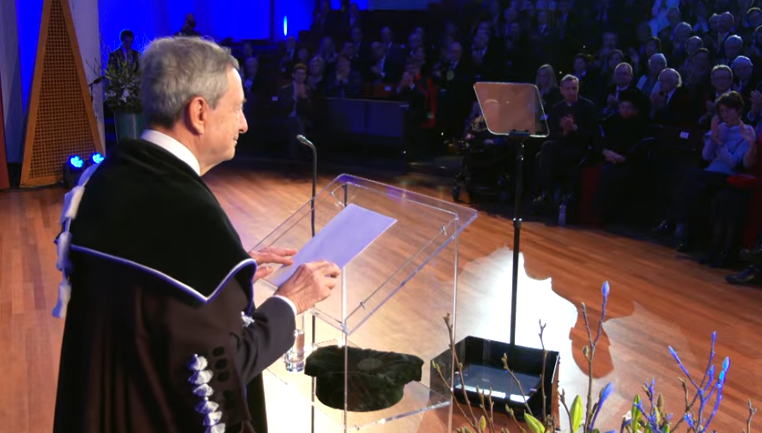
Brussels – “Power requires Europe to move from confederation to federation.” The crucial passage of Mario Draghi’s speech at the University of Leuven is here. He calls for a United States of Europe because in the face of the disintegration of the world order, “the transition from this order to whatever lies next will not be easy for Europe” unless nationalism and sovereignty are overcome. He anticipates what he will likely say on 12 February, during the informal meeting of EU heads of state and government to which he was invited, together with Enrico Letta, taking stock of the situation, which is not the best.
“We face a United States that, at least in its current posture, emphasises the costs it has borne while ignoring the benefits it has reaped,” Draghi complains. Donald Trump’s US is “imposing tariffs on Europe, threatening our territorial interests, and making clear, for the first time, that it sees European political fragmentation as serving its interests.” As if that were not enough, he recalls, “we face a China that controls critical nodes in global supply chains and is willing to exploit that leverage: flooding markets, withholding critical inputs, forcing others to bear the cost of its own imbalances.” Well, Draghi warns, “is a future in which Europe risks becoming subordinated, divided, and deindustrialised—at once.“
No one should think they can simply flip a switch to put an end to all this. On the contrary, continues the former President of the Council and the European Central Bank (ECB), “We will face a long period in which interdependencies persist even as rivalries intensify.” As the European Union, “we remain heavily dependent on the US for energy, technology, and defence,” while China “supplies over 90% of our rare earth imports, and dominates the global solar and battery value chains that underpin our green transition.” Given the situation, “the best path for Europe is the one it is now pursuing: to conclude trade agreements with like-minded partners that offer diversification, and to deepen our position in supply chains where we are already critical.”
Draghi therefore praises the work of European Commission President Ursula von der Leyen and her efforts to forge alliances – the latest in a series is the historic agreement with India – that are more strategic than ever. This emphasis is aimed at quelling national political controversies, both in Italy and elsewhere, and inviting all governments to avoid counterproductive, short-sighted reactions. On the subject of trade, Draghi emphasises that “where Europe has federated—on trade, on competition, on the single market, on monetary policy—we are respected as a power and negotiate as one.” Conversely, “where we have not—on defence, on industrial policy, on foreign affairs—we are treated as a loose assembly of middle-sized states, to be divided and dealt with accordingly.”
From here, Draghi launches his political call for an even more political Europe, specifying the differences: “grouping together small countries does not automatically produce a powerful bloc. This is the logic of confederation—the logic by which Europe still operates in defence, in foreign policy, in fiscal matters. This model does not produce power.” Not only that: “A group of states that coordinates remains a group of states—each with a veto, each with a separate calculus, each vulnerable to being picked off one by one,” he stresses. It follows that “power requires Europe to move from confederation to federation.”
So let’s move forward with the United States of Europe. But let it be a reality that is different from the rest of the global players. Because “the United States, in its current posture, seeks dominance together with partnership,” while “China sustains its growth model by exporting its costs onto others.” European integration, on the other hand, “is built differently: not on force, but common will; not on subjugation, but shared benefit,” he said. “It is integration without subordination—vastly preferable, but vastly more difficult.”
Europe, therefore, needs what Draghi calls “pragmatic federalism,” where “pragmatic implies that “we must take the steps that are currently possible, with the partners who are currently willing, in the domains where progress can currently be made.” Provided that it is federalism, “because the destination matters.” Draghi is speaking to an academic audience in Leuven, but in reality, he is addressing chancelleries across Europe: “Common action and the mutual trust it creates must eventually become the foundation for institutions with real decision-making power—institutions able to act decisively in all circumstances.”
English version by the Translation Service of Withub


![[Copyright: European Union]](https://www.eunews.it/wp-content/uploads/2026/10/euco-261015-120x86.png)