- Europe, like you've never read before -
Tuesday, 5 May 2026
No Result
View All Result
  • it ITA
  • en ENG
Eunews
  • Politics
  • World
  • Business
  • News
  • Defence
  • Health
  • Agrifood
  • Other sections
    • Culture
    • Diritti
    • Energy
    • Green Economy
    • Finance & Insurance
    • Industry & Markets
    • Media
    • Mobility & Logistics
    • Net & Tech
    • Sports
  • Newsletter
  • European 2024
    Eunews
    • Politics
    • World
    • Business
    • News
    • Defence
    • Health
    • Agrifood
    • Other sections
      • Culture
      • Diritti
      • Energy
      • Green Economy
      • Finance & Insurance
      • Industry & Markets
      • Media
      • Mobility & Logistics
      • Net & Tech
      • Sports
    No Result
    View All Result
    Eunews
    No Result
    View All Result

    Home » Culture » From the Biennale of Dissent to the Russian Pavilion, in defiance of the European Union’s ban

    From the Biennale of Dissent to the Russian Pavilion, in defiance of the European Union’s ban

    Justus Lipsius by Justus Lipsius
    5 May 2026
    in Culture, Opinions, World politics
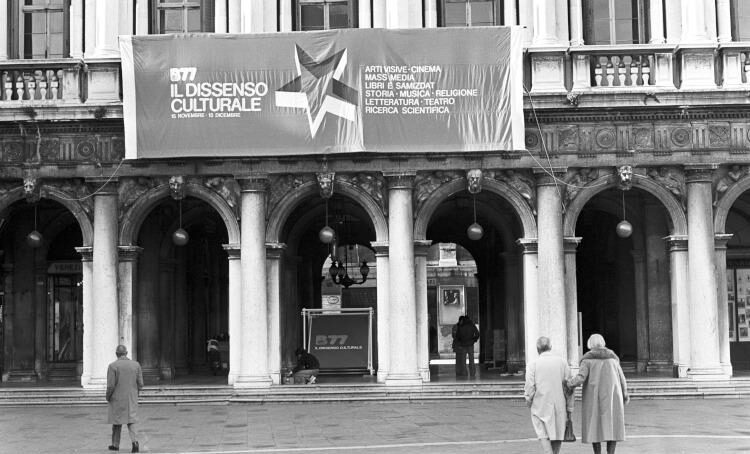
    (Foto: archivio Biennale)

    (Foto: archivio Biennale)

    In 1977, Carlo Ripa di Meana, then president of the Venice Biennale, organised the famous “Biennale of Dissent” to give a voice to opponents of the Soviet regime, which at the time encompassed the entire Eastern Bloc. 

    The initiative, which had been facilitated by the signing, two years earlier, of the Helsinki Accords—which provided for a more open cultural policy between the two blocs—and by the PCI’s shift towards “Eurocommunism”, was strongly opposed not only by those directly affected, namely the USSR, which tried by every means to prevent the event, but also by all those—businesspeople, intellectuals, and political leaders, starting with the Communist Party’s own leadership, who feared that the initiative might jeopardise the ongoing normalisation of “good relations” with the Soviet Union. 

    Backed mainly by Bettino Craxi’s Socialist Party, Carlo Ripa pressed ahead, and a huge crowd visited the Biennale from 15 November to 15 December 1977. 

    Almost fifty years on, the situation has been turned on its head. Following a decision by its current president, Pietrangelo Buttafuoco, the Russian pavilion, among others, will reopen on Wednesday, 6 May, after being closed since the invasion of Ukraine in 2022. That year, it was the artists themselves and the curator who cancelled their participation in the Biennale. 

    For weeks, this decision has been the subject of endless controversy, which has led, amongst other things, to the resignation of the international jury that was due to award the main prizes, including the prestigious Golden Lion for Best National Contribution. 

    The controversy has also engulfed the European Union, which has allocated two million euros in funding to the Biennale (to be disbursed over three years, between 2025 and 2028). 

    On 23 April, following criticism of Buttafuoco’s decision by 22 culture ministers from member states, the European Commission announced its decision to withdraw funding on the grounds of a breach of the European Union’s regulations on sanctions against Russia, granting the Biennale Foundation 30 days to explain the reasons behind the decision and persuade the Commission not to withdraw the funds. 

    Discussions are still ongoing, and just yesterday the European Commission sent a second letter to the Venice Biennale, citing further “evidence” of a second possible breach of the grant agreement. 

    While awaiting the final outcome of the dispute between the Biennale and the European Union—a dispute that could have been avoided, given that the decision’s entirely political, and certainly not merely cultural, nature is obvious to everyone, so much so that Minister Matteo Salvini has announced a prompt visit to the Russian pavilion—it is striking to compare this with what has happened in the past.

     In 1977, the Biennale hosted dissidents from Russia and other countries of the Soviet bloc, caught between the ostracism of the USSR and part of the intelligentsia and the embarrassment of the Italian government. 

    In 2026, the Biennale will host the Russian pavilion amid condemnation from the European Union and Russian dissidents, as well as those from other former Soviet states who are set to take to the streets tomorrow, and the embarrassment of the Italian government. 

    In short, a world turned on its head—and it is no coincidence that General Vannacci supports the initiative. 

    Only the government’s embarrassment remains, mutatis mutandis, always the same.

    English version by the Translation Service of Withub
    Tags: biennialrussia

    Related Posts

    Il presidente del Consiglio europeo, Antonio Costa (sinistra), con il primo ministro armeno, Nikol Pashinyan [Yerevan, 4 maggio 2026. Foto: European Council]
    World politics

    The West advances as the European Political Community meeting in Armenia challenges Putin

    4 May 2026
    RUSSIA, MOSCA - 19 FEBBRAIO 2024: Un bambino ucraino è sdraiato su un divano presso l'ambasciata del Qatar a Mosca. Il Qatar aiuta i bambini ucraini a tornare dalle loro famiglie in Ucraina. Mikhail Metzel/TASS/Sipa USA. Fonte: IPA Agency
    Defence & Security

    Bringing home Ukrainian children abducted by Moscow: the International Coalition meeting on 11 May

    21 April 2026
    Briefs

    Russia: EU blacklists Euromore and Pravfond, calling them “propaganda outlets”

    21 April 2026
    [foto: Jennifer 8. Lee/Wikimedia Commons]
    World politics

    Latvia pressures Italy: “The EU should ban Russia from the Venice Biennale”

    21 April 2026
    I vigili del fuoco lavorano tra le macerie di una sezione di un condominio di nove piani nel quartiere di Sviatoshynskyi, distrutto dall'attacco missilistico e con droni russi a Kiev, il 31 luglio 2025. Sei persone sono morte nella capitale, tra cui un bambino di sei anni e sua madre, e decine sono rimaste ferite. Fonte: Ipa Agency (Foto di Danylo Antoniuk/Ukrinform) (Foto di Ukrinform/Ukrinform/Sipa USA)
    World politics

    The EU following Russian attacks on Ukrainian cities: “We will step up the pressure on Moscow”

    16 April 2026
    Da sinistra: l'ex-premier bulgaro, Boyko Borissov, il presidente russo, Vladimir Putin, l'omologo turco, Recep Tayyip Erdoğan, e serbo, Aleksandar Vučić, all'inaugurazione del gasdotto TurkStream nel 2020
    Business

    War in Iran boosts Russia: March oil and gas exports surge, driven by China and India

    16 April 2026
    map visualization

    On 9 May, Brussels celebrates Europe Day: EU institutions open their doors to the public

    by Giorgio Dell'Omodarme
    5 May 2026

    The event was established forty years ago to commemorate the Schuman Declaration, which laid the foundations for the future EU...

    Source: IPA agency - Roma, in tenda sotto l'assessorato al Patrimonio

    Housing crisis: parliamentary debate on the new European Housing Plan

    by Caterina Mazzantini
    5 May 2026

    Interinstitutional dialogue continues to establish a European framework that can lead to a new paradigm for the right to housing,...

    (Foto: archivio Biennale)

    From the Biennale of Dissent to the Russian Pavilion, in defiance of the European Union’s ban

    by Justus Lipsius
    5 May 2026

    In 1977, Carlo Ripa di Meana, then president of the Venice Biennale, organised the famous "Biennale of Dissent" to give...

    Kyriakos Pierrakakis [foto: European Council]

    Major European banks and political and economic stability: Pierrakakis’s recipe for the EU

    by Emanuele Bonini emanuelebonini
    5 May 2026

    The President of the Eurogroup urges partners to find the courage needed to revitalise and rebuild: "If we fail to...

    • Director’s Point of View
    • Opinions
    • About us
    • Contacts
    • Privacy Policy
    • Cookie policy

    Eunews is a registered newspaper
    Press Register of the Court of Turin n° 27


    Copyright © 2025 - WITHUB S.p.a., Via Rubens 19 - 20148 Milan
    VAT number: 10067080969 - ROC registration number n.30628
    Fully paid-up share capital 50.000,00€


    No Result
    View All Result
    • it ITA
    • en ENG
    • Politics
    • Newsletter
    • World politics
    • Business
    • General News
    • Defence & Security
    • Health
    • Agrifood
    • Altre sezioni
      • Culture
      • Diritti
      • Energy
      • Green Economy
      • Gallery
      • Finance & Insurance
      • Industry & Markets
      • Media
      • Mobility & Logistics
      • Net & Tech
      • News
      • Opinions
      • Sports
    • Director’s Point of View
    • Draghi Report
    • Eunews Newsletter

    No Result
    View All Result
    • it ITA
    • en ENG
    • Politics
    • Newsletter
    • World politics
    • Business
    • General News
    • Defence & Security
    • Health
    • Agrifood
    • Altre sezioni
      • Culture
      • Diritti
      • Energy
      • Green Economy
      • Gallery
      • Finance & Insurance
      • Industry & Markets
      • Media
      • Mobility & Logistics
      • Net & Tech
      • News
      • Opinions
      • Sports
    • Director’s Point of View
    • Draghi Report
    • Eunews Newsletter

    Attention