![[Credits: AgainErick/Wikimedia Commons]](https://www.eunews.it/wp-content/uploads/2026/02/containers.jpg)
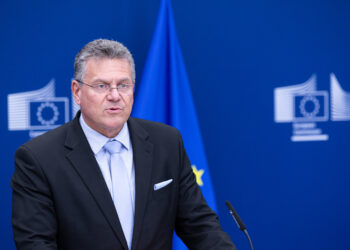
Brussels – Trade agreements are a valuable resource. The new developments in the US tariffs saga dominate the economic and trade agenda of the twelve stars, but the Commissioner for Trade, Maros Sefcovic, reiterates the need to pursue as many free trade agreements as possible. This is because they are also a means of defence against the whims of the US president. Signing trade agreements, he explains during a hearing at the International Trade Commission of the European Parliament, is intended to meet the objective of “ensuring that the EU remains competitive and able to secure supply chains in an ever-changing geo-economic landscape.” In this agenda, “diversifying our trade is a key element of this commitment.”
Sefcovic uses the free trade agreement with Mercosur to give an idea of the scope of free trade agreements. “I would like to be more specific: between 2021 and 2025, the EU would have benefited from an additional €183 billion in exports and €291 billion in GDP if the agreement had been in force.” That is why, he explains, “the Commission, and I personally, remain committed to ensuring that Mercosur is ratified and implemented quickly.” Given that competitiveness has become the EU’s new priority, there is no reason, he points out, to waste any more time: “Every year we lose is a year of lost trade, jobs and economic opportunities that we desperately need for our competitiveness and prosperity.”
The free trade agreement with India, which has just been signed, “will help open up the world’s fourth largest economy, traditionally characterised by high tariffs and significant non-tariff barriers, to the EU,” Sefcovic continues. “The agreement liberalises 97 per cent of our trade (from 93 per cent to zero) with four billion euros per year in tariff savings,” he says. Then there is the global economic partnership agreement with Indonesia, which offers EU exporters the opportunity to expand and find new markets, “liberalising 98 per cent of trade with Southeast Asia’s largest economy,” for tariff savings of €600 million.”
According to Sefcovic, these figures indicate the need to continue along this path. The von der Leyen 2 team is therefore committed to concluding free trade agreements with Australia, which, according to Commission estimates, could add up to €3.9 billion to the EU’s GDP by 2030. Thailand and, above all, the Philippines are also in the sights: with the Manila government, “we hope to finalise the agreement this year.”
![L'Alta rappresentante per la Politica estera e di sicurezza, Kaja Kallas, alla conferenza annuale dell'EDA [Bruxelles, 28 gennaio 2026]](https://www.eunews.it/wp-content/uploads/2026/01/kallas-eda-260128-350x250.png)


![Da sinistra: il presidente del Consiglio europeo, Antonio Costa; il presidente dell'Ucraina, Volodymir Zelensky: la presidente della Commissione europea, Ursula von der Leyen [Bruxelles, 18 giugno 2024. Foto: European Council]](https://www.eunews.it/wp-content/uploads/2026/06/euco_ua260618-120x86.jpg)
![[foto: Saverio De Giglio/imagoeconomica]](https://www.eunews.it/wp-content/uploads/2026/10/cpt-120x86.png)