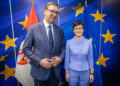
![Il presidente dell'Indonesia, Prabowo Subianto, con la presidente della Commissione europea, Ursula von der Leyen [foto: European Commission]](https://www.eunews.it/wp-content/uploads/2025/09/ue-indonesia.jpg)
Brussels – Reduction of export duties, access to raw materials essential for the twin green and digital transition, development of electric vehicles, access to the telecommunications market, more agri-food exports with protection of ‘Made in’ European excellence. The European Union and Indonesia sign a trade agreement, a Comprehensive Economic Partnership Agreement, that opens a new chapter not only in trade but also in geostrategy. It is a response to the tensions and impulses of Donald Trump’s US, and a first real response to the new regime of tariffs and trade wars triggered by the White House.
Precisely the abolition of tariffs is, in this sense, the main – albeit normal – innovation produced by the understanding reached between the parties. The understanding results in a 50 percent reduction of current customs duties on European cars sold in Indonesia, a tariff cut of up to 15 percent on exported machinery and pharmaceuticals, and a 25 percent reduction in tariffs on chemicals.
More generally, the removal of 98.5 percent of Indonesian customs tariffs on EU products. In addition, this reduction of sectoral tariffs and individual duties by up to 150 percent will allow EU exporters to save over €600 million in customs duties paid on their goods entering the Indonesian market.
https://www.eunews.it/2025/01/03/ue-mercosur-materie-prime-green-deal/
“By gradually removing Indonesia’s 50% car import tariff, the agreement creates fresh opportunities for EU automotive exports and electric vehicle investments,” in line with the commitments announced by the EU executive, stresses Maros Sefcovic, Trade Commissioner and EU Chief Negotiator. “I am convinced that today’s conclusion of negotiations is just the beginning of an exciting new chapter,” he adds before taking a jab at those concerned. “In today’s unpredictable global economy, trade relationships are not merely economic tools – they are strategic assets.” A message to Parliament that challenges the Commission’s actions on trade, particularly regarding Mercosur, and a reminder to the Trump administration, which provides the rationale for this agreement.
Electric cars and raw materials, EU ‘saves’ the Green Deal
The understanding reached envisages the elimination of tariffs on environmentally friendly goods, as well as new rules to allow more European investment in sectors such as renewable energy and electric vehicles. As for the electric vehicle sector, crucial is the EU’s access to raw materials, especially nickel and cobalt, which Indonesia is rich in, and are necessary for batteries. Not only that, but cobalt is also used in solutions for storing energy from renewable sources (wind and solar).
It does not end there, however. In industry, nickel is used in the production of metal alloys and stainless steel components. The agreement between the parties also allows access to a valuable raw material for the European steel industry.
The President of the European Commission, Ursula von der Leyen, rejoices—and it couldn’t be otherwise. “Our deal with Indonesia also provides us with a stable and predictable supply of critical raw materials, essential for Europe’s clean tech and steel industry.”

Telecommunications and e-commerce, all the benefits of the agreement
The Comprehensive Economic Partnership Agreement includes a comprehensive digital trade facilitation package which simplifies electronic transactions (e.g, electronic signatures and authentication), promotes a secure online environment for consumers, improves predictability and legal certainty (e.g., protection of computer source code), and provides for the prohibition of customs duties on electronic transmissions (such as software, messaging, digital media), a first for Indonesia.Additionally, for the first time, Indonesia will permit 100 percent foreign ownership in the telecommunications and IT services sectors.
New products for agrifood
The EU-Indonesia trade cooperation agreement will eliminate tariffs on key EU export products, including dairy, meat, fruit and vegetables, and processed foods. There will be a ban on imitations of the 221 typical products recognised as Geographical Indications, with the EU succeeding in keeping the single market closed to Indonesia for sensitive agri-food products such as rice, sugar, eggs, fresh bananas, or ethanol, and limited quotas for garlic, mushrooms, sweet corn, cassava starch, and high-sugar products.
English version by the Translation Service of Withub

![Da sinistra: il presidente del Consiglio europeo, Antonio Costa; il presidente dell'Ucraina, Volodymir Zelensky: la presidente della Commissione europea, Ursula von der Leyen [Bruxelles, 18 giugno 2024. Foto: European Council]](https://www.eunews.it/wp-content/uploads/2026/06/euco_ua260618-120x86.jpg)
![[foto: Saverio De Giglio/imagoeconomica]](https://www.eunews.it/wp-content/uploads/2026/10/cpt-120x86.png)