![Riunione del consiglio Affari esteri [Bruxelles, 16 marzo 2026. Foto: European Council]](https://www.eunews.it/wp-content/uploads/2026/03/consiglio-esteri.jpg)
Brussels – “It was clear from the outset that a war with Iran would entail the closure of the Strait of Hormuz.” The words of Austria’s Foreign Minister, Beata Meinl-Reising, encapsulate the historic moment facing the European Union, as it grapples with existential fears and challenges. First and foremost, she states in no uncertain terms, there is the “fear that what we went through in 2022 might be a mere fraction of what we could face with the blockade of Hormuz”. This means that the high energy prices caused by the war in Ukraine and skyrocketing inflation could be a walk in the park.
Austria’s comments are a clear criticism of Israel and the United States, responsible for triggering a conflict, which “must come to an end,” the Austrian official insists. “The only thing that would have a positive impact on the Hormuz crisis is an end to the war,” accompanied by a “nuclear deal.” A viewpoint that differs from that of some partners, both European and transatlantic, and which highlights differences and divisions.
On Iran, Finland and Lithuania take a completely different line: they continue to condemn Iran’s military responses and hold the ayatollahs’ regime responsible for what is happening. In the remarks by the foreign‑policy chiefs of Helsinki and Vilnius, Elina Valtonen and Kęstutis Budrys, one sees once again Europe’s own spiral over principles and values: why, unlike in the case of Ukraine, is it acceptable to bomb Iran, while expecting it not to return fire?
It is on the issue of law and principle that the European Union gets lost, adding to its already inherent structural difficulties the challenge of reaching a consensus on foreign policy. The EU’s High Representative for Foreign and Security Policy, Kaja Kallas, is working on possible solutions with the UN Secretary‑General at a time when the main actors in the Middle East conflict are openly mocking the United Nations — even if the attack is, admittedly, personal and outside any international mandate — and when democratic America shows an authoritarian streak on matters of press freedom, raising serious questions about the country’s reliability.
Speaking of the United States, “we believe that the US easing of sanctions on Russian oil sets a dangerous precedent, because right now we need Russia to have fewer funds to finance the war, not more,” Kallas saids ahead of the start of the today’s Foreign Affairs Council meeting (16 March). There is a rift with the historic partner, which is no longer the partner it once was, with the White House occupant, Donald Trump, threatening to pull the plug on NATO if the Europeans do not intervene in Hormuz. Here, Kallas glosses over the issue. “NATO is a defence alliance,” the Romanian Foreign Minister, Oana-Silvia Toiu, cuts short, in what amounts to a veiled “no” to the US demands. Poland is considering the matter: “We have already said ‘no’, but there are procedures that have not yet been activated. If the United States activates them, we will assess the situation carefully,” says Radoslaw Sikorski.
The issue of sanctions against Russia has reignited the EU-wide debate over support for Ukraine, with the Netherlands, France, Lithuania, and Luxembourg determined to overcome Hungary’s veto on the 20th sanctions package. Hungary’s ‘no’ vote currently appears insurmountable, and virtually all delegations will attempt to corner Budapest, without success. “Overall, the EU’s sanctions policy is a massive failure,” Budapest’s Foreign Minister, Péter Szijjarto, said, who is blunt on the 90 billion euro loan: “As long as the blockade on oil transit from Druzhba pipeline continues, we will not vote in favour.“
The Ukraine issue is even more complex than that. As Luxembourg’s Foreign Minister, Xavier Bettel, explains, there is a problem with how the matter is being handled. “When I was Prime Minister, I spoke on the phone with Russian President Putin every week, and then I received calls from colleagues in Poland and the Baltic states telling me that my country is too small to be able to negotiate, and this is a question of mindset because it is not a country’s size that determines its relations.”
English version by the Translation Service of Withub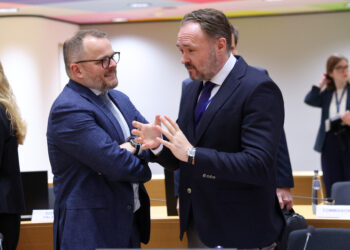


![Da sinistra: il presidente del Consiglio europeo, Antonio Costa; il presidente dell'Ucraina, Volodymir Zelensky: la presidente della Commissione europea, Ursula von der Leyen [Bruxelles, 18 giugno 2024. Foto: European Council]](https://www.eunews.it/wp-content/uploads/2026/06/euco_ua260618-120x86.jpg)
![[foto: Saverio De Giglio/imagoeconomica]](https://www.eunews.it/wp-content/uploads/2026/10/cpt-120x86.png)