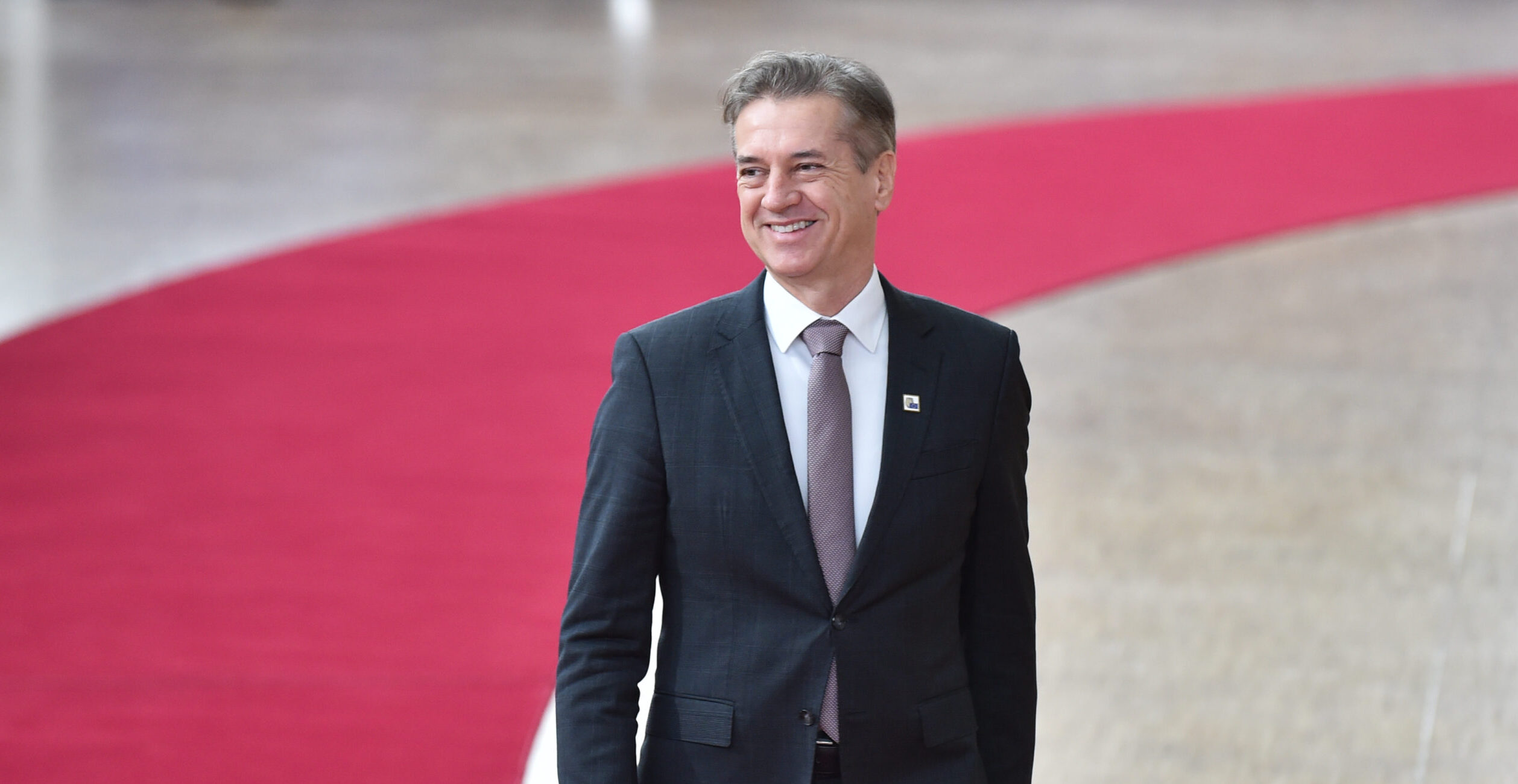
Brussels – It was forecast to be a neck-and-neck race, and so it was. In the Slovenian parliamentary elections, the Movement for Freedom (GS) of Prime Minister Robert Golob and the Slovenian Democratic Party (SDS) of former Prime Minister Janez Janša are separated by less than one percentage point: 28.6 per cent for Golob’s liberals, 28 per cent for Janša’s ultra-conservatives. A phase of complex negotiations to form a new government is now set to begin.
It is a Pyrrhic victory, but a victory nonetheless: while Golob’s narrow lead is the result of an unexpected resurgence in recent weeks, the 29 seats secured in Parliament reveal a collapse compared to the 2022 election, when GS secured as many as 41 elected members in Ljubljana. It is unlikely to succeed in forming a majority coalition (46 seats are required): SDS won 28 seats; the Christian-conservative-inspired list comprising New Slovenia, the People’s Party, and Fokus 9; the Social Democrats and Anže Logar’s Democrats 6 each; the joint Levica/Left and Vesna list 5, as well as the Resnica/Truth party.
“We are moving forward, and that is what matters most,” Golob told his supporters after the votes had been counted. “In the next term of office, we will do everything we can to ensure a better future for all citizens,” he promised. Voter turnout was just under 70 per cent, slightly lower than four years ago.

The election campaign took place in a highly tense and polarised atmosphere. Jansa, a three-time prime minister, a sovereigntist, and supporter of Donald Trump’s MAGA ideology, focused on a programme of tax cuts and greater executive powers. Golob, on the other hand, emphasised the choice between liberal-democratic values and an illiberal, Hungarian-style model attributed to Jansa. The clash intensified particularly in recent weeks, when the campaign focused on the scandal of alleged espionage against the government by an Israeli intelligence firm and on audio and video recordings circulated online earlier this month, which reportedly show prominent figures from Slovenian politics and business – including a former minister – discussing corruption, illegal lobbying, and the misuse of state funds.
According to the authorities, members of the private Israeli firm Black Cube, founded by former Israeli military personnel, visited the SDS headquarters in December. Jansa himself acknowledged having had contact with Giora Eiland, former head of Israel’s National Security Council and a figure linked to Black Cube, but denied any involvement in gathering compromising material against the government. With 72 hours to go before the vote, during the European Council meeting in Brussels, Golob called on the European Commission to investigate the alleged electoral interference, describing it as “a clear hybrid threat against the European Union.”
In Brussels, a potential victory for Jansa could have widened the already deep rifts between the moderate, pro-European bloc and the bloc of sovereigntist and Eurosceptic governments, comprising Hungary, Slovakia, and the Czech Republic. In Budapest, elections are scheduled for 12 April, and Viktor Orbán risks losing power. But with the far-right Rassemblement National in the running for the crucial 2027 French presidential elections, and Alternative für Deutschland (AfD) continuing to strengthen its support in Germany, the rise of parties opposed to European integration will remain an issue. In Ljubljana, at least, it has been postponed for four years.
English version by the Translation Service of Withub

![Da sinistra: il presidente del Consiglio europeo, Antonio Costa; il presidente dell'Ucraina, Volodymir Zelensky: la presidente della Commissione europea, Ursula von der Leyen [Bruxelles, 18 giugno 2024. Foto: European Council]](https://www.eunews.it/wp-content/uploads/2026/06/euco_ua260618-120x86.jpg)
![[foto: Saverio De Giglio/imagoeconomica]](https://www.eunews.it/wp-content/uploads/2026/10/cpt-120x86.png)