![La premier danese Mette Frederiksen [EU Council]](https://www.eunews.it/wp-content/uploads/2026/03/7284006d-f687-43ae-baf4-f4afdba621a4-scaled.jpg)
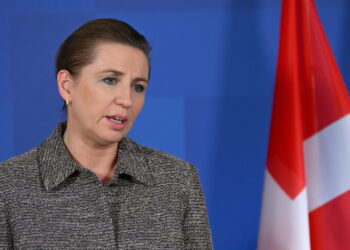
Brussels – Prime Minister Mette Frederiksen’s Social Democratic Party has won the parliamentary elections in Denmark, despite a slump in support compared to the 2022 elections and the worst result in its history. Neither the left-wing ‘red bloc’ nor the right-wing ‘blue bloc’ managed to reach the majority. With 21.9 per cent of the vote, Frederiksen remains in power, but the ruling centre-right coalition is on its way out.
The early elections, called by Frederiksen to capitalise on the handling of tensions with the United States over Greenland, confirmed the deep fragmentation of the Danish political landscape. The Social Democrats lost more than 5 percentage points compared to 2022, yet still came first among the 12 parties in the running. Even the allies of the unprecedented governing coalition – the first outside the traditional ‘blocs’ – lost ground: the liberal-conservative Venstre secured only 10.1 per cent, whilst the centrist Moderates obtained 7.8 per cent. The green left Socialist People’s Party came second, with around 11.6 per cent of the vote. The conservatives of the Liberal Alliance reached 9.7 per cent, closely followed by the Danish People’s Party, which saw a sharp rise to 9 per cent.
The ‘red bloc’, comprising the Social Democrats and left-wing parties, has won 84 seats. The right-wing bloc has won 77. Neither has reached the 90 seats required to secure a majority in the Copenhagen Parliament. It will be up to the king to grant an exploratory mandate to one of the party leaders. In all likelihood, the choice will fall on Frederiksen for the third time. Like four years ago, she will not be able to form a government without the Moderates led by the current Foreign Minister, Lars Løkke Rasmussen, and their 14 seats. Frederiksen has said she is “ready to take on” the task once again, admitting that “there is no indication that it will be easy to form a government.”
Difficult negotiations lie ahead, which could yield a new centre-left coalition comprising the Social Democrats, the Socialist People’s Party, the Moderates, and the Danish Social Liberal Party. Together, the four parties hold 82 seats. Rasmussen has, however, invited his two government allies, Frederiksen and the leader of the right-wing Liberals, Troels Lund Poulsen, to join him in the centre. However, Poulsen has ruled out a new partnership with the Social Democrats, reiterating his ambition to lead a right-wing government. On the other hand, the leader of the Socialist People’s Party, Pia Olsen Dyhr, has set out her conditions: “We must seek to ensure the preservation of the welfare state; we must seek to initiate an ecological transition,” she told the press, warning: “If we do not succeed, we will not join the government and will remain in opposition.”
English version by the Translation Service of Withub