- Europe, like you've never read before -
Friday, 2 October 2026
No Result
View All Result
  • it ITA
  • en ENG
Eunews
  • Politics
  • World
  • Business
  • News
  • Defence
  • Health
  • Agrifood
  • Other sections
    • Culture
    • Rights
    • Energy
    • Green Economy
    • Finance & Insurance
    • Industry & Markets
    • Media
    • Mobility & Logistics
    • Net & Tech
    • Sports
  • European 2024
    Eunews
    • Politics
    • World
    • Business
    • News
    • Defence
    • Health
    • Agrifood
    • Other sections
      • Culture
      • Rights
      • Energy
      • Green Economy
      • Finance & Insurance
      • Industry & Markets
      • Media
      • Mobility & Logistics
      • Net & Tech
      • Sports
    No Result
    View All Result
    Eunews
    No Result
    View All Result

    Home » Politics » Frederiksen narrowly wins Danish vote with governing coalition set for a political shift

    Frederiksen narrowly wins Danish vote with governing coalition set for a political shift

    The Social Democrats remain the largest party with 21.9 per cent, their worst result ever. Their government allies, the right-wing Liberals and the Moderates, have also lost ground. In second place is the green left of the Socialist People’s Party

    Simone De La Feld</a> <a class="social twitter" href="https://twitter.com/@SimoneDeLaFeld1" target="_blank">@SimoneDeLaFeld1</a> by Simone De La Feld @SimoneDeLaFeld1
    25 March 2026
    in Politics
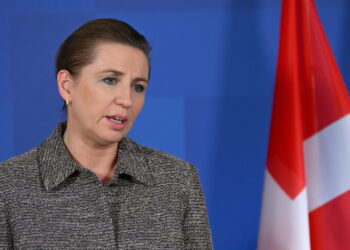
    La premier danese Mette Frederiksen [EU Council]

    La premier danese Mette Frederiksen [EU Council]

    Powered by powered by evolution group

    Brussels – Prime Minister Mette Frederiksen’s Social Democratic Party has won the parliamentary elections in Denmark, despite a slump in support compared to the 2022 elections and the worst result in its history. Neither the left-wing ‘red bloc’ nor the right-wing ‘blue bloc’ managed to reach the majority. With 21.9 per cent of the vote, Frederiksen remains in power, but the ruling centre-right coalition is on its way out. 

    The early elections, called by Frederiksen to capitalise on the handling of tensions with the United States over Greenland, confirmed the deep fragmentation of the Danish political landscape. The Social Democrats lost more than 5 percentage points compared to 2022, yet still came first among the 12 parties in the running. Even the allies of the unprecedented governing coalition – the first outside the traditional ‘blocs’ – lost ground: the liberal-conservative Venstre secured only 10.1 per cent, whilst the centrist Moderates obtained 7.8 per cent. The green left Socialist People’s Party came second, with around 11.6 per cent of the vote. The conservatives of the Liberal Alliance reached 9.7 per cent, closely followed by the Danish People’s Party, which saw a sharp rise to 9 per cent. 

    The ‘red bloc’, comprising the Social Democrats and left-wing parties, has won 84 seats. The right-wing bloc has won 77. Neither has reached the 90 seats required to secure a majority in the Copenhagen Parliament. It will be up to the king to grant an exploratory mandate to one of the party leaders. In all likelihood, the choice will fall on Frederiksen for the third time. Like four years ago, she will not be able to form a government without the Moderates led by the current Foreign Minister, Lars Løkke Rasmussen, and their 14 seats. Frederiksen has said she is “ready to take on” the task once again, admitting that “there is no indication that it will be easy to form a government.”

     Difficult negotiations lie ahead, which could yield a new centre-left coalition comprising the Social Democrats, the Socialist People’s Party, the Moderates, and the Danish Social Liberal Party. Together, the four parties hold 82 seats. Rasmussen has, however, invited his two government allies, Frederiksen and the leader of the right-wing Liberals, Troels Lund Poulsen, to join him in the centre. However, Poulsen has ruled out a new partnership with the Social Democrats, reiterating his ambition to lead a right-wing government. On the other hand, the leader of the Socialist People’s Party, Pia Olsen Dyhr, has set out her conditions: “We must seek to ensure the preservation of the welfare state; we must seek to initiate an ecological transition,” she told the press, warning: “If we do not succeed, we will not join the government and will remain in opposition.”

    English version by the Translation Service of Withub
    Tags: danimarcamette frederiksen

    Eunews Newsletter

    Related Posts

    frederiksen danimarca
    Politics

    The pitfalls of an early election in Denmark: Frederiksen set for re-election, but with whom?

    23 March 2026
    METTE FREDERIKSEN PRIMO MINISTRO DANIMARCA
    Politics

    Denmark heads for early elections: Frederiksen plays the Greenland card

    26 February 2026
    map visualization
    Former Prime Minister Mario Draghi at the conference in Brussels on September 16, 2025. Source: EU Commission

    Draghi: Balancing the books is inevitable, but not just through cuts and taxes – growth is essential

    by Giulia Torbidoni
    1 October 2026

    The former Italian Prime Minister gave a lecture in memory of the economist Karl Brunner at the Swiss National Bank

    Bandiera ucraina. Crediti: Andrea Panegrossi via Imagoeconomica

    The EU Commission is covering Ukraine’s budgetary needs for 2026

    by Iolanda Cuomo
    1 October 2026

    Looking ahead to 2027, a call for partners to honour their commitments. Von der Leyen: “Our teams have made good...

    Albert Kurti e von der Leyen - Pristina, Kosovo

    Von der Leyen in Pristina: “I believe in a European future for Kosovo.” But reforms are needed

    by Annachiara Magenta annacmag
    1 October 2026

    Since Kosovo submitted its official application for membership in 2022, Prime Minister Kurti has stated that “clear progress” has been...

    La presidente della Commissione europea, Ursula von der Leyen, e la presidente del Consiglio dei Ministri, Giorgia Meloni a una riunione informale dei capi di Stato nel 2024. Crediti: Stavros Ioannides via Imagoeconomica

    Meloni calls on the EU for greater flexibility, but Brussels rebuffs her: “We’ve already granted it”

    by Iolanda Cuomo
    1 October 2026

    A Commission spokesperson said: “Member States may request the activation of the national safeguard clause,” but “this must not be...

    • Director’s Point of View
    • Opinions
    • About us
    • Contacts
    • Privacy Policy
    • Cookie policy

    Eunews is a registered newspaper
    Press Register of the Court of Turin n° 27

    Copyright © 2025 - WITHUB S.p.a., Via Savona 127/B, 20144 Milano
    VAT number: 10067080969 - ROC registration number n.30628
    Fully paid-up share capital 50.000,00€


    No Result
    View All Result
    • it ITA
    • en ENG
    • Politics
    • Newsletter
    • World politics
    • Business
    • General News
    • Defence & Security
    • Health
    • Agrifood
    • Altre sezioni
      • Culture
      • Rights
      • Energy
      • Green Economy
      • Gallery
      • Finance & Insurance
      • Industry & Markets
      • Media
      • Mobility & Logistics
      • Net & Tech
      • News
      • Opinions
      • Sports
    • Director’s Point of View
    • Draghi Report
    • Eunews Newsletter

    No Result
    View All Result
    • it ITA
    • en ENG
    • Politics
    • Newsletter
    • World politics
    • Business
    • General News
    • Defence & Security
    • Health
    • Agrifood
    • Altre sezioni
      • Culture
      • Rights
      • Energy
      • Green Economy
      • Gallery
      • Finance & Insurance
      • Industry & Markets
      • Media
      • Mobility & Logistics
      • Net & Tech
      • News
      • Opinions
      • Sports
    • Director’s Point of View
    • Draghi Report
    • Eunews Newsletter

    Attention