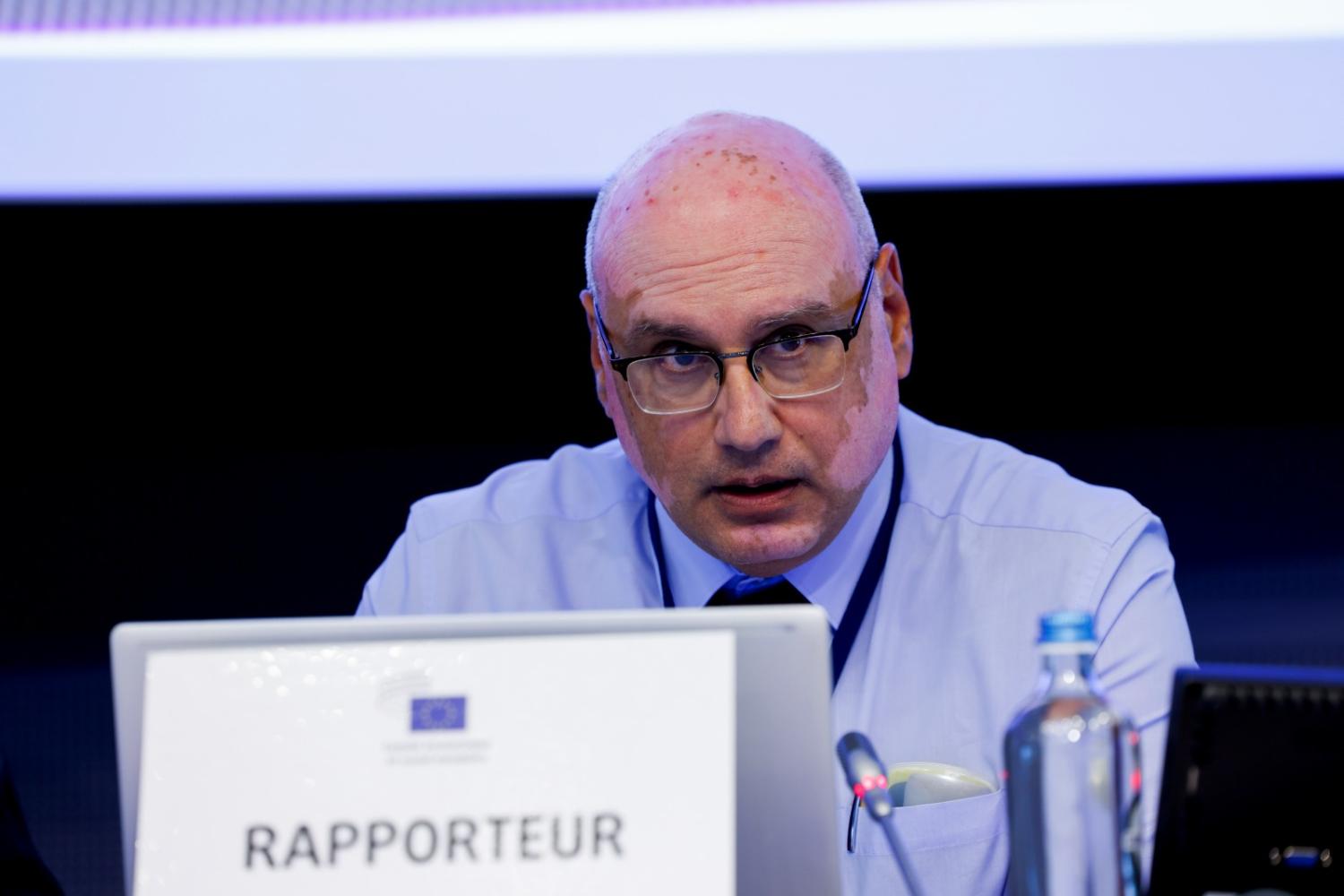
Brussels – Europe’s true resilience is not measured by the continuity of current policies, but by its ability to anticipate disruptive scenarios and realistically address internal challenges and the demographic shifts that will reshape society over the next twenty years. This vision is outlined by Philip von Brockdorff, a Maltese economist and academic, who is a representative of the Workers’ Group at the EESC, the European Economic and Social Committee. His analysis, having gained experience as rapporteur for the Committee’s opinion on the Commission’s Strategic Foresight Report 2025, calls for a paradigm shift to tackle the non-linear challenges facing the continent.
The Strategic Foresight Report 2025, entitled “Resilience 2.0”, is the European Commission document that sets out a proactive strategy to ensure the Union’s prosperity up to 2040 and beyond. The report aims to identify emerging risks and future opportunities: economic competitiveness, strategic autonomy and the defence of democratic values to strengthen the Union’s long-term resilience.
Eunews: You criticise the Commission’s proposal for being too tied to current political trajectories. What do you mean by that?
Philip von Brockdorff: “The Commission’s 2025 report focused on linear projections largely centred on security, climate, and demographics. However, radical and non-linear upheavals are becoming the norm. The Commission should examine a range of scenarios, from the least disruptive to the most extreme, in order to truly prepare for the unpredictable.”
E: In your view, what are the most pressing pessimistic or disruptive scenarios that the EU is overlooking, and how should they be used to test the robustness of current policies?
PvB: “The internal challenges facing the Union, such as Member States’ resistance to majority voting on foreign affairs, are not overlooked in the strategic report. We must consider these internal challenges in a rapidly changing world, where the European Union has lost ground in innovation compared with countries such as China, particularly in the high-tech and electric-vehicle sectors. If we do not address this gap, we risk seeing our manufacturing sector severely disrupted and becoming totally dependent on foreign markets. This innovation gap must be addressed through strategic foresight. Once these multi-level scenarios have been constructed, stress tests can be carried out: these are not economic forecasts but rather scenario constructions. Once we have created scenarios ranging from the least to the most disruptive, we must test the EU’s resilience. For example, what would happen if we were to lose our technological leadership for good? Are we prepared to rely more on services, where productivity is difficult to measure?
E: Many European businesses, particularly in Italy, are small and medium-sized enterprises. You argue that the Commission’s “Resilience 2.0” concept does not take them sufficiently into account. Could you explain how?
PvB: “The role of small and medium-sized enterprises and family businesses is crucial; if we lose them, we lose the fabric of our economy. The European institutions have provided support to these businesses, but things are changing so rapidly that we need to gain a better understanding of how different scenarios affect them and incorporate this into our strategic planning.”
E: In this regard, what do you think of the 28th regime presented by the European Commission?
PvB: “It is still too early to assess the impact, but once implemented, any initiative that supports small and medium-sized enterprises in innovation is important. At the same time, we must not forget the social economy: if we put workers’ rights on the back burner, we will create explosive social tensions. Therefore, the transition must also support the social aspect.”
E: In your opinion, you emphasise the urgency of completing the Union in the area of savings and investment. Why do you believe this should be a central pillar of the Union?
PvB: “Because today we are at a huge disadvantage compared to the United States when it comes to access to capital. In Europe, small and medium-sized enterprises rely almost exclusively on banks, whereas in the US, they draw much more heavily on the capital markets. A financial union would reduce costs and boost competitiveness. There was a Franco-German idea for a European stock exchange, but it remained just an idea. Putting these ideas into practice is difficult because many Member States are resisting in order to defend national interests.”
E: The issue of demographic change appears to be central to the Commission’s report, which notes that by 2040, there will be 17 million fewer people of working age than in 2023. The Berlaymont building sees migration as a possible solution. What is the EESC’s position on this?
PvB: “By 2040, we will lose millions of workers due to the falling birth rate. Although this is mentioned in the Commission’s report, I believe it needs to be emphasised further, because it is not just a question of an ageing population, but also of the composition of the population and how this affects communities. We need to analyse how the labour market is changing, not just from a macro perspective, but at a more granular level: country by country, region by region and even at the city level. The Commission often takes too broad a view, which fails to provide the full picture. The European Union needs a labour market plan, and this must be included in the analysis of future scenarios. The second point concerns the role of the Committee. I strongly recommend that the EESC should not be involved only at the end, when it receives the strategic foresight report, but that consultations should take place at various stages of the Commission’s work. Taking Malta as an example, we can see that almost 45 per cent of the workforce is foreign. If this trend continues, the local population will be a minority in the not-too-distant future. Integration is a huge challenge that will change the social and political fabric, and the EU can no longer sweep this problem under the carpet.”
E: Are there any other risks that the Commission is underestimating?
PvB: “The issue of enlargement: particularly with regard to Ukraine. Delaying accession poses enormous risks to global security and will force an increase in defence spending.”
According to Philip von Brockdorff, the essence of strategic foresight lies in looking ahead to 2040 to prepare today’s Europe. And this is a challenge that requires complete synergy between the plans of individual Member States and the Commission’s overarching vision, because “only in this way can we build true Resilience 2.0,” he concluded.
English version by the Translation Service of Withub