




Brussels – “Sustainable development must remain a key issue on the European Union’s political agenda.” These are the words of Enrico Giovannini, scientific director of ASviS (Italian Alliance for Sustainable Development). Today (8 May), Brussels hosted an event as part of the festival celebrating the association’s tenth anniversary. Entitled “European leadership for the future: civil society driving the post-2030 agenda”, the initiative provided an opportunity to reflect on the EU’s role as a driving force behind a new global post-2030 strategy. “It is right to think about the future, and it is necessary to do so. First, however, we must remember to defend everything we have achieved so far,” pointed out Teresa Ribera, Executive Vice-President of the European Commission for a Clean, Fair and Competitive Transition, during the meeting. “At a time like this, when working together seems almost impossible, we must not forget that we are fortunate: we live in the best possible place,” and “this leaves us with a great responsibility to take care of what we leave behind for the years to come,” she added.
In general, Europe’s progress towards the Sustainable Development Goals (SDGs) continues, but not at the pace required to meet the 2030 Agenda deadlines. This finding emerges from the 2026 report “Europe sustainable development“, which, through the SDG Index, paints a picture of a continent still far from achieving several key targets, particularly in climate, biodiversity, and inequality. The analysis shows that, despite high average performance levels compared to other parts of the world, significant differences persist between countries and regions. Furthermore, the report highlights that without a significant acceleration of policies, many indicators will not converge towards the targets by 2030.
“The value of the SDGs is that they require cooperation to work,” added Ribera, “they are driving us towards an integrated system.” According to Cillian Lohan, chair of the Civil Society Organisations Group, the EU’s central role in sustainable development “must be maintained, but one message must also be reiterated: the SDGs are a community endeavour and must strengthen cohesion among member states.” In this sense, a process of “policy redefinition” is even more necessary, added Marco Riccardo Rusconi, director of the Italian Agency for International Cooperation (AICS), because “we need to build strategies based on participation.” As Teresa Ribera pointed out, “multilateralism cannot be seen as a threat” and “those who are critical of common goals seek to create divisions and factions.”
“We often hear that the right context or political momentum to achieve the SDGs is missing,” commented Giovannini, “but that simply cannot be the case.” The Sustainable Development Goals “are already enshrined in Article 3 of the EU Treaty; they are part of the very essence of Europe.” In Italy, for example, 90 per cent of students and families consider them very important, as revealed by an ASviS survey. “Politics, however, continues to look elsewhere, caught between energy crises and geopolitical uncertainties,” said the former Minister for Infrastructure and Sustainable Mobility.
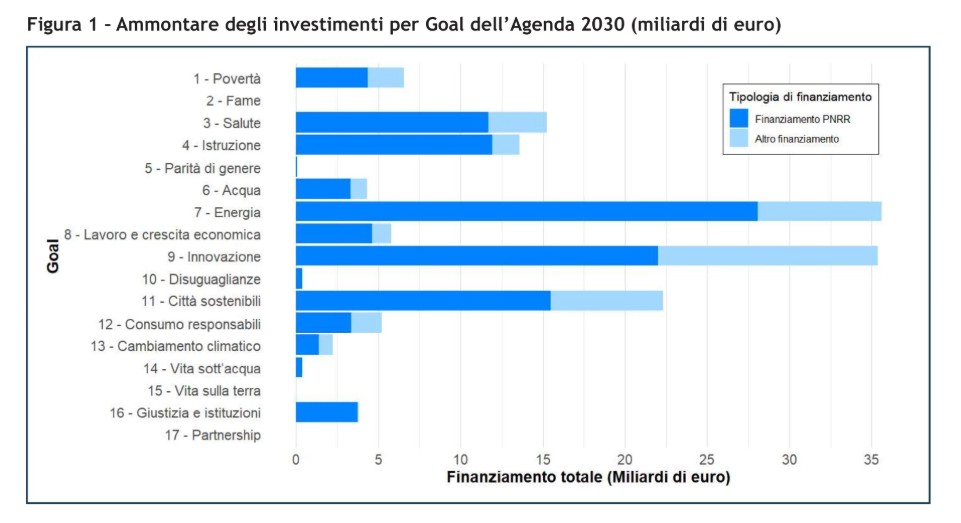
ASviS analyses are clear in their message. “The risk of a disconnect between statements and concrete actions is becoming increasingly real,” reads the report “The European Union’s progress towards the SDGs“. Italy was cited as an example of this disconnect at today’s meeting. Looking at how Member States have used Next Generation EU funding, in fact, allows us to understand the orientation of policies towards the goals, and ASVIS has monitored the contribution of the National Recovery and Resilience Plan to building sustainable development. According to the estimates, the NRRP allows for a 39 per cent approach to the quantitative targets considered. This result is insufficient: to reach the target, “around €20 billion in additional investment would be required.” Some areas of the SDGs “have been neglected,” explained Enrico Giovannini. These include expenditure directly aimed at combating hunger (Goal 2), gender equality (Goal 5), reducing inequalities (Goal 10), protecting marine and terrestrial ecosystems (Goals 14 and 15) and cooperation (Goal 17).

![Leon Löwentraut, gli obiettivi ONU di sviluppo sostenibile in mostra al Parlamento europeo [Bruxelles, novembre 2025. Foto: Emanuele Bonini]](https://www.eunews.it/wp-content/uploads/2025/11/Lowentraut-mostra-350x250.jpeg)


