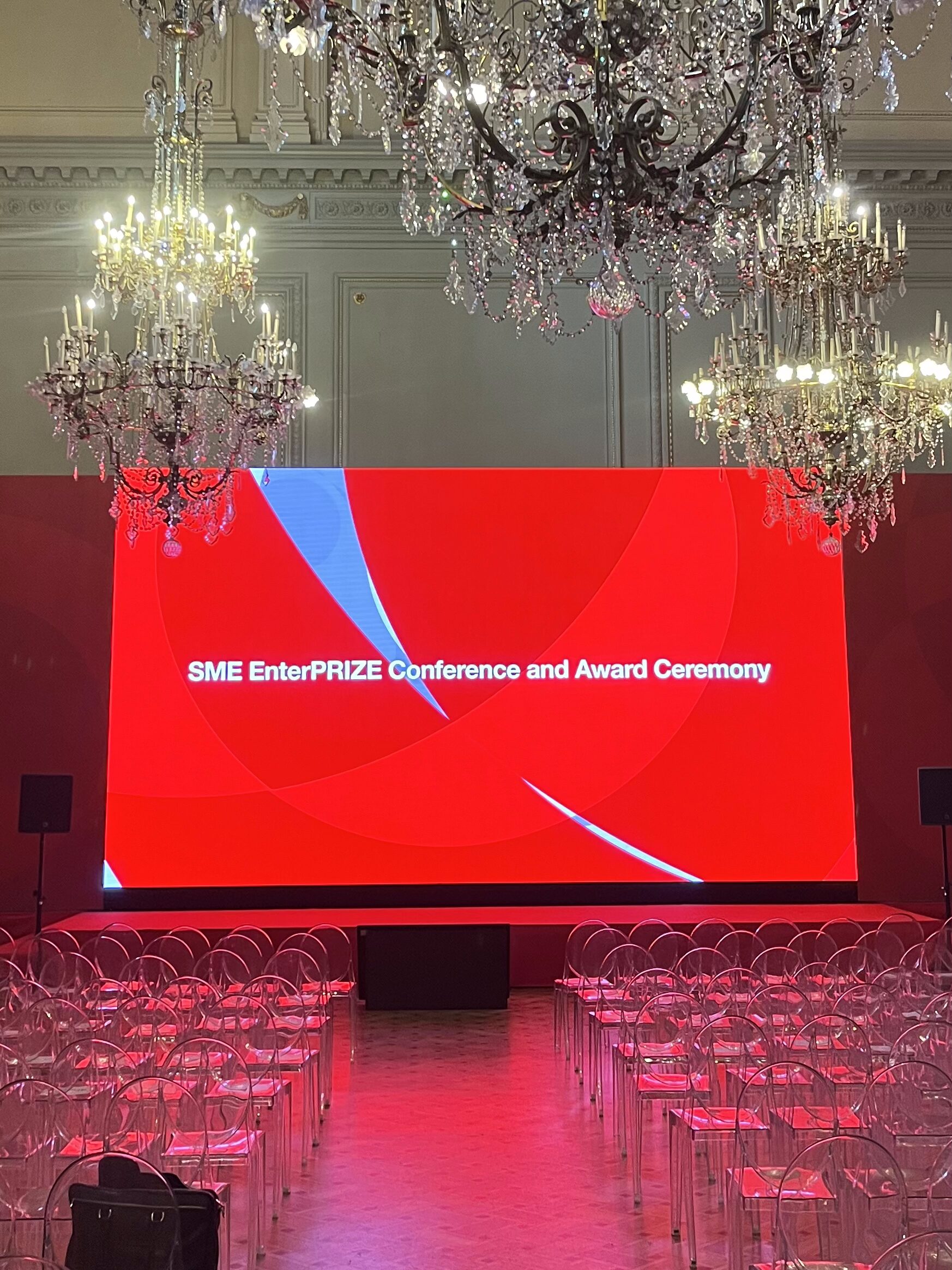

Brussels –In the backdrop of the Concert Noble building in Brussels, the Generali Group celebrated the fifth edition of SME EnterPRIZE, the European initiative dedicated to small and medium-sized enterprises that stand out for their sustainability, innovation, and climate resilience. The 2025 edition, entitled “Fostering Climate Resilience for European SMEs,” focused on an increasingly urgent issue: the ability of businesses to cope with climate shocks and to embed sustainability as a tangible factor in competitiveness and business continuity.
During the evening, the “Sustainability Heroes” were honoured – eleven of the more than 8,500 SMEs from eleven European countries involved in the initiative — Austria, Bulgaria, Croatia, the Czech Republic, France, Germany, Hungary, Italy, Portugal, Slovenia and Spain — selected for their achievements in transforming sustainable practices into long-term value. Representing Italy, the award went to Diemmebi, a Treviso-based company specialising in industrial design. A Special Mention dedicated to climate resilience was also awarded to the German company Procedes, which specialises in large-format printing.
The event was opened by the Chairman of the Generali Group, Andrea Sironi, who described SME EnterPRIZE as “much more than a single event”, characterising it as a European platform that promotes responsible entrepreneurs and shares innovative models. In his speech, Sironi emphasised that climate resilience does not merely mean withstanding change, but “adapting and thriving in the face of climate risks.” “Sustainability is not a cost, but an investment in the future of our society”, he stated, reiterating the need for a “new pact” between finance, politics, and business to build a more competitive, resilient and inclusive European economy.
Next to speak was the CEO of the Generali Group, Philippe Donnet, who noted that small and medium-sized enterprises represent “a fundamental pillar for Europe’s sustainable growth and economic resilience.” Donnet reiterated the insurer’s commitment to supporting businesses in the face of the effects of climate change and the green transition: “In an increasingly uncertain global context, strengthening the resilience of SMEs is not only necessary, but represents a strategic priority for the economy and society.”
Another highlight of the conference was the presentation of the new White Paper on SMEs and sustainability in Europe, produced in collaboration with the SDA Bocconi School of Management, based on a sample of 1,100 European companies. The report paints a picture of an evolving landscape: despite economic volatility, regulatory complexity, and the growing impact of climate change, 41 per cent of SMEs continue to integrate sustainability into their business decisions, up from 34 per cent in 2020. At the same time, 68 per cent of companies now consider sustainability a strategic competitive advantage.
Among the countries that have made the most significant progress are Italy (+27 percentage points compared to 2020), Spain (+13 points), France (+10 points), and Hungary (+8 points). The impact of company size, however, remains clear: SMEs with 50–249 employees show a sustainability implementation rate of 56 per cent, while smaller firms with 10–19 employees show a rate of 35 per cent.
The report also highlights a significant shift in the obstacles businesses perceive. For the first time since the observatory was launched, the main difficulties are not financial but institutional. Between 53 per cent and 56 per cent of companies report critical issues linked to a lack of public support, insufficient incentives and regulatory clarity. For this reason, the White Paper recommends measures such as stable tax incentives, subsidised European and national funds, and more favourable credit terms for companies investing in sustainability.
One of the most sensitive issues to emerge from the analysis, however, concerns protection against climate risks. While risk awareness is growing — rising from 50 per cent to 55 per cent compared to last year — difficulties remain in addressing it with concrete solutions: 59 per cent of European SMEs have no cover against extreme weather events, and 74 per cent are not insured against business interruption. At the same time, compared to 2024, the data nevertheless show some signs of improvement, with a 10-point increase in cover against climate-related damage and a 26 per cent rise in policies against business interruption.
The General Manager of the Generali Group, Marco Sesana, emphasised that “the data show how necessary it is to strengthen support for businesses, particularly in terms of climate resilience and insurance protection.” According to Sesana, the results confirm “the importance of an integrated approach that combines awareness, financial solutions and risk protection tools.”
English version by the Translation Service of Withub