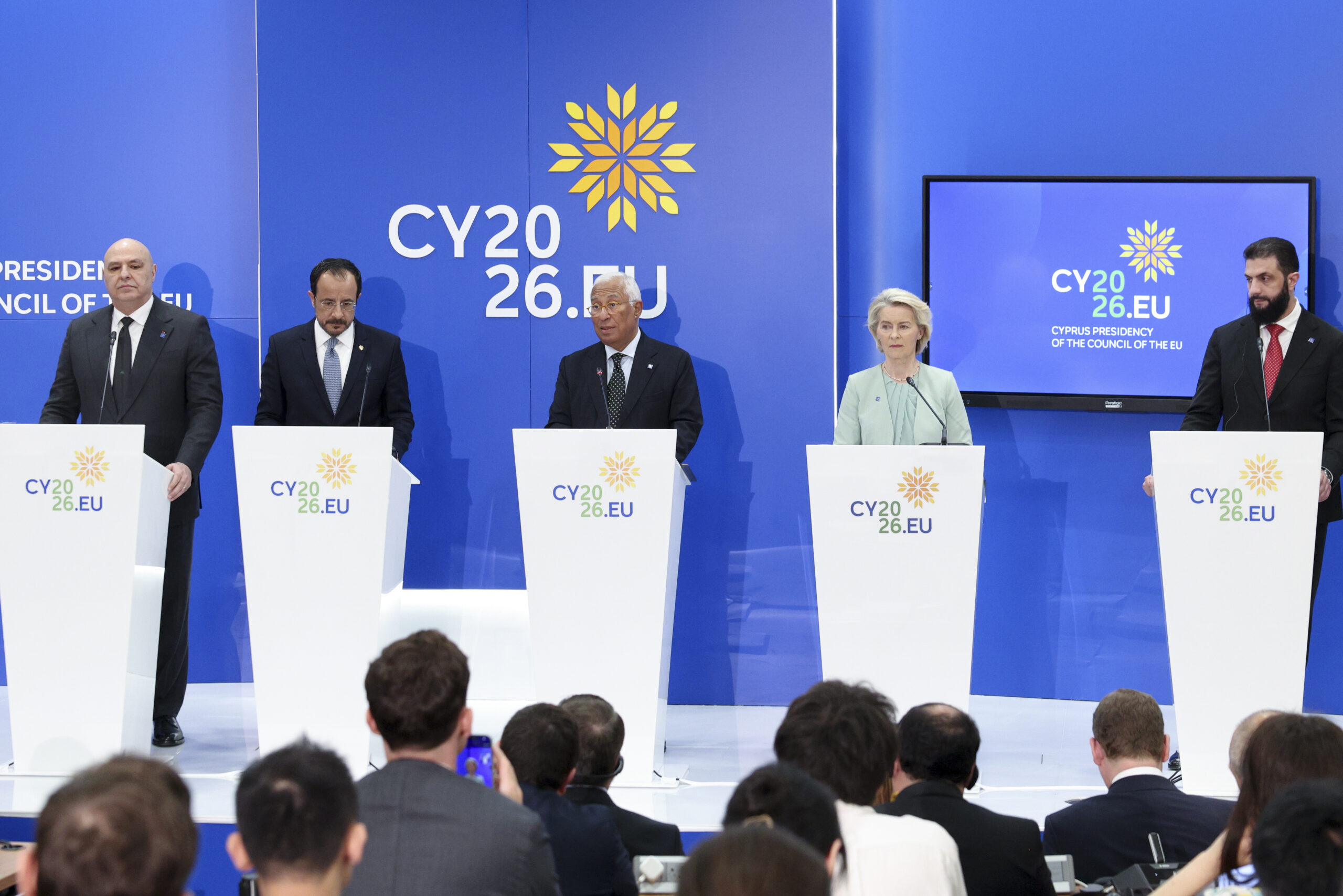

Brussels – In January 2026, the President of the European Commission, Ursula von der Leyen, announced a 620 million euro financial package for Syria for the 2026–2027 period. The stated aim was to build a “new peaceful, inclusive, and secure Syria” through three pillars: a new political partnership; a framework for trade and economic cooperation; financial support for humanitarian aid; and recovery support and bilateral assistance. From the outset, however, the funding sparked some controversy.
On 9 April 2026, a group of MEPs – Katrin Langensiepen, Thomas Waitz and Leoluca Orlando (Greens/EFA), Elena Kountoura, Leila Chaibi, Nikolas Farantouris and Sebastian Everding (The Left) and Barry Andrews (Renew) – submitted a priority question to the European Commission raising three issues: the traceability of funds, the ability to reach civil society actors and independent media, and the concrete allocation of funds among the various sectors and stakeholders involved. Farantouris, in particular, requested urgent clarification on how the funds are to be spent, highlighting the risks of their misuse in light of reports of escalating violence against religious and ethnic minorities in Syria.
Where is the EU money for #Syria going, whilst #Christians #Alawites #Δρούζοι #Kurds are being persecuted?
I am calling for a detailed report on the allocation of hundreds of millions of euros to Syria in a parliamentary question that I have co-signed with fellow MEPs from… pic.twitter.com/RFJsFeaLzg
— Nikolas Farantouris (@NFarantouris) 17 April 2026
The reply, signed by the Commissioner for the Mediterranean, Dubravka Šuica, arrived on 7 May. The Commission, the reply states, is preparing a 280 million euro programme for 2026–2027, “focusing on capacity building of the Syrian institutions, socioeconomic recovery, transitional justice, and accountability.” Šuica pointed out that “the EU remains steadfast in its efforts to support a genuinely inclusive transition and fosters engagement with communities and civil society across the whole of Syria.” In 2025, “the EU co-organised the Day of Dialogue for the first time in Damascus, gathering more than 350 Syrian civil society representatives from across the country. The Union, the response continues, “actively supports media freedom and local democracy.” EU assistance to Syria “is designed and implemented in line with the requirements of the Financial Regulation. Funding is channelled through established international organisations, UN agencies, and vetted non-governmental partners with demonstrated operational capacity, compliance systems, and proven track record of transparency and accountability.” Furthermore, Šuica emphasised that “No EU funds committed for Syria have been channelled through the Syrian authorities.“
The situation in Syria is particularly complex. On 11 May, when the EU reinstated its cooperation agreement with the country, Asaad Hassan al-Shaibani, the Minister of Foreign Affairs, stated that “there are no minorities in Syria, but a single people.” In fact, as early as March 2026, Human Rights Watch (HRW) had expressed concern about the situation in Syria. Over the past year, in fact, the organisation has documented “widespread identity-based killings perpetrated by government forces, along with summary executions, abductions and mass displacement, arbitrary arrests, aid blockades and the disruption of essential services.”
Transparency regarding funding is not merely a procedural matter. In its response, the Commission listed the major areas of expenditure but did not provide the requested breakdown of data. It is therefore currently unclear how much funding will go to local civil society, independent media, and women’s organisations compared to the major institutional and infrastructure sectors.
English version by the Translation Service of Withub