
- Europe, like you've never read before -
Thursday, 21 May 2026
No Result
View All Result
  • it ITA
  • en ENG
Eunews
  • Politics
  • World
  • Business
  • News
  • Defence
  • Health
  • Agrifood
  • Other sections
    • Culture
    • Diritti
    • Energy
    • Green Economy
    • Finance & Insurance
    • Industry & Markets
    • Media
    • Mobility & Logistics
    • Net & Tech
    • Sports
  • Newsletter
  • European 2024
    Eunews
    • Politics
    • World
    • Business
    • News
    • Defence
    • Health
    • Agrifood
    • Other sections
      • Culture
      • Diritti
      • Energy
      • Green Economy
      • Finance & Insurance
      • Industry & Markets
      • Media
      • Mobility & Logistics
      • Net & Tech
      • Sports
    No Result
    View All Result
    Eunews
    No Result
    View All Result

    Home » Business » Brussels takes aim at Trump and Netanyahu: “US and Israeli Middle East wars will cost the EU a third of its 2026 GDP”

    Brussels takes aim at Trump and Netanyahu: “US and Israeli Middle East wars will cost the EU a third of its 2026 GDP”

    The spring economic forecast confirms a 0.3 percentage point cut in growth for 2026. Dombrovskis: "The conflict in the Middle East has triggered a severe energy shock, putting Europe under further strain. Prudence and reforms are needed."

    Emanuele Bonini</a> <a class="social twitter" href="https://twitter.com/emanuelebonini" target="_blank">emanuelebonini</a> by Emanuele Bonini emanuelebonini
    21 May 2026
    in Business
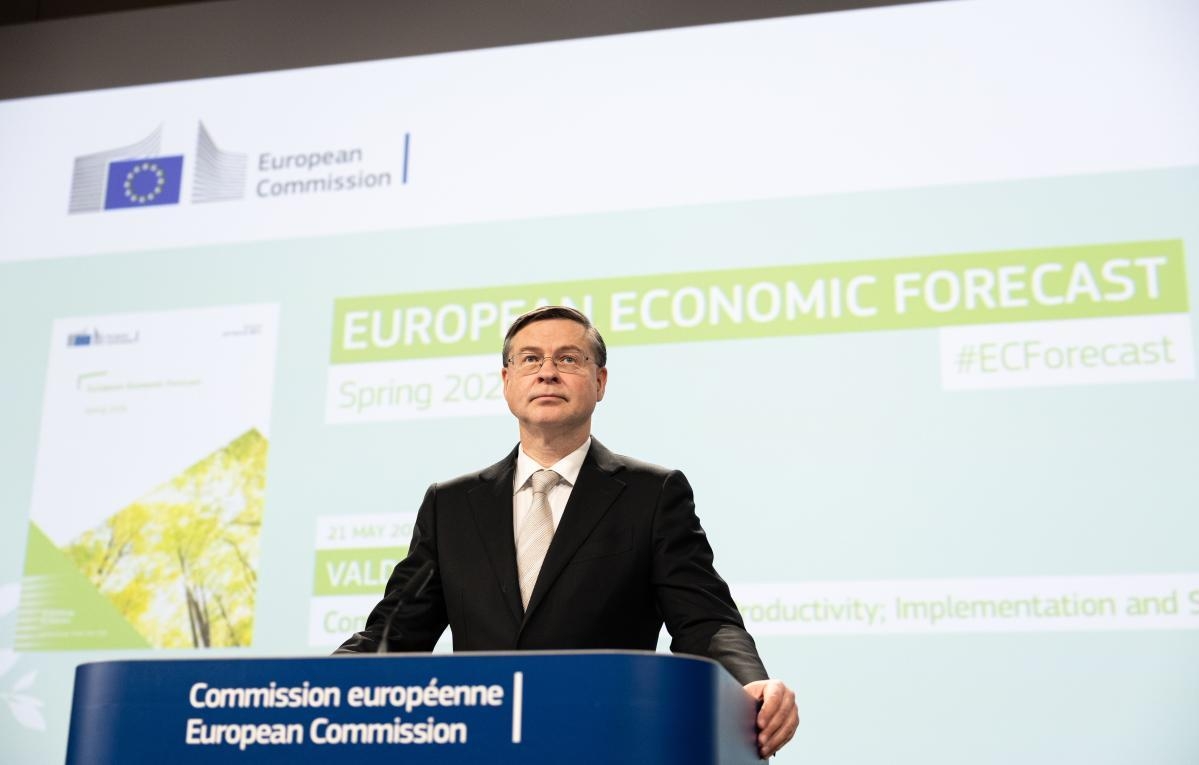
    Il commissario per l'Economia, Valdis Dombrovskis [Bruxelles, 4 giugno 2025]

    Il commissario per l'Economia, Valdis Dombrovskis [Bruxelles, 4 giugno 2025]

    Brussels – It’s all down to Donald Trump and Benjamin Netanyahu, and their wars in the Middle East. The political message underlying the Commission’s spring economic forecasts is all there, in the not-so-veiled condemnation that the Commissioner for the Economy, Valdis Dombrovskis, directs at the military manoeuvres of the United States and Israel. “The conflict in the Middle East has triggered a major energy shock, further testing Europe as it navigates an already volatile geopolitical and trade environment,” Dombrovskis said as he presented the figures, which confirm what the ECB had already anticipated, namely a loss of one-third of a percentage point in growth.

     Due to rising energy prices caused by the war in Iran, the European Commission has revised down its growth forecasts for the EU and the eurozone. For the European Union as a whole, growth is now expected to be 1.1 per cent in 2026 (compared to the 1.4 per cent forecast in November), and 1.4 per cent in 2027 (compared to the previously expected 1.5 per cent). The eurozone has also seen its forecast cut by 0.3 percentage points: growth is now expected to be 0.9 per cent by the end of 2026 (instead of 1.2 per cent) and 1.2 per cent in 2027 (instead of 1.4 per cent). 

    “The EU economy will continue to grow, but at a slower pace,” summarises the European Commission, and this is due to the actions of actors traditionally considered EU partners, whose behaviour now calls everything into question. The note accompanying the economic forecasts clarifies “before the end of February 2026, the EU economy was set to keep expanding at a moderate pace alongside a further decline in inflation, but the outlook has changed substantially since the outbreak of the conflict“ in Iran. This is where the blame is pointed at the United States and Israel. Due to their actions, “inflation started picking up a few weeks after the outbreak of the conflict, driven by the sharp increase in energy commodity prices, and economic activity is losing momentum.” For Brussels, the situation “is set to improve slightly in 2027 if tensions on energy markets ease.” In other words, peace is needed in Iran.

    The Commission fears the worst: calls for reforms and spending restraint

    The major risk surrounding the forecast concerns the duration of the conflict in the Middle East and its implications for global energy markets: this is the real wildcard of economic forecasts drafted with so many question marks. “Given the unusually high degree of uncertainty, and the narrowing window for a rapid normalisation of supply conditions,” the baseline forecast is complemented by an alternative scenario assuming more prolonged disruptions. 
    In this scenario, officials in Brussels acknowledge that energy commodity prices are assumed to rise significantly above baseline futures curves, peaking at the end of 2026 before gradually realigning with them by the end of 2027. In this scenario, inflation would not subside, and economic activity would fail to recover in 2027 as envisaged in the baseline projections. Furthermore, higher prices could lead households and businesses to cut back more sharply on consumption and investment.

    Furthermore, “the energy shock is also shaking economic sentiment, with households tempted to increase their savings, thereby exposing businesses to weaker demand,” Dombrovskis warned. Faced with this situation, Member States should take appropriate precautions and implement suitable policies. The Commissioner for the Economy explains what this means: “Acting with unity and determination, Europe should accelerate reforms, remove barriers to growth, and safeguard sound public finances.” More generally, Dombrovskis continues, “The EU must learn from past crises by keeping fiscal support temporary and targeted, and further reducing its reliance on imported fossil fuels.”
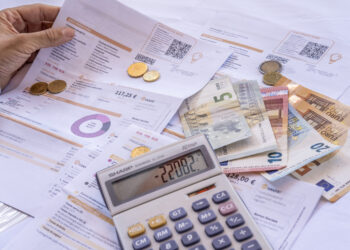
    Over half of EU countries exceed the 3 per cent deficit-to-GDP threshold

    Dombrovskis’ calls to “be careful” with public budgets and to ensure “the sustainability of public finances” are no coincidence, because, given the current situation, there are 13 out of 27 EU Member States that will find themselves in a situation of excessive deficit in both 2026 and 2027, that is to say, exceeding the 3 per cent threshold for the deficit-to-GDP ratio. “We are not here to present the countries’ budgetary situations, but the economic forecasts,” the Commissioner for Economic Affairs cuts short, but the forecasts themselves speak for themselves: Austria, Belgium, Bulgaria, Estonia, Finland, France, Germany, Latvia, Poland, Romania, Slovakia, Slovenia, and Hungary will exceed the reference values for at least two years, which could trigger the excessive deficit procedure from which Italy is expected to emerge.
    English version by the Translation Service of Withub
    Tags: deficitenergiainflationiranmiddle eastuevaldis dombrovskis

    Related Posts

    CARO BOLLETTE UTENZA UTENZE SPESE BOLLETTA LUCE ENERGIA ELETTRICA COSTO BOLLETTA AUMENTO CALCOLO CALCOLI CALCOLATRICE
ELETTRICITA' GAS
    Business

    Iran: the ECB calls it an “unprecedented energy crisis”. Risks for investment, consumption and aviation

    6 May 2026
    Milano - Aumento dei costi delle bollette della luce elettrica
    Business

    Rising energy prices drive Eurozone inflation: up 0.4 percentage points in April to 3 per cent

    30 April 2026
    Il commissario per l'Economia, Valdis Dombrovskis [Atene, 23 aprile 2026]
    Business

    Dombrovskis says reforms are the answer to the crisis in the Middle East

    23 April 2026
    map visualization
    Il commissario europeo per i Trasporti sostenibili, Apostolos Tzitzikostas (Fonte: EC - Audiovisual service)

    Biofuels: Commission urges caution, calling to use them “for aviation and shipping, while for cars the priority is electric”

    by Giorgio Dell'Omodarme
    21 May 2026

    Speaking at the plenary session in Strasbourg, the Commissioner for Sustainable Transport, Apostolos Tzitzikostas, referred to the ongoing review of...

    Hantavirus - Tzitzikostas

    Hantavirus: EU clarifies contagion risk is very low, though more cases can’t be ruled out

    by Annachiara Magenta annacmag
    21 May 2026

    At the European Parliament in Strasbourg, Transport Commissioner Apostolos Tzitzikostas speaks during the debate on the outbreak on board the...

    Il presidente ucraino, Volodymyr Zelensky, e il cancelliere tedesco,

    Merz proposes making Ukraine an associate EU member

    by Valeria Schröter
    21 May 2026

    The proposal, which was submitted to the EU institutions in a letter, also provides for the extension to Ukraine of...

    Il commissario per l'Economia, Valdis Dombrovskis [Bruxelles, 4 giugno 2025]

    Brussels takes aim at Trump and Netanyahu: “US and Israeli Middle East wars will cost the EU a third of its 2026 GDP”

    by Emanuele Bonini emanuelebonini
    21 May 2026

    The spring economic forecast confirms a 0.3 percentage point cut in growth for 2026. Dombrovskis: "The conflict in the Middle...

    • Director’s Point of View
    • Opinions
    • About us
    • Contacts
    • Privacy Policy
    • Cookie policy

    Eunews is a registered newspaper
    Press Register of the Court of Turin n° 27


    Copyright © 2025 - WITHUB S.p.a., Via Rubens 19 - 20148 Milan
    VAT number: 10067080969 - ROC registration number n.30628
    Fully paid-up share capital 50.000,00€


    No Result
    View All Result
    • it ITA
    • en ENG
    • Politics
    • Newsletter
    • World politics
    • Business
    • General News
    • Defence & Security
    • Health
    • Agrifood
    • Altre sezioni
      • Culture
      • Diritti
      • Energy
      • Green Economy
      • Gallery
      • Finance & Insurance
      • Industry & Markets
      • Media
      • Mobility & Logistics
      • Net & Tech
      • News
      • Opinions
      • Sports
    • Director’s Point of View
    • Draghi Report
    • Eunews Newsletter

    No Result
    View All Result
    • it ITA
    • en ENG
    • Politics
    • Newsletter
    • World politics
    • Business
    • General News
    • Defence & Security
    • Health
    • Agrifood
    • Altre sezioni
      • Culture
      • Diritti
      • Energy
      • Green Economy
      • Gallery
      • Finance & Insurance
      • Industry & Markets
      • Media
      • Mobility & Logistics
      • Net & Tech
      • News
      • Opinions
      • Sports
    • Director’s Point of View
    • Draghi Report
    • Eunews Newsletter

    Attention