![Hadja Lahbib [Foto: ]](https://www.eunews.it/wp-content/uploads/2026/05/P-069822_00-05_02-HIGH-153349.jpg)

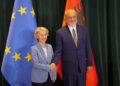
Brussels – The European Union will retain its central role in the delivery of humanitarian aid, but will adapt to current challenges, said the European Commissioner for Crisis Preparedness and Response, Hadja Lahbib, today (27 May) while presenting the Joint Communication, produced in collaboration with the EU High Representative for Foreign Affairs and Security Policy. “Humanitarian needs are at an all-time high with 239 million people worldwide in need of assistance,” said Lahbib, who is responsible for the portfolios of international cooperation, humanitarian aid, and crisis response. Current global funding, however, enables assisting fewer than half of the people in need.” Meanwhile, “the number of crises and their duration grow, while funding cuts and insecurity are making life-saving aid increasingly difficult to deliver.”
Currently, the EU and its Member States provide the largest share of global humanitarian funding (35 per cent in 2025). The international humanitarian system, however, is in a state of profound crisis. The number of people forcibly displaced or seeking asylum has doubled over the last decade, according to Commission documents, reaching 117.3 million in 2025. Sexual and gender-based violence, including that linked to conflict, has continued to rise. Furthermore, global food insecurity and malnutrition are becoming increasingly widespread, and there are currently around 130 conflicts taking place worldwide, more than double the number of just 15 years ago.
Meanwhile, over the past year, the system has come under further pressure “due to major political decisions and severe funding cuts, particularly from the United States and certain other major donors“, according to the Commission. This has forced humanitarian organisations to make drastic choices regarding operational priorities, reaching only a fraction of those in need. Furthermore, the European Commission emphasises, “aid is increasingly influenced by political or ideological considerations, rather than being guided by the humanitarian principles of humanity and impartiality, undermining the foundations on which the international humanitarian system rests.”
“It is at times like these that we find out whether our principles are more than just posturing and are truly put to the test,” Lahbib said. The aim, therefore, is to respond with real solutions structured around three pillars: protect, act, and collaborate. “The EU and its Member States remain the world’s largest and most reliable donors” of humanitarian aid, the EU High Representative for Foreign Affairs and Security Policy, Kaja Kallas, noted. “With our new approach to humanitarian diplomacy, we will make better use of every tool at our disposal to safeguard aid delivery, secure humanitarian access, protect civilians, and ensure respect for international humanitarian law. It will also help ensure that humanitarian issues are front and centre in our external action,” she added.
The Commission made clear that the EU would “take concrete actions for humanitarian assistance to be delivered safely and without impediments.” This also involves “stepping up humanitarian diplomacy in a collaborative Team Europe effort.” Particular attention will be paid to field workers. “Last year, over 300 aid workers were killed. Nearly 200 injured. Over 100 kidnapped,” the Commissioner pointed out. The vast majority of them were local staff. “We will do more to protect them. Through financial support and capacity building. And through security training, especially for local workers, so they have the knowledge and tools to operate safely. To protect themselves and the civilians they serve,” Lahbib said. In this regard, the programme Protect aid worker, already active in several countries, “will be expanded until it is operational on a global scale.”
The Belgian Commissioner also highlighted the suffering of women in crisis situations, who “are always the first victims and always pay the highest price.” That is why “we are launching SHIELD, Sexual and Reproductive Health in Emergencies and Life in Dignity. To improve access to sexual and reproductive healthcare in crises. And to strengthen support for survivors of gender-based violence.”
The EU would like to revitalise its humanitarian aid strategy, focusing on efficiency, partnerships and long-term solutions. “We want to make sure the humanitarian system performs under pressure, especially with fewer resources.” As needs are growing much faster than funding, “every euro must deliver more, but also more quickly.” For this reason, the EU wants to reform supply chains. Logistics accounts for “60 to 80 per cent of all humanitarian spending” and “every euro saved on logistics is a euro we can spend on food or vaccines,” the Commissioner pointed out.
Brussels, therefore, intends to optimise every stage of the supply chain, from the procurement of goods to delivery in the most remote areas. At the same time, funding mechanisms will be expanded – from cash assistance to multi-year funds – to ensure more predictable aid that respects the dignity of beneficiaries. The EU will increase funding, targeting 25 per cent localisation by 2027, more than double last year’s level. “This gives our local partners real ownership. Strengthening their capacity and bringing humanitarian action closer to communities,” Lahbib added. In practical terms, international partners will now have to explain in their funding proposals how affected communities and local actors are involved in the design and delivery of assistance. Local players will therefore be encouraged “to play a more effective role in the humanitarian response.”
But the question of how funding is allocated is complex in itself. A 1996 regulation prohibits the EU from directly funding local actors. Responding to journalists on this point, Lahbib explained that the EU is “a global donor, not an operational actor.” The Union, therefore, “works through reliable international NGOs, which are entrusted with managing audit procedures and ensuring compliance with European financial regulations.” So, yes to strengthening local actors, but “always through international partners,” the Commissioner clarified, reiterating the “zero tolerance” stance towards violations. “The EU has a robust control system for traceability and responsibility, and the Directorate-General that manages humanitarian aid has never had any issues with the European Court of Auditors,” she reiterated.
Finally, on the subject of data, the Commissioner emphasised the need to change approach: “We all need good data. Data we can access fast, data we can trust, and data we can compare. Across countries. Across crises. Across organisations.” Currently, she explained, each organisation collects data differently, and this “creates gaps and duplication.” For this reason, Lahbib concluded, the EU is pushing for data sharing, “using every available tool, including AI and satellite technology.”
English version by the Translation Service of Withub