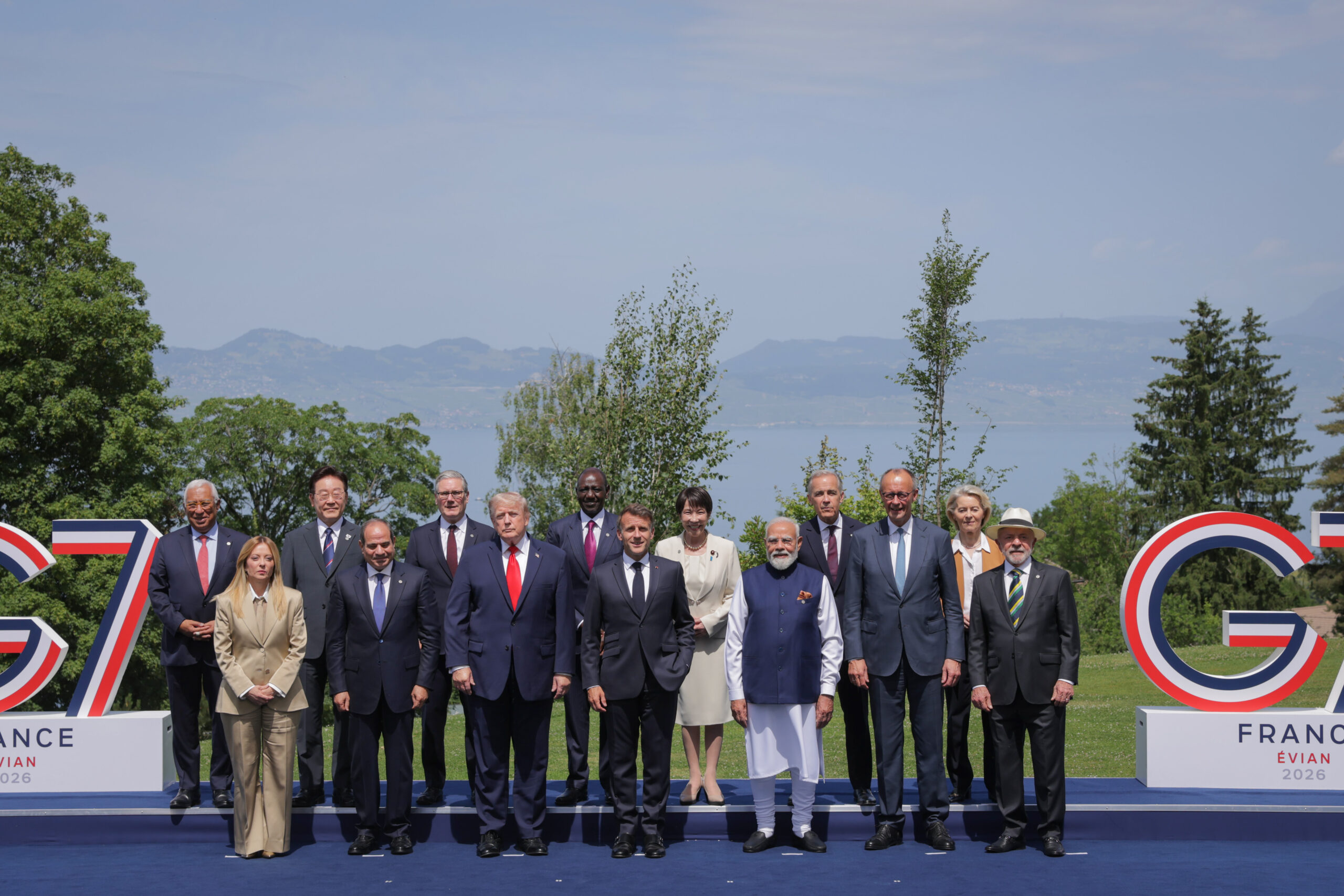
Brussels – Reforming the international cooperation system to make it more effective, less fragmented and more focused on economic growth: This is the message contained in the G7 leaders’ statement on “mutually beneficial international partnerships”, one of the first documents adopted by the summit currently taking place in Evian (France) from 15 to 17 June.
In the text—also supported by Kenya and the Republic of Korea as partner countries—the Heads of State and Government recognise the contribution made by the current development finance system in supporting the most vulnerable populations. However, the leaders believe the time has now come for a fundamental overhaul. “We recognise the need to modernise the current international development system to ensure that it fully meets the needs of future generations and current challenges,” the declaration states.
In particular, according to the G7, “traditional development policies have had a limited impact
in reducing financial dependency on
external assistance,
strengthening country ownership and
creating pro-growth incentives.”
For this reason, the leaders state that they are “united in reforming the development cooperation system and in building mutually beneficial partnerships”, based not only on international solidarity but also on the convergence of the strategic interests of donor countries and their partners.
One of the key concepts in the declaration is that of economic sovereignty. The G7 states its intention to support partner countries in their ability to finance themselves, by strengthening “decision-making capacity, accountability, long-term economic sovereignty and resilience”, whilst respecting national development priorities. This approach aims to move beyond a purely aid-based approach, favouring instead greater financial autonomy.
With this in mind, the document devotes considerable space to the mobilisation of domestic resources. The world’s seven leading economies are committed to continuing their support for partner countries by strengthening tax administrations and public revenue collection capacity. The aim is to help countries “in raising revenues, spending effectively,
borrowing sustainably and adequately managing fiscal risks”: a genuine paradigm shift.
Another issue requiring action is that of public debt in low- and middle-income countries. The G7 expresses “concern about the growing financial vulnerabilities” affecting these countries, which risk undermining the investment needed for development. For this reason, the leaders are calling for further progress within the G20 towards a shared approach to debt restructuring and are urging “a strengthening
of the implementation of the G20 Common Framework to ensure debt treatments are
delivered in a predictable, timely, orderly and coordinated manner.” This refers to the mechanism established by the G20 in 2020 to coordinate debt restructuring for the most vulnerable countries when their debt becomes unsustainable.
Alongside public resources, the declaration assigns an increasingly important role to private capital. According to the leaders, government measures alone are not sufficient to meet global financial needs. Hence, the commitment to “support more effective mobilisation of private capital to finance long-term development and generate large-scale impact.”
How exactly? The idea that emerged from the summit is to utilise the development finance institutions of the “big 7” and urge multilateral banks to make greater use of guarantees, risk-sharing instruments, blended finance, and co-financing mechanisms.
When it comes to international cooperation, one of the regions most closely involved is clearly Africa: a part of the world that indeed occupies a prominent position in the vision set out at Evian. The leaders welcome the support expressed by their African partners during the Africa Forward Summit—the summit in Nairobi (Kenya) organised by the Kenyan President William Ruto and his French counterpart Emmanuel Macron last May—and highlight a series of existing initiatives, ranging from the Mattei Plan for Africa drawn up by the Italian government to the Partnership for Global Infrastructure and Investment conceived by the G7 as a counterbalance to China’s Belt and Road Initiative.
On the subject of infrastructure, the signatory countries aim to strengthen supply chain resilience and promote investment in transport, energy, and digital infrastructure. The document also highlights the strategic importance—here too, the reference to China is implicit but clear—of critical mineral supply chains, which are increasingly seen as central to economic growth and industrial security. The stated objective is to develop “mutually beneficial partnerships based on high standards, transparency and local value creation.”
The statement also addresses food security, calling on international financial institutions to monitor the impact of difficulties in accessing essential inputs, such as fertilisers, and to coordinate support for the countries most affected.
Finally, the leaders included in the document a more general reflection on the critical issues facing the architecture of international cooperation, emphasising that it suffers from increasing fragmentation. For this reason, they are committed to “strengthening coordination amongst all stakeholders, including development banks and similar financial institutions,” thereby prioritising existing aid instruments rather than creating new ones and further complicating the framework.
“Delivering this transformative agenda will require sustained and collective commitment within and beyond
the G7,” is the phrase with which the leaders chose to conclude their joint statement. Is this an encouraging call to action, or a concerned warning about the risk that these words will—yet again—remain nothing more than words on a piece of paper?
English version by the Translation Service of Withub
![Hadja Lahbib [Foto: ]](https://www.eunews.it/wp-content/uploads/2026/05/P-069822_00-05_02-HIGH-153349-350x250.jpg)

![Da sinistra: il presidente del Consiglio europeo, Antonio Costa; il presidente dell'Ucraina, Volodymir Zelensky: la presidente della Commissione europea, Ursula von der Leyen [Bruxelles, 18 giugno 2024. Foto: European Council]](https://www.eunews.it/wp-content/uploads/2026/06/euco_ua260618-120x86.jpg)
![[foto: Saverio De Giglio/imagoeconomica]](https://www.eunews.it/wp-content/uploads/2026/10/cpt-120x86.png)