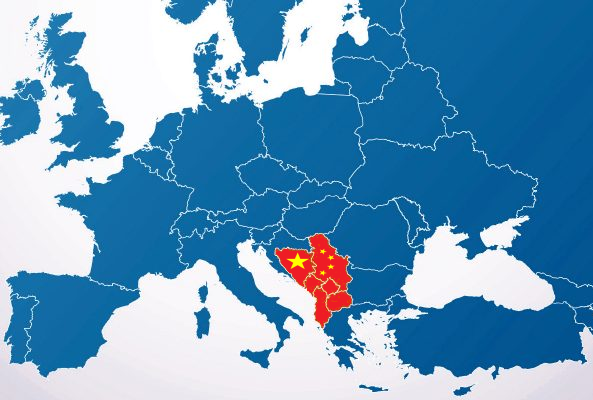
Brussels – The shared future of the EU and the Western Balkans brings with it a third party that could prove highly troublesome: China. China’s influence in the region is already excessive, and the European Union’s enlargement into the region is beginning to unsettle the leading pro-European party on the twelve-star political scene: the EPP. Sebastião Bugalho, a member of the European Parliament’s Committee on Foreign Affairs, urges the European Commission to be vigilant, about Beijing’s strong presence in the candidate countries.
“Chinese influence could shape the region’s path towards the EU and undermine European standards, the single market and the legitimacy of institutions required by the accession process,” Bugalho said in the parliamentary question submitted to ask how Montenegro, Albania, Serbia, and Bosnia‑Herzegovina can be guaranteed an accession resilient to influence from the People’s Republic. The answer to the question is: trust in the Balkan governments.
“The Commission is aware of the growing presence of China and other global actors in the Western Balkans,” the Commissioner for Enlargement, Marta Kos, acknowledges. “Enlargement partners are regularly reminded that their engagements with third countries must be transparent, financially sustainable, and compatible with EU rules and standards.” Essentially, they are trusted to resist Chinese influence while working toward EU membership.
The approach adopted in Brussels appears superficial, particularly given that China is increasingly viewed as a rival and hostile power. However, while Kos points out, on the one hand, “enlargement is a geostrategic imperative,” particularly from an anti-Russian perspective and at a time of unsustainable transatlantic relations, on the other, entering into open conflict with Beijing is not a viable option. Enlargement: for the EU, the Western Balkans are the ‘Chinese’
However, the concerns harboured within the EPP are far from unjustified. In Montenegro, China has had a presence since 2006, and over the past 20 years, investment has grown to the point that Beijing now holds a quarter of Montenegro’s public debt. The bilateral trade balance favours China, with the
People’s Republic selling more than ten times the value of Montenegro’s exports to China. The government in Podgorica has exposed itself to Chinese control, particularly through the A1 motorway linking the port city of Bar to Boljare. The project costs 944 million dollars and is financed by the Exim Bank of China. Chinese companies are also active in the railway sector, and Dongfang Electric is working hard to retrofit the Pljevlja thermal power station in the north of the country sustainably. The bilateral trade balance favours China, with telecoms and telecommunications products dominating the trade, in defiance of the EU’s declaration of war on Huawei and ZTE.
For
Bosnia and Herzegovina, the situation mirrors that of Montenegro:
China exports goods worth almost 1.5 billion dollars to Bosnia and Herzegovina, with telecoms and telecommunications products dominating the market. Bosnian exports to the Asian country are worth “just” 91 million dollars, indicating an unrivalled imbalance and level of market penetration. Investments in the motorway sector and in renewable energy projects are increasingly consolidating China’s presence, while loans from Chinese banks are ultimately tying the Balkan country to Beijing.
However, it is Serbia that is China’s main partner in the Western Balkans: cooperation ondefence, transport, infrastructure, energy, and technology makes the two countries such active partners that there are direct flights between Belgrade and no fewer than four Chinese destinations (Beijing, Shanghai, Guangzhou, and Tianjin).
China is in the Western Balkans and determined to remain there, even once the candidate countries have joined the EU. Faced with such a scenario, “the EU closely monitors the rate of alignment with the Common Foreign and Security Policy of all enlargement partners, an important indicator of the region’s geopolitical orientation,” Kos noted. “By systematically inviting them to align, the EU aims to ensure strong engagement with the Western Balkans, while also promoting the region’s stability, security, and prosperity.”