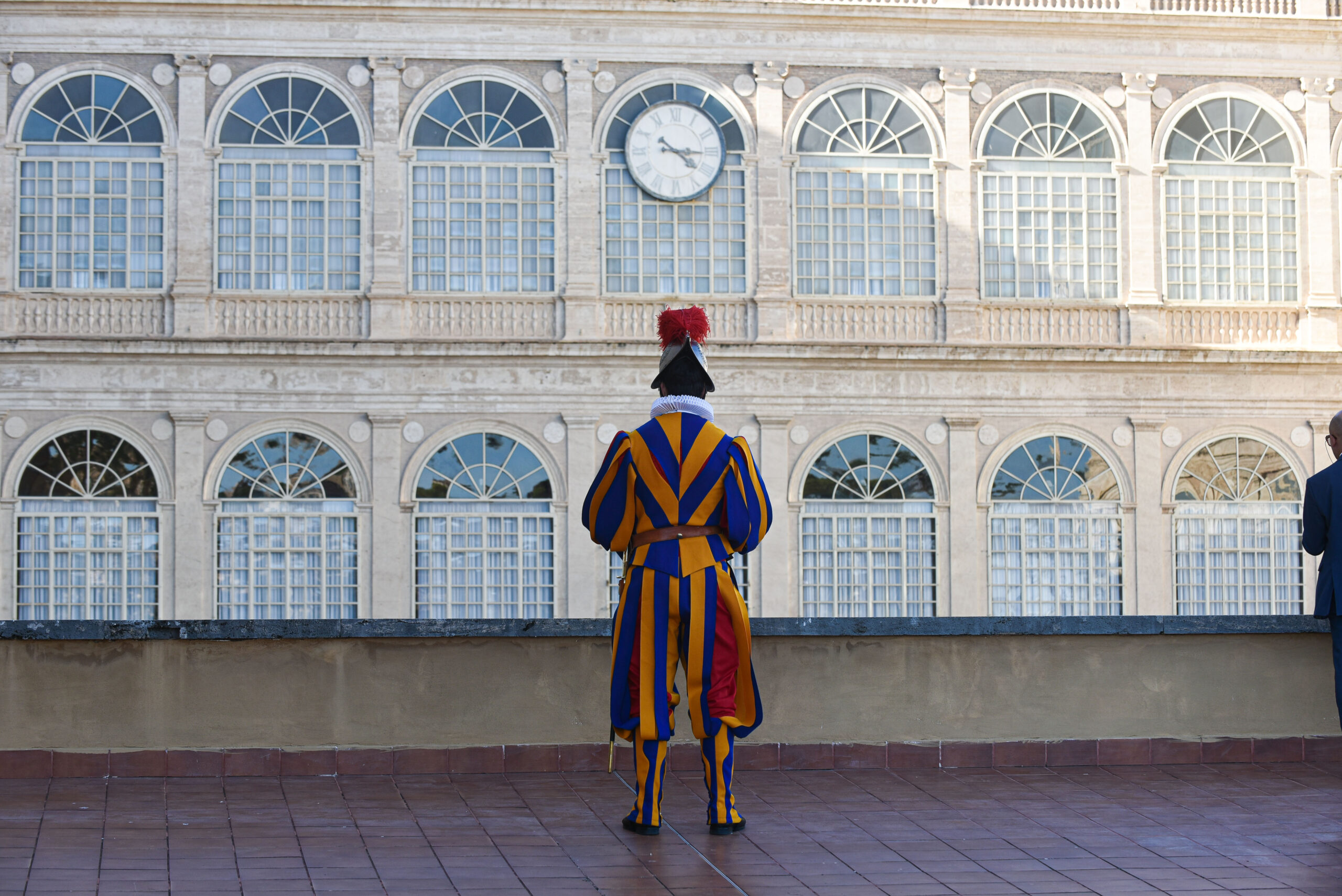
Brussels – “The European Union, in effect, imposes economic sanctions on one country and sends financial aid and weapons to another, while turning a blind eye to other, even more serious invasions, with even more brutal consequences for entire populations”. The accusation comes from Cardinal Víctor Manuel Fernández, during his opening address at an Extraordinary Consistory at the Vatican on Friday (26 June) with Pope Leo XIV.
The implication is clear. The EU is imposing sanctions on Russia but supplying arms to Israel. To avoid any misunderstanding, the cardinal added that “Israel’s destruction of entire cities cannot be considered a proportionate defensive action. The enormous disproportion of the military operations in Gaza and southern Lebanon is evident”. Furthermore, “as these are densely populated territories, the proportion of civilian deaths relative to the total population, the huge number of children killed and the number of homes bombed allow us to speak of total destruction,“ he added.
Fernández described the EU’s inaction towards Israel as symptomatic of a global order in which “there is no longer a real and stable framework of truth and values.” The cardinal went on to say that Israel and Russia are framing their own acts of aggression within the “theological criteria of just wars.” A “manipulation of the Church’s Social Doctrine” which is “used to provide a theoretical basis for the most unjust wars,” he explained. Despite the devastating effects of the ongoing attacks, the cardinal observed that “both in Russia and in the United States’ involvement in the wars in the Middle East, the justification is always some form of self-defence.”
For over two years, the European Union has been discussing sanctions against Israel without managing to translate them into concrete measures. In September 2025, the President of the Commission, Ursula von der Leyen, announced a proposal for the partial suspension of the EU-Israel Association Agreement, in force since 2000, which grants Israel preferential access to European markets. The package provided for tariffs on 37 per cent of Israeli imports, individual sanctions against Ministers Ben-Gvir and Smotrich, and the freezing of approximately 20 million euros in European funds. The proposal stalled almost immediately until the Foreign Affairs Council in Luxembourg in April 2026, where the High Representative of the Union for Foreign Affairs and Security Policy, Kaja Kallas, had to admit that she had “seen no change in positions around the table.”
The only concrete step forward came on 11 May when, following the fall of Viktor Orbán in Hungary – who had vetoed the move for years – the 27 foreign ministers unanimously approved sanctions against certain violent settlers and members of Hamas. The next meeting is scheduled for 13 July 2026, when the Foreign Affairs Council is due to examine new options regarding illegal settlements.
So far, the Italian government has not responded to the Vatican’s message. Italian Prime Minister Giorgia Meloni finds herself in a difficult position. On the one hand, she has gradually – and tentatively – distanced herself from Israel. In August 2025, she stated that Israeli operations had “exceeded the bounds of proportionality,” and in September, at the UN, she announced Italy’s support for some of the sanctions proposed by the Commission. Then, in April 2026, she suspended the automatic renewal of the bilateral defence cooperation agreement with Tel Aviv. On the other hand, in Brussels, the Italian government has continued to block the most substantial measure, namely the suspension of the Association Agreement.
English version by the Translation Service of Withub![[Foto: Unsplash]](https://www.eunews.it/wp-content/uploads/2026/06/jakob-rubner-oqCRCYUiJpw-unsplash-350x250.jpg)
![Riunione del consiglio Affari esteri [Lussemburgo, 15 giugno 2026. Foto: European Council]](https://www.eunews.it/wp-content/uploads/2026/06/fac-council-250615-350x250.jpg)