
We were still in the grip of Covid, with the first hints of a Recovery Plan and technical rehearsals for dividing up the funds that the European Council would eventually approve five years ago, on 13 July 2021. At the time I wrote a piece for zafferano.news, the weekly webzine founded by Riccardo Ruggeri, framing Mark Rutte’s recent conduct and his underlying disposition as the Dutch prime minister. I quote myself: ‘The Dutch prime minister’s vocation for governorship is a matter of ethnic genetics, so please, let us not be too scandalised. Governors, who rank a little below viceroys, have a taste for command, for the orderly and predictable path along which expectations are carried out without too much discussion… Being lesser than viceroys, governors rarely hatch court intrigues the way viceroys do. Instead they tend to obey their monarchs.’ Little has changed since. And here we are again with Rutte, who, in the eyes of many, now treats NATO as a colony to be brought into line rather than a body to be managed with an eye to, and respect for, its delicate complexity.
His stewardship of the Atlantic alliance turns one year old in October, closing out an eventful six months: a summit in Ankara marked by Donald Trump’s outbursts, and a gaffe over Italian bases that revived Rome’s distrust. There was, admittedly, a very Dutch beau geste along the way. Rutte and the Dutch prime minister, Rob Jetten, either declined or diplomatically forgot, in Jetten’s case, to take home the awkward gift Recep Tayyip Erdoğan and his protocol office had arranged for every participant: a Turkish pistol, the Gümüşay, a historic trinket designed in 1990 by the local arms industry and chambered for .357 Magnum rounds. Six bullets came with the gift, tucked alongside the pistol. There was little doubt about it: the recipient’s name was engraved on the revolver.
Beyond that, there were few surprises. Rutte behaved exactly as expected and brushed aside the question, put to him at the press conference and shared not only by the rest of the journalists but also among allied staff, of how far his ‘diplomacy of flattery’ would stretch before turning into servility. On a summer terrace overlooking Milan’s thin greenery, not nearly enough to temper the heat wave of recent days, a lady only just past sixty asked, amid the usual chatter of a summer dinner among people ‘presumed to know’: ‘So where does this Rutte actually come from, in the end?’ Her accent and the way she phrased it betrayed a longstanding southern nobility, yet the question still deserved a precise answer.
Mark Rutte was born in The Hague on Valentine’s Day in 1967, the youngest of seven children in a middle class Protestant family. His father was a merchant, his mother a secretary. He attended a classical grammar school with an arts specialism, took a master’s in History at Leiden in 1992, chaired the VVD’s youth wing and built a management career at Unilever before entering politics in 2002, in the Balkenende government. From there the climb was swift: leader of the VVD from 2006, prime minister from 2010 to 2024, four consecutive governments and the longest tenure in power in Dutch history. His fourth government fell in July 2023, brought down by a coalition row over migration policy.
Little is known about his private life. Unmarried, childless, he calls himself ‘a happy bachelor’, and his reticence intrigues people well beyond the Netherlands too. He has played the piano for years, neither smokes nor drinks, loves reading, and cultivates a Calvinist understatement that shows in his style too: dark jackets, no frills. His sporting heart belongs to Feyenoord of Rotterdam and to the small club ADO Den Haag. He was long known for getting about by bicycle and in an old secondhand Saab, consistent with the frugality that trailed him long before it became the label by which Europe came to know him.
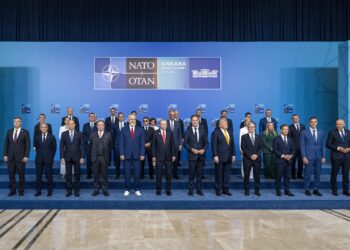
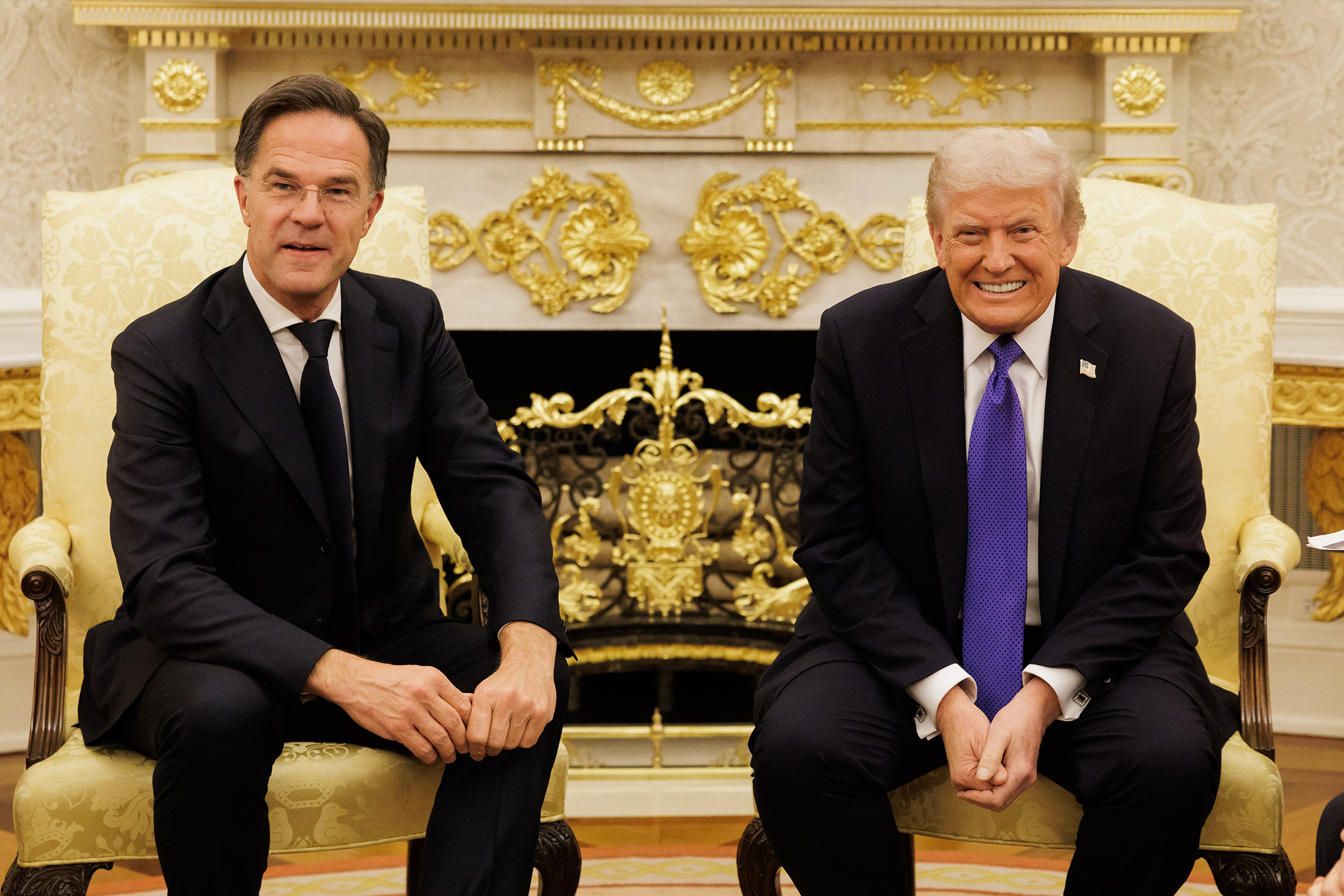
Rutte has been NATO’s fourteenth Secretary General since October 2024, and the last six months have tested him on the most treacherous ground of his mandate: holding the Alliance together while Washington, under the second Trump administration, swings between endorsement and threats. The Ankara summit of 8 July 2026 sums it up neatly. Trump praises the rise in allied military spending, yet also threatens to cut trade with one ally, floats annexing another’s territory, and publicly targets Italy, France, Germany and the United Kingdom over their supposedly weak logistical support during the operation against Iran.
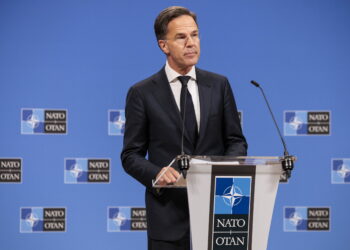
Rutte answers with what the Anglo Saxon press has dubbed ‘the diplomacy of adulation’. Trump becomes ‘dear Donald’, and the rise in allied spending becomes the ‘Trump Trillion’. It is not the first time. He had earlier likened Trump to a ‘daddy’ for his role in the crisis between Iran and Israel, a remark that earned him weeks of mockery online and which he later dismissed as ‘a matter of taste’. At the closing press conference in Ankara, the Danish journalist Rasmus Svaneborg, of Ritzau, the Danish news agency now a hundred and sixty years old, put him on the spot, asking whether sitting beside Trump while he threatened Greenland and Spain had not dented his ‘self respect’. Rutte replied that his job is ‘to acknowledge merit where merit is due’. The clip went viral and was read by many as yet more proof of servility. Criticism from within is not lacking either. Several analysts speak of a ‘law of diminishing returns’ in Rutte’s strategy, arguing that it distracts him from the increasingly urgent debate on an autonomous European defence. Some allies, according to press reports, are said to show growing impatience with a style seen as far too accommodating.
The most concrete item of the past six months is the commitment, confirmed in Ankara after the green light given in The Hague in 2025, to raise defence and security spending to 5% of GDP by 2035 (3.5% of ‘core’ spending plus 1.5% on related items). Rutte presents this as proof that ‘NATO keeps its promises’, with the total already up to 4% just a year into the ten year path. The target is welcomed by the Baltic states and Poland, long in favour of more aggressive spending given the Russian threat, while Spain considers it excessive, feeding Trump’s direct attacks on Madrid during the summit.
Even Rutte’s appointment in 2024 was not a foregone conclusion. Orbán’s Hungary threatened to veto it over Rutte’s past criticism of the Hungarian rule of law and of legislation restricting LGBT rights, going so far as to say the aim was to ‘bring Budapest to its knees’. The veto was withdrawn only after a private meeting on the sidelines of a European Council. His image as a progressive hawk on civil rights has always coexisted with an almost total pragmatism at the negotiating table.
Within the Alliance two issues remain on which Italy has direct skin in the game, and on which Rutte’s mediation is anything but settled. The first is whether the 5% target is even sustainable. Rome currently declares defence and security spending at 2.8% of GDP (2.09% strictly military plus 0.71% on a broader perimeter), well short of the 2035 mark. The economy minister, Giancarlo Giorgetti, calls it ‘a blanket too short to cover the whole bed’: every extra euro spent on weapons weighs on health and pensions, while debate continues over whether SAFE loans are cheaper than government bonds, and whether the rise is compatible with exiting the EU’s excessive deficit procedure. It is a row that splits both the governing majority and the opposition, with Giorgetti acting as a brake on Crosetto’s Atlanticist enthusiasm.
The second dossier is the ‘Southern flank’. For months Giorgia Meloni has been asking NATO to look at the wider Mediterranean, at Libya and at Africa with the same attention paid to the eastern front, arguing that today’s threats are ‘hybrid’ and do not come from the East alone. Rutte, absorbed by Moscow and by Trump, has so far not given this Italian request the same weight as the eastern flank, feeding a feeling in Rome that NATO’s agenda remains too focused on the Baltics. So the Italian chapter stays the most contentious part of Rutte’s story, and its roots go back to 2020. As Dutch prime minister and leader of the so called ‘frugal countries’ (alongside Austria, Sweden, Denmark and later Finland), Rutte led the toughest opposition to non repayable grants under the Recovery Fund, arguing that Italy should receive only loans and ‘learn to manage on its own’ at the next crisis. The remark triggered a united reaction from Italian parties and a public clash with the then prime minister, Giuseppe Conte, who shot back tersely: ‘that is exactly what we will do’. Dutch sources leaked to the press at the time described the Italian proposal as ‘unworkable’.
The memory turned even more bitter thanks to a video, widely shared on Italian social media, in which Rutte laughed while joking about the idea of ‘no money for Italians and Spaniards’, an image that fed the narrative of the Netherlands as a country scornful of southern Europe for years afterwards. The deal was struck all the same: €750bn in total, with the grant share cut from €500bn to €390bn. It was a compromise the frugal countries claimed as a victory, and one Italy pocketed as the largest aid package in its recent history, though it kept the political scar of the clash. Rome was not a one off case. Rutte applied the same rhetoric about ‘fiscal responsibility’ to Greece, Spain and Portugal too, in keeping with the line The Hague had already taken during the Greek debt crisis. A paradox often raised by observers: Dutch household debt, at roughly 107% of GDP, ranked among the highest in Europe, well above Italy’s, at around 41%, a figure that fuelled the charge of a fiscal moralism not always matched by the numbers at home.
If one episode brought Rutte and Rome’s tension back to 2020 levels in the past six months, it is the affair of the Italian bases tied to Operation Epic Fury against Iran, in June 2026. In an interview with Fox News, Rutte revealed that around 500 American aircraft had taken off from bases on Italian soil in support of the operation, citing Italy as the most significant case in Europe out of a total of between 4,000 and 5,000 allied missions. The account set off a domestic political storm. Italy’s defence ministry denied it, speaking only of ‘logistical and technical activity, with no combat role’, and Giorgia Meloni publicly corrected the NATO Secretary General, saying he had ‘mixed up different facts’ in an account that was ‘too enthusiastic’. The opposition, led by Angelo Bonelli of the Green and Left Alliance, instead used Rutte’s words as proof of wider Italian involvement than the government had admitted, calling it a ‘serious contradiction’ of the official line from Palazzo Chigi. Rutte backtracked a few days later, in an interview with L’Espresso in which he praised Meloni’s ‘decisive leadership’ and Italy’s ‘essential contribution’ to Ukraine, clarifying that his earlier remarks referred only to existing bilateral agreements on bases and airspace. It is an episode that sums up the Secretary General’s fragile position rather well. In trying to please Washington by claiming credit for Europe’s contribution, he keeps exposing allied governments on their home front.
Setting the June slip up aside, both sides still describe the Rutte Meloni relationship as ‘strategic cooperation’. The prime minister chose to play down the incident and, even after Trump’s direct criticism in Ankara over Italy’s supposedly weak support, repeated that her line is ‘the unity of the West’ rather than a personal relationship with this or that leader. ‘Relations with Trump are cordial,’ she said, ‘but I do not change my approach depending on how personal relationships happen to be going.’ It was an indirect way of putting some distance between herself and Rutte’s own style too. The past six months also showed that Rutte’s management is not always fully coordinated with the European chancelleries. At the E5 summit in Berlin on 24 June, which brought together Macron, Merz, Meloni, Tusk and Starmer to prepare a common position ahead of Ankara, the Secretary General took part only by video link from Washington, a detail read as a sign that the real decision making axis is shifting further towards the European capitals and the White House, leaving Rutte a reactive mediator rather than a director. Cracks between the European powers remain open too, from the collapse of the Franco German programme for the FCAS fighter jet to the diverging strategies of Paris and Berlin over how much autonomy to seek from Washington, terrain on which Rutte can mediate but can hardly arbitrate in his own right.
A year into his term, the portrait emerging from Brussels is of a mediator as tireless as he is exposed: able to hold an Alliance under pressure together through flattery towards Trump, yet increasingly called upon, in Ankara as much as in Rome, to answer the Danish journalist’s question: where does diplomacy end and where does servility begin.
As for me, as I already made clear a few years back, in the house where I was born and grew up, in the Dutch colony of the Spice Islands, people spoke Italian, Piedmontese, Indonesian and, of course, Dutch. The Governor’s residence stood only a short, very direct walk away. Everyone passed in front of it with respect, even long after the Dutch had been sent packing. And when the Governor speaks, I know how to listen. And I understand what he is saying. This Governor, not yet sixty, is sharp and ambitious. I rather think he regards the vast building on Avenue Léopold III in Brussels as a prestigious training ground from which to prepare a political future just a few kilometres further on, at the heart of Brussels’ European Quarter.
After all, setting aside Frans Timmermans’s time as vice president, the last Dutch president of the European Commission held office for a mere nine months: Sicco Mansholt, from 22 March 1972 to 5 January 1973. ‘There would certainly be room for reflection along those lines,’ as one senior Mediterranean diplomat puts it, ‘for a candidate with a distinguished multilateral career, representing one of the Union’s founding members.’