
Brussels – Support for Ukraine’s accession to the European Union, but only after certain reforms have been implemented. There is, however, widespread support for the United Kingdom’s return to the 12-star club, with Italians expressing the highest level of support at 77 per cent. This is according to the latest survey by Polling Europe Euroscope – a Brussels-based market research and polling organisation, a joint venture between SWG and OpinionWay – previewed exclusively by Eunews.
When asked specifically about eastward enlargement, 19 per cent of respondents said they were “in favour of Ukraine joining the EU as soon as possible”, 30 per cent were “in favour, but not just yet” as Kyiv “must implement all the necessary reforms, just like all the other candidate countries,” while 18 per cent would prefer the country to “first become an associate member (with security guarantees but without voting rights) and subsequently a full member.” Twenty-one per cent of those surveyed say they are “opposed to Ukraine joining the EU.”
The survey analyses data at a pan-European level, but with breakdowns for the five largest countries: Germany, France, Italy, Spain, and Poland. In this context, Italy and Spain have the highest percentages of support for Kyiv’s accession to the EU. Thirty-two per cent of Spaniards and 17 per cent of Italians surveyed would like to see the country attacked by Moscow join the EU “as soon as possible.” The French follow with 16 per cent, the Germans with 15 per cent, and just 8 per cent of Poles. Conversely, 35 per cent of Italians surveyed, 34 per cent of Poles, 33 per cent of Spaniards, 26 per cent of Germans, and 25 per cent of French people would only want Ukraine to join the EU once it has implemented “the necessary reforms.”
Another striking finding is that the highest proportion of those opposed to Ukraine’s accession is in neighbouring Poland, at 28 per cent. Twenty-seven per cent of Germans and 24 per cent of French respondents also oppose Ukraine’s accession, while these figures fall to 19 per cent and 6 per cent in Italy and Spain, respectively.
When it comes to support for Kyiv’s accession to the EU among European political groups, the two largest groups in the European Parliament are roughly on a par in terms of percentage support, though there is a slight edge in favour of the Socialists (S&D). Of these, 29 per cent say they are in favour of accession “as soon as possible”, and 38 per cent are in favour once the necessary reforms have been implemented. The European People’s Party (EPP) stands at 22 per cent and 37 per cent for the same two options. The liberals of Renew Europe, the third-largest force within the so-called pro-European majority, stand at 24 per cent and 35 per cent. Voters from The Left surveyed for the poll expressed support of 24 per cent for both options, while the Greens recorded 20 per cent and 34 per cent, respectively.
On the right, only the ECR’s Conservatives and Reformists show more favourable attitudes towards Kyiv: 16 per cent are in favour of its accession to the EU “as soon as possible”, and 27 per cent after the necessary reforms have been carried out. Right-wing groups, on the other hand, are opposed to Kyiv’s accession to the EU: this ranges from 57 per cent in the Europe of Sovereign Nations (ESN) to 34 per cent in Patriots for Europe (PfE) and 30 per cent in the ECR. Next come 21 per cent of The Left, 15 per cent of the Greens, and 14 per cent of the EPP (Renew Europe stands at 13 per cent and S&D at 9 per cent).
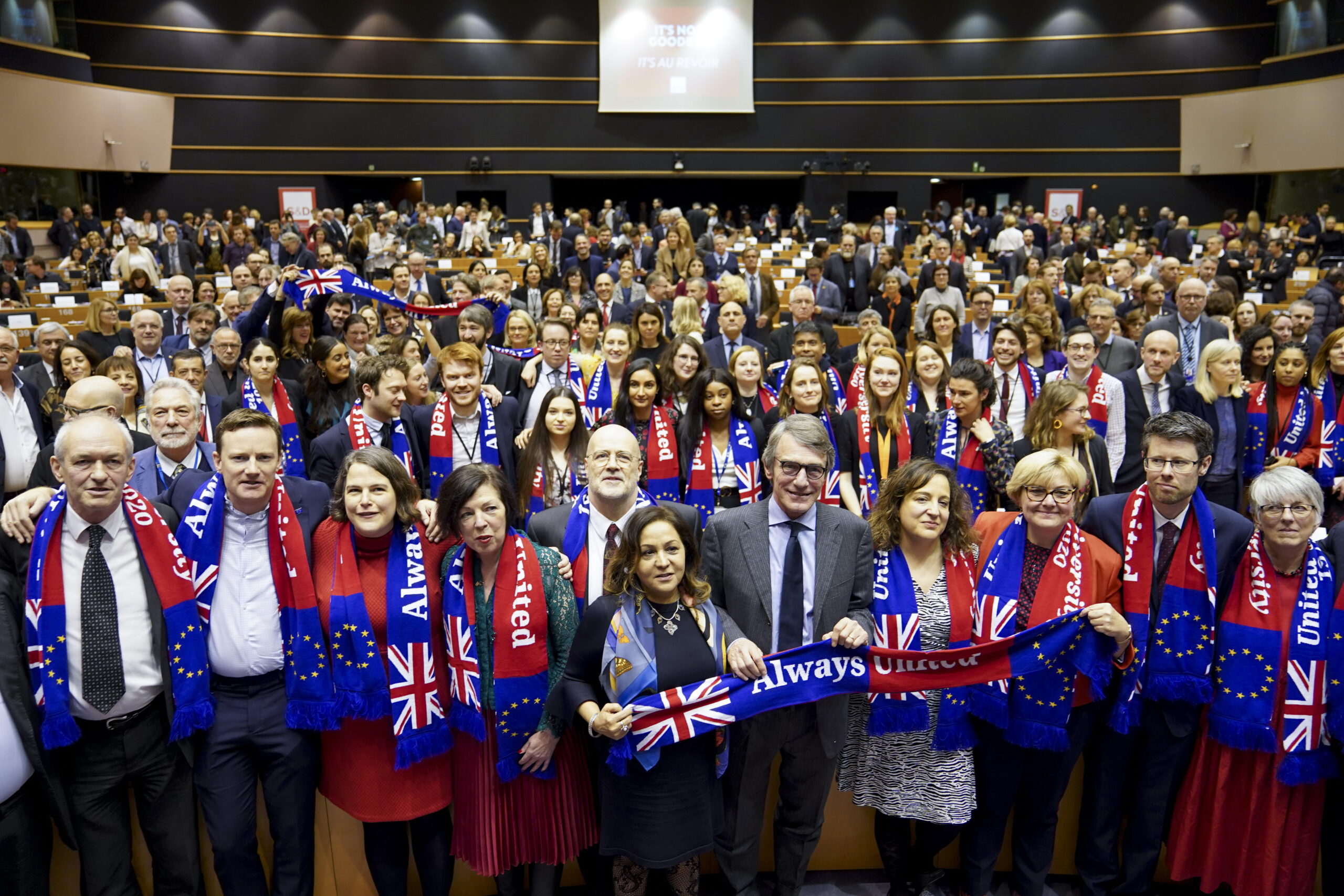
Ten years since Brexit, Europeans would be happy to welcome their cousins from across the Channel back into the EU. 67 per cent of those surveyed are in favour of London’s return, compared with 19 per cent who are against and 14 per cent who are undecided. In this regard, Italians are the ones who feel the British absence most keenly and would welcome their return: 77 per cent say they are in favour (40 per cent strongly and 37 per cent somewhat). Following the Italians are the Poles at 70 per cent (31 per cent strongly in favour and 39 per cent somewhat in favour), the Spaniards at 67 per cent (33 per cent and 34 per cent respectively), Germans at 62 per cent (28 per cent and 34 per cent respectively) and the French at 59 per cent (with 24 per cent strongly in favour and 35 per cent somewhat in favour).
At a political level, the strongest support for a possible return of the United Kingdom comes from voters in the Socialist group, at 80 per cent. They are followed by the EPP at 78 per cent and Renew Europe at 74 per cent. The Greens stand at 69 per cent, The Left and the ECR both at 67 per cent, and the Patriots at 61 per cent. Only ESN voters fall to 46 per cent. This demonstrates, however, that even the far right is not fully convinced by leaving the EU.
The survey was conducted online using the CAWI (Computer-Assisted Web Interview) method on a representative sample of the EU population aged 18 and over. A total of 5,048 complete interviews were conducted – collected between 3 and 10 July 2026 – distributed proportionally across the populations of the 27 EU countries, with a slight adjustment to enable the data to be analysed at a pan-European level, with breakdowns for the five largest countries (Germany, France, Italy, Spain and Poland) and for three different regions: Eastern Europe, Northern Europe and Southern Europe. For each country, proportional quotas were established for age and gender, based on the most recent parameters provided by Eurostat.
English version by the Translation Service of Withub