Brussels – Not just Afghanistan: in the name of repatriation, the EU is now also stepping up its relations with Syria and its government, thereby increasingly legitimising a regime that is officially outlawed. The current Syrian president, Ahmed al-Sharaa, is the leader of Hayʼat Tahrir al-Sham (HTS), the Islamist militia that overthrew the Assad regime and was designated as a terrorist organisation by the UN for the entire duration of the civil war. On 27 February, the UN Security Council removed HTS from the blacklist, and the EU brought its stance into line with this in early March. The sudden international rehabilitation of the jihadists, combined with the need to resolve the migration issue, is increasingly driving the organisation of forced returns of Syrian asylum seekers to Syria, like the Commission is doing regarding Afghans.
Kostas Papadakis, a Greek MEP (KKE/NI) and member of the European Parliament’s Committee on Foreign Affairs, points the finger at the von der Leyen team: “Why—he asks in a parliamentary question—is the Commission sending invitations to representatives of the Taliban’s obscurantist leadership and maintaining corresponding relations with Syrian jihadists, while covering up and financing their atrocities against the peoples of Afghanistan and Syria?”
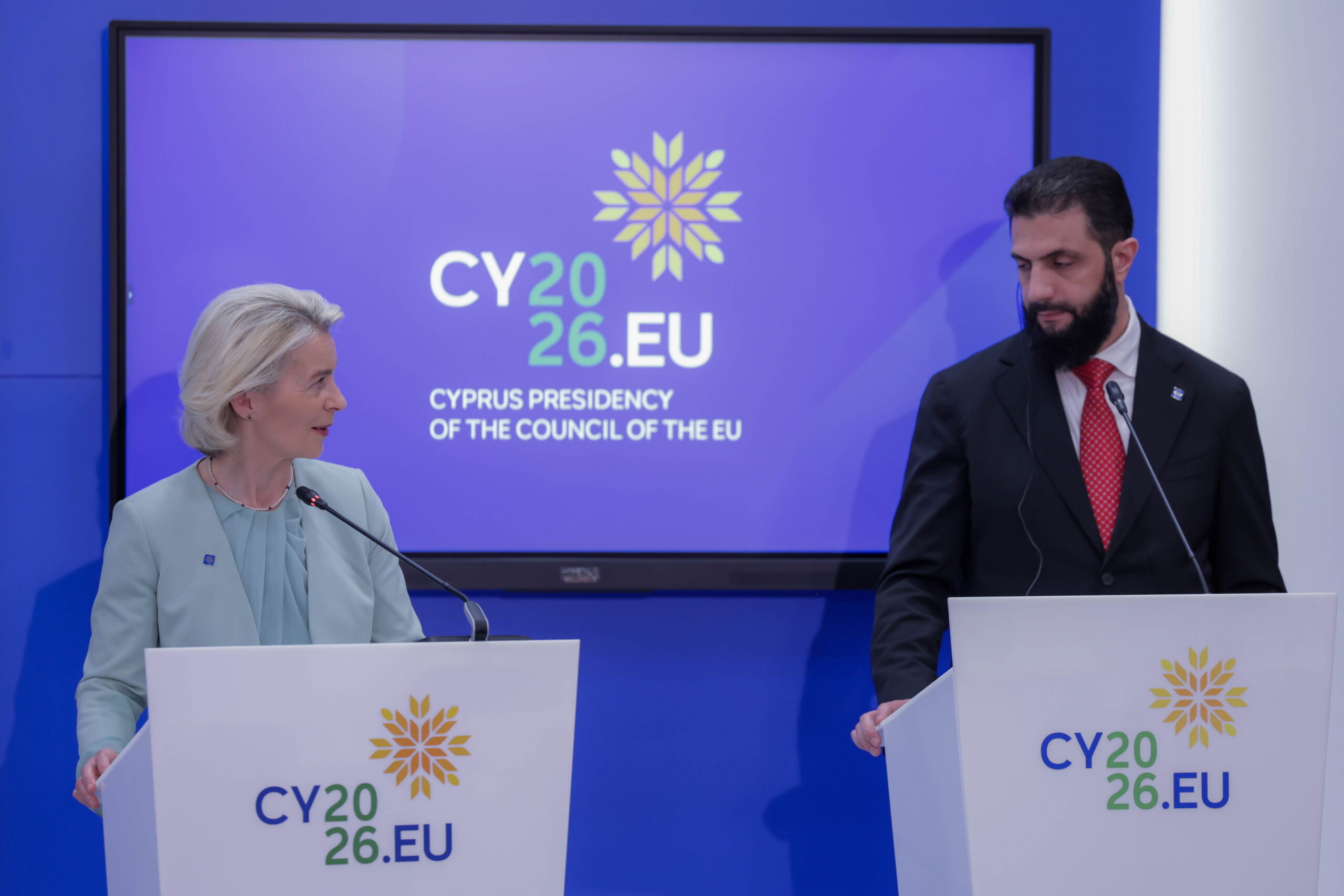
More than a question, it is an accusation and a condemnation, because whether we are talking about Afghan or Syrian citizens makes little difference: the EU meets with and legitimises the leaderships of Afghanistan and Syria to “discuss the expulsion and repatriation of migrants who are prohibited from staying in the EU.” These are accusations that the Commissioner for Home Affairs and Immigration, Magnus Brunner, does not refute. On the contrary, he points out that “the first high-level political dialogue between the EU and Syria took place in Brussels on 11 May 2026,” and that the meeting “provided an opportunity to discuss issues of strategic interest to Syria and the EU, including migration.”
The EU is therefore working with the Syrian authorities to ensure that Syrian citizens who sought asylum in Europe before the fall of the Assad government are repatriated. Efforts are being made in this regard, Brunner admits, and “cooperation with the authorities and the United Nations High Commissioner for Refugees is continuing to ensure that conditions are created that are conducive to a safe, dignified, and sustainable return to Syria.” Therefore, yes, “the EU is stepping up its cooperation with the Syrian authorities and relevant partners to develop a comprehensive approach to migration and displacement,” the Commissioner for Home Affairs confirms once again, especially as the Syrian leadership is no longer “bad”. “This means strengthening institutional capacities to address asylum and migration issues, including returns, and helping to find solutions for internally displaced populations.”
It matters little whether the Syrian president has been the leader of a terrorist organisation, has little regard for rights and democracy, and does not share quite all the same values as Europeans: just as with the Taliban in Afghanistan, the jihadists in Syria become strategic partners and friendly interlocutors when it comes to removing from the EU territory non-EU citizens viewed and regarded as a cost and a burden: this, after all, is how the Danish Presidency of the Council of the EU had described Syrian refugees.
The values so loudly trumpeted by the EU are therefore a symbol of hypocrisy, which today’s European Union no longer even attempts to conceal. Brunner can only lay the blame at the door of national governments: “The operational involvement with the de facto authorities is in line with the Conclusions of the General Affairs Council of 15 September 2021 and with the Conclusions of the Foreign Affairs Council of 20 March 2023.” In short, the Member States of Europe wanted this, and the Commission is merely carrying out its instructions.
English version by the Translation Service of Withub


![Da sinistra: il presidente del Consiglio europeo, Antonio Costa; il presidente dell'Ucraina, Volodymir Zelensky: la presidente della Commissione europea, Ursula von der Leyen [Bruxelles, 18 giugno 2024. Foto: European Council]](https://www.eunews.it/wp-content/uploads/2026/06/euco_ua260618-120x86.jpg)
![[foto: Saverio De Giglio/imagoeconomica]](https://www.eunews.it/wp-content/uploads/2026/10/cpt-120x86.png)