



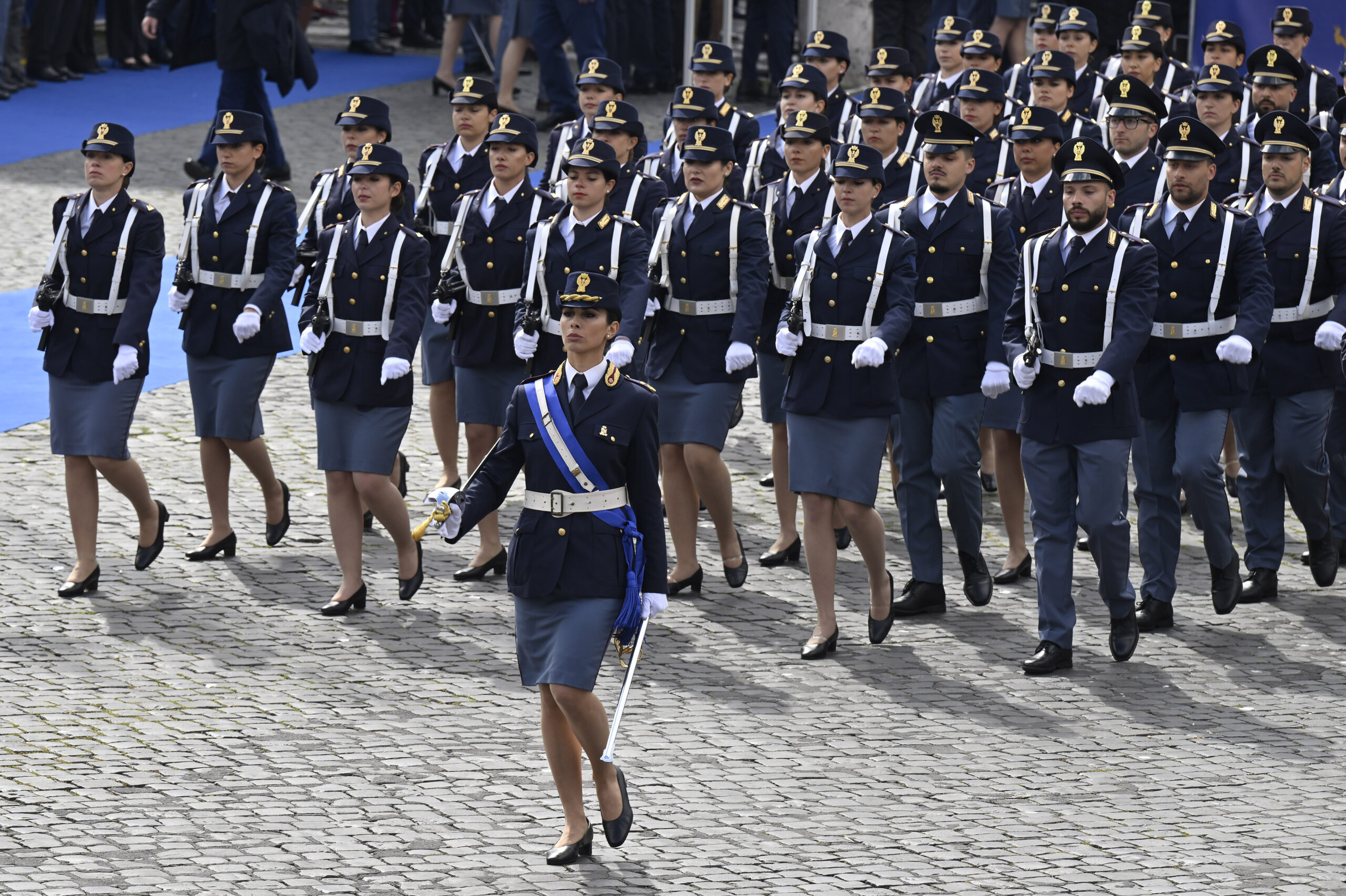

Brussels – Excluding a female candidate from a State Police recruitment competition because she has a tattoo that is visible only when she wears the women’s uniform with a skirt may constitute direct gender discrimination. That is the conclusion, of the Advocate General of the Court of Justice of the European Union, Tamara Ćapeta, on a case (C-320/25) concerning an Italian candidate (identified by the initials HG) who was excluded from a recruitment competition to become a police officer because of a small flower-shaped tattoo on her left calf.
In Italy, regulations governing entry into the police force stipulate that candidates with tattoos visible when in uniform are ineligible. In this candidate’s case, however, the tattoo was visible only when wearing the women’s uniform used for ceremonial duties, which consists of a skirt and high-heeled shoes. When wearing the operational uniform, which for women also includes trousers, the tattoo would have remained concealed.
It is precisely this difference that prompted the Lazio Regional Administrative Court to refer the matter to the Court of Justice. The Italian court asked whether national legislation is compatible with European law on equal treatment between men and women, given that a tattoo on a woman’s leg could lead to her exclusion as a candidate, whilst the same tattoo would not be visible on a male candidate’s leg, which is always covered by trousers.
In Ćapeta’s view, the combined application of the two rules – the ban on visible tattoos and the requirement for women to wear a skirt at certain ceremonies – therefore penalises female candidates precisely on the grounds of their sex. “If Ms HG were a man, she would
not have been excluded from the selection procedure on the sole ground that she has a tattoo on her lower leg,” the Advocate General noted.
The Advocate General considers that the discrimination at issue cannot be justified by the reasons offered
by the Italian Government. The government argues that the ceremonial uniform helps to convey traditional values and strengthen the identity of the police force. However, ceremonies represent only a marginal part of officers’ duties and, above all, female police officers already wear trousers as part of their operational uniform. Furthermore, senior officers may authorise a female police officer to wear trousers even during a specific ceremony.
According to Ćapeta, preserving a tradition does not require limiting access to the profession. Allowing some of the female officers to take part in ceremonies wearing trousers would not undermine either the uniformity or the recognisability of the police force. Furthermore, the harm suffered by a candidate excluded from the recruitment process would be far greater than the symbolic benefit of her occasional participation in a ceremony in the traditional uniform.
This case forms part of a wider controversy in Italy regarding having tattoos in the police force. In 2025, the Lazio Regional Administrative Court had already referred the matter to the Court of Justice, highlighting the potential conflict between the rules on tattoos and the European non-discrimination principle.
Among the cases that have fuelled the debate is that of Karen Bergami, a woman from Bologna who was not admitted to the entrance exam for the Police Academy because of a tattoo on the back of her foot, which she had gotten when she was 16 and had already removed by laser. The Lazio Regional Administrative Court had initially readmitted her to the recruitment process and subsequently upheld her appeal on the merits, but the Council of State later overturned that decision. The Court of Cassation, called upon to examine the case, recognised that restrictions on tattoos also affect constitutional freedoms and carry a risk of discriminatory effects on women, but declared the appeal inadmissible.
The ball is now in the court of the judges of the Court of Justice. The Advocate General’s opinion is not, in fact, binding: it will be up to the Court to rule on the matter and provide the interpretation of EU law that the Italian court must then apply.
English version by the Translation Service of Withub![[foto: imagoeconomica]](https://www.eunews.it/wp-content/uploads/2022/05/Imagoeconomica_1686256-scaled.jpg)




![Hussam-Abu-Safiya [foto: Amnesty International]](https://www.eunews.it/wp-content/uploads/2026/07/Hussam-Abu-Safiya-120x86.jpeg)


