
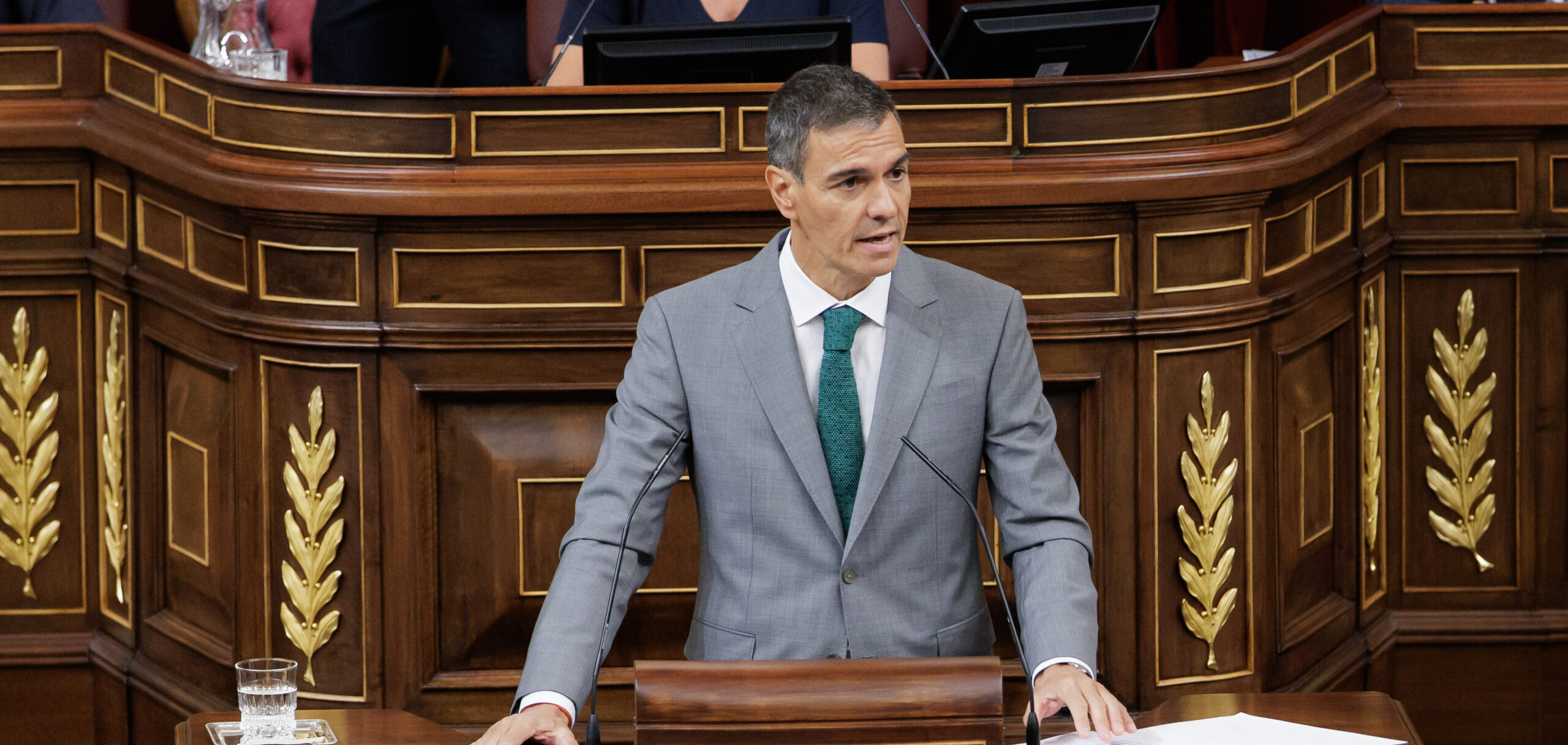
Brussels – “The European Commission did not set the example of solidarity that I believe all Spaniards were expecting at that time,” said the Spanish Prime Minister, Pedro Sánchez, during a plenary session of the Congreso de los Diputados, the Spanish Parliament, today (3 September). On the contrary, “we maintain that the European Union is founded on that value,” whether we are talking about “Lampedusa, Greenland, the Canary Islands or the autonomous city of Ceuta.” Sánchez was invited to “report on the extremely serious situation” experienced by the Spanish exclave – where, between 30 and 31 July, around 60,000 migrants from Morocco entered the country – “due to the increase in illegal entries” into the territory – as well as to explain the “measures he intends to take to ensure the integrity of Spain’s borders and those of the European Union.”
It remains unclear who is responsible for the incident, nor has it been possible to identify the individuals who used the so-called “subtle indicators of coordination in text messages” to urge people to flock to the exclave. “To date, no one – not a single person – has been able to establish whether these attacks were in fact orchestrated by social media accounts linked to Moroccan social protest movements, or to the states of Morocco, Russia, or Israel”, he pointed out. This “hypothesis has been ruled out by our intelligence services for the time being,” because “this is the information we have at our disposal at the moment.” What seems certain, however, is “that organised crime groups and traders have taken advantage of the situation, fuelling it, to sell goods and services related to assisting people at the border crossing”.
But relations with Morocco will change. “We are reviewing all the alert coordination mechanisms we share with the Moroccan state” and “we will put in place additional safeguards to ensure that the situation we experienced on 30 July does not happen again,” the Prime Minister stressed. Madrid will continue “to cooperate with Morocco” and to maintain “good neighbourly relations.” However, it is “clear” that, following the events in Ceuta, “this relationship must be different,” he said.
Despite his harsh words directed at Brussels and the EU-27 – “we have not seen the example of solidarity from Europe that we all expected” – the Spanish Prime Minister has his sights set on the European dimension. For this reason, he announced that he would ask Brussels to “recognise its status as an outermost region” for Ceuta – a special legal status reserved for certain territories that are geographically distant from the European continent but form an integral part of the EU. He argues that this entails “numerous advantages and is fundamental to its regional identity.” The aim is to ensure a “greater integration in the European Union” and to make Brussels understand “that these territories do not represent a border issue to be passively endured.” “These are not the only two land borders that Europe and Spain have in Africa, but an integral part of Europe’s past and future, which must be recognised and treated as such,” he said.
Meanwhile, from Brussels, the European Commission confirmed that it has received “requests from the Spanish authorities – not today, but previously – for both emergency funding and support from agencies” such as Frontex to ensure a presence in Ceuta, and that it is “prioritising the assessment of these requests.” However, “to complete our final assessment, there are still some important outstanding issues to which the Spanish authorities must first provide answers,” explained the EU Commission spokesperson, Markus Lammert. “Let me reiterate that, from the very outset, Commission President Ursula von der Leyen has emphasised that we are ready to strengthen, if necessary, Frontex’s presence in Ceuta and in other parts of the external borders,” spokesperson Paula Pinho noted.
Finally, regarding the future of migrants, the government is reportedly speeding up repatriation and transfer procedures “to minimise the time migrants have to spend in the autonomous city of Ceuta, whilst always complying with the law,” explicitly rejecting summary expulsions and explaining the procedure on a case-by-case basis. However, no figures have been provided on the number of migrants still present in Ceuta, nor has any distinction been made between those who will be repatriated and those who will be transferred to the mainland.


![Il ministro dei Trasporti, Matteo Salvini [Bruxelles, 5 dicembre 2024. Foto: Emanuele Bonini per Eunews]](https://www.eunews.it/wp-content/uploads/2024/12/salvini241205-120x86.jpeg)