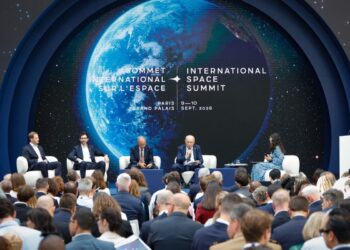
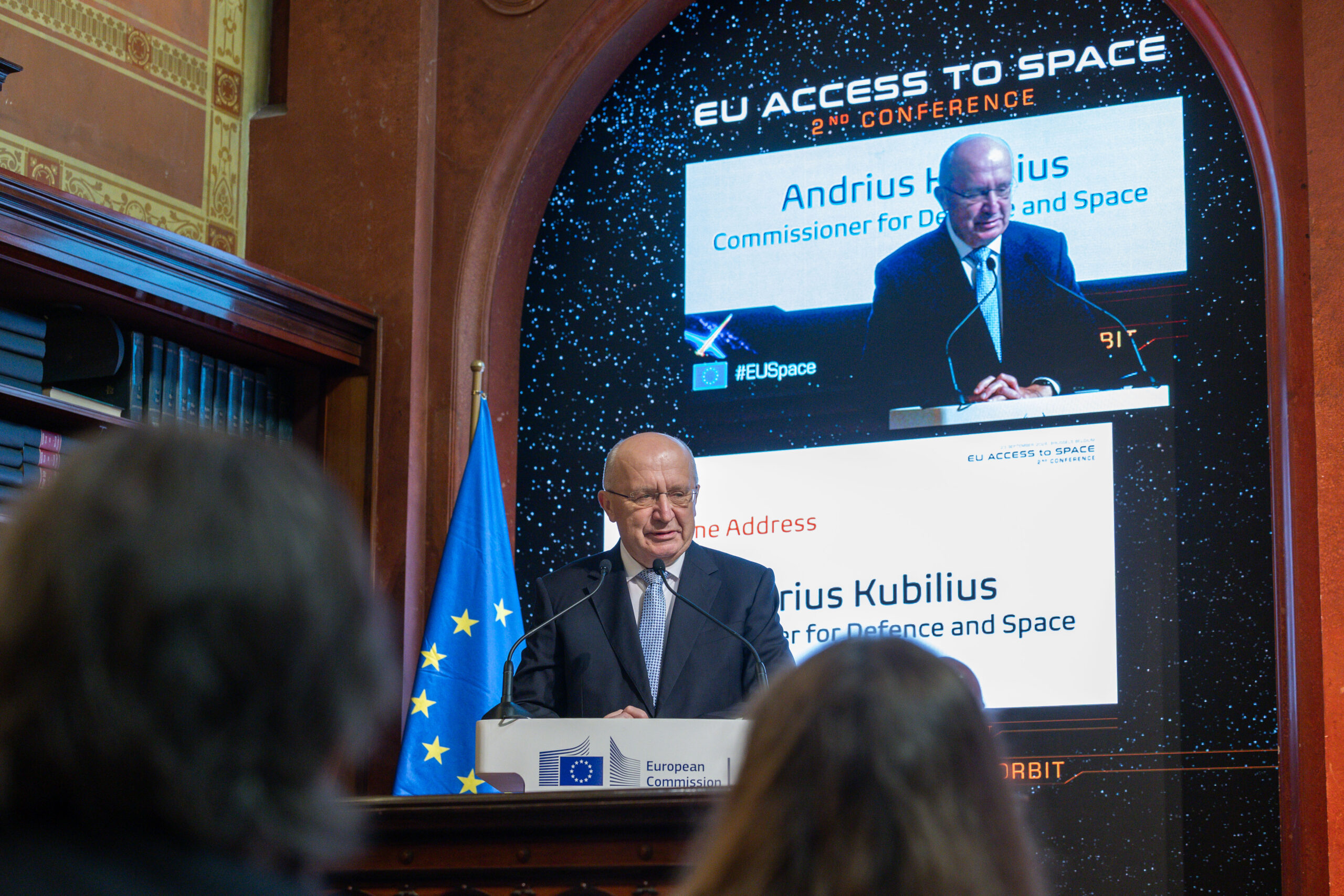

Brussels – Trying to compete with the United States, China and Russia in the space race? Yes, but without “rockets” there is no “access to space”, and without access to space “there is no future.” Above all, the EU “must not be dependent on foreign rockets,” as its “long-term future is at stake.” This was the reality check delivered by the European Commissioner for Defence, Andrius Kubilius, speaking from the podium at the second EU conference on access to space, held today (23 September) in Paris. The Lithuanian official explained that “in the next ten years, an expected 50,000 satellites will be launched into space worldwide. For defence. For the economy. For mega constellations.” He added that until 2035, “an exponential increase in European satellites – compared to the 2016 – 2024 period. National defence satellites from about 20 to nearly 300, government satellites: from nearly 70 to nearly 630. Commercial satellites: from around 1000 satellites will nearly double,” Kubilius explained. This means that “from a European side, launch demand will multiply by nearly six times.” For the EU alone “we will need 62 launches by 2034” through Galileo and Copernicus – the global satellite navigation system and the EU’s Earth observation programme, respectively, “14 launches in 2031 alone” by Ariane – a series of civil launch vehicles built and designed by the Arianespace consortium on behalf of the European Space Agency – and “8 launches in 2030 alone” by Vega rockets.
As regards the number of launches, the European Union is “currently in fourth place”, behind “the United States, China, and even Russia.” This lag persists “even from a technological point of view,, the Commissioner said. In terms of public investment in the space sector, “the European Space Agency’s report on the space economy” shows that “the United States leads the way with 60 per cent of global spending, followed by China with 15 per cent and Europe with 11 per cent.” As for private investment, “the picture is the same.” Therefore, the Commissioner acknowledged and warned: “As Europe as a whole, we are only in third place in this ranking.”
The lack of individual Member States “from this list” highlights “our main obstacle: division,” he noted. To address this shortcoming, his proposal calls for “substantial funding for space.” In particular, Kubilius “welcomed the growing national investment by Member States in the space sector” and explained that the EU is “encouraging more private investment. After the success of the Cassini seed fund for space, we will launch Cassini 2.0. And we’re promoting access to risk finance together with the European Investment Bank,” he explained. The key, therefore, lies in “greater access to investment, from debt to venture capital,” but “European money” is also needed, such as the EU’s multiannual budget for the seven years 2028–2034. “Last year we proposed a five-fold increase for defence and Space for the next multi-annual EU budget,” he noted.
The EU must bridge the gap. In this regard, Kubilius announced that he will embark on a tour of Europe to engage in “roundtables and bilaterally. To discuss the road ahead.” The aim is to “present an action plan on European access to space” by next year, while seeking to encourage a “broad public debate on how to speed up Europe’s access to space” with “all stakeholders sitting round the table,” he concluded. But the aim is twofold and also relates to European autonomy. “We must not be dependent on foreign rockets,” he said “Our long-term future is at stake: our ability to shape the space economy, to lead in the space economy. Our long-term European competitiveness. Our strategic sovereignty and independence,“ he concluded.
English version by the Translation Service of Withub