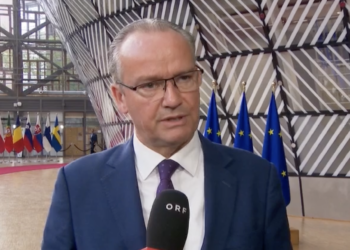
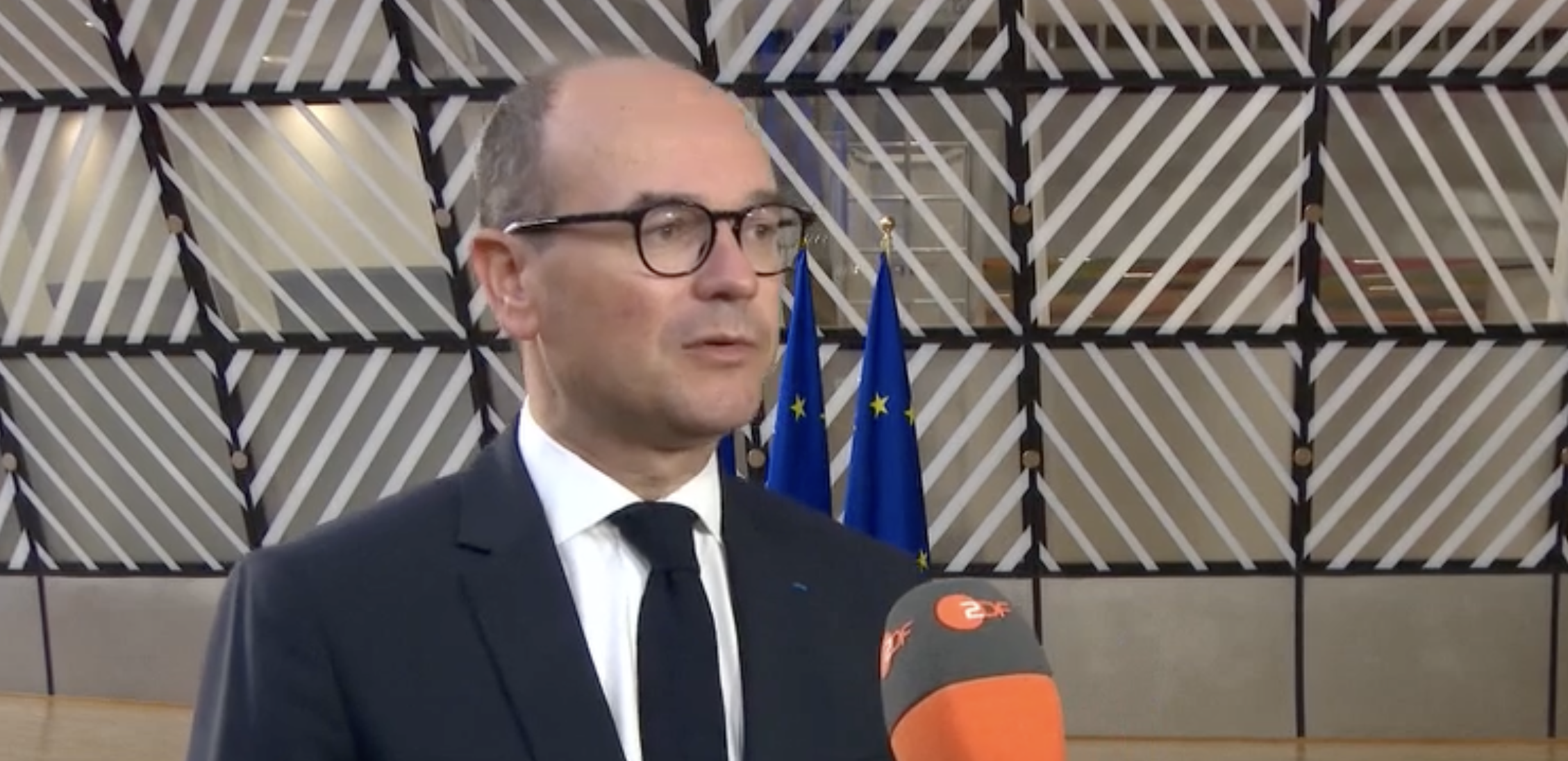

Brussels – “Channelling European public funds towards European factories” is an urgent priority that the French Minister for Industry, Sébastien Martin, intends to tackle together with the other 26 EU ministers. Arriving in Brussels today (24 September) for the Competitiveness Council, Martin reiterated that “strong competition, particularly from Asia, is having an impact on the European market” and that it was necessary to “agree as soon as possible on the Industrial Accelerator Act (IAA)” to finally give “Europe the capacity to act in industrial matters.”
According to Martin, the matter comes down to a single question: “When public funds are available, do we want to channel them towards European factories and workers” or “those outside Europe?” Martin noted that for “certain industrial sectors”, and in particular “the automotive industry”, Europe already has “an integrated value chain capable of producing cars.” On the other hand, “for other sectors, the value chain may be more open” and, consequently, “we must remain open to the world”. However, he stressed that “production must take place in Europe to qualify for public incentives.” Therefore, “European public money must go to European workers and factories.”
The IAA is a legislative proposal put forward by the European Commission to strengthen the competitiveness, resilience and decarbonisation of EU industry. It introduces the concept of ‘Made in Europe’ – that is, a European preference – which imposes strict requirements on production chains to qualify for EU public procurement contracts. The text also includes the possibility that products from around 40 third countries outside the EU may be treated as equivalent to ‘Made in Europe’ and be eligible for European public procurement contracts.
Some EU countries urge a greater openness to trade. For example, the German Minister for Economic Affairs, Katherina Reiche, said that “the regulatory framework should, in our view, follow the ‘Made with Europe’ principle – that is, manufacturing in Europe, but in partnership with our trading partners such as Norway, Switzerland, and Canada.” Similarly, the Spanish Minister for Industry, Jordi Hereu I Boher, has pointed out that his country promotes “open strategic autonomy, in cooperation and collaboration with other regions of the world and other countries.” Spain approaches this issue by defining “three basic geographical areas”: the “core”, that is, the EU-27; the “European Economic Area” and “other reliable countries with which we have reciprocity from both a legal and practical standpoint,” and, finally, “the rest of the world”. That is, “third countries with which we have trade agreements and other treaties which, depending on the sector, we can make full use of in defining our strategy,” Boher clarified.
The Italian Minister for Industry and Made in Italy, Adolfo Urso, stands halfway between a “protectionist” stance and a more ‘open-market’ approach. At a press briefing on the sidelines of the Council meeting, the minister stated that “this ‘Made in Europe’ must be effective and balanced.” This means that, on the one hand, it must “ensure the competitiveness of our industrial sectors,” and on the other, “integrate those strategic partners with whom we share values and industrial supply chains, to ensure the production lines and supply chains that are fundamental to the growth, resilience and security of our continent.” Among the strategic partners, Urso mentioned “Great Britain, Norway, Canada, and Japan.” More specifically, regarding the Industrial Accelerator Act and the ‘Made in Europe’ principle, “we believe we must build on the industrial base of the 27 member states, with an inclusive and balanced vision, both to safeguard industrial supply chains and thus security of supply, and to include the continent’s strategic partners in our industrial policy strategy”, he said. “We must not be unrealistic,” he added, “we must be pragmatic and responsible” because “now is the time to build our continent’s strategic autonomy” and “we have no time to lose,” the minister concluded.
English version by the Translation Service of Withub