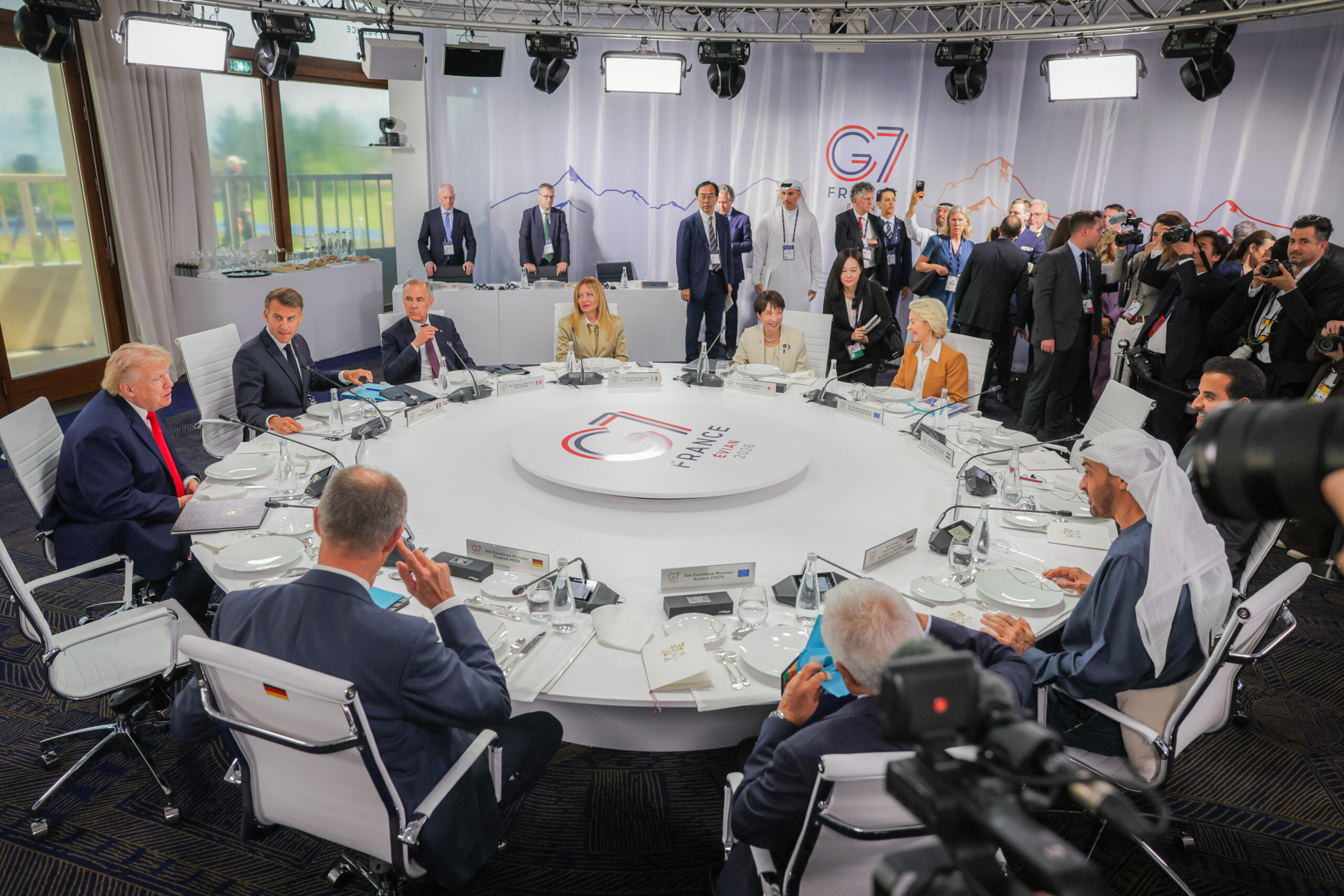
Brussels – The release of 100 million barrels of oil over four months, a commitment “not to impose restrictions on the export of energy and energy products” between countries, and “a call on all producers to refrain from imposing bans that could exacerbate tensions in the markets.” These are the decisions taken by the G7 leaders during the extraordinary video conference organised to address “the increasingly critical challenges to our energy security.” In the end, the US secured what it had long been demanding of its European allies – the release of oil reserves – while the Europeans tried to come to terms with this concession, avoiding the worst-case scenario: a complete ban on US diesel exports, which Trump had raised fears of in recent days. At the conclusion, the heads of state and government of France, Italy, Germany, the United Kingdom, Canada, the US, and Japan have issued a joint statement stated that they had adopted “decisive and coordinated measures” because “the volatility of the oil markets” is “unprecedented” and “the surge in prices threatens the economic stability and well-being of our citizens.”
Specifically, the leaders agreed to coordinate “maintenance plans at G7 refineries to avoid simultaneous disruptions to production capacity” and to “temporarily increase utilisation rates where possible.” Furthermore, “we encourage dialogue with countries possessing significant refining capacity to increase global production of refined products, in particular diesel, in light of current market pressures in this sector.” The leaders also call upon the International Energy Agency (IEA), asking it “to monitor the immediate and full implementation of the commitments made in March 2026,” when the first decision to release oil stocks was taken. For this reason, “taking into account the commitments already fulfilled, we will implement our commitments through the coordinated release, via the IEA, of 100 million barrels (MB) over a period of four months, starting immediately.” This measure “will include a substantial and early release of diesel – by G7 members and partners – within the first 20 days.” But that is not all. The situation is so volatile and worrying that the leaders say they are prepared to take further measures: “In the coming days, we will meet within the IEA to discuss, if necessary, the possibility of further releases of diesel.”
There will be no ban on exports, however. “We reaffirm our commitment to refrain from imposing restrictions on the export of energy and energy products amongst G7 countries, and we urge all producers to avoid bans that could exacerbate market tensions.” And “we call on the IEA to monitor the impact of such measures on energy security and market stability, as well as the implementation of the commitments made.
A follow-up report should be delivered before 20 days, include actionable recommendations to enhance future responses, including stocks replenishment,” the leaders write. Finally, the statement condemns “Iran’s ongoing attacks against neighbouring countries in the region and its actions disrupting international trade, energy security, and the global economy”; calls for “the full and immediate restoration of navigation rights and principles in the Strait of Hormuz” and expresses appreciation for “the commitment of the United States to ensuring the free flow of trade through the Strait of Hormuz.”
Today’s meeting was convened by President Emmanuel Macron, as France is set to hold the rotating presidency of the G7 in 2026. “We have agreed to work in a coordinated manner to help reduce the prices of petroleum products, particularly diesel,” he told the press. “I hope that all this will accompany and trigger a fall in prices on world markets,” he added, emphasising that “markets have already started to fall since the announcement of this meeting, and this should normally lead to a drop in the prices of both crude oil and diesel.”
The French President was keen to make it clear that the decisions taken were not the result of pressure from President Trump on European allies to release their strategic diesel reserves. “The tone of our discussions was not one of threats, but a constructive one. We have all committed together to releasing these strategic reserves,” Macron continued. Furthermore, “we have all committed to ensuring there is no export ban. In particular, President Trump was very clear on this point, and I think that is very positive,” he emphasised. That may be so, but from across the Atlantic it is Trump himself who is commenting with satisfaction: “Europe has just decided to release a huge quantity
of their heavily stocked diesel oil. The process will begin immediately.”
At the extraordinary summit, the Prime Minister Giorgia Meloni “shared” with the other leaders “the government’s measures to limit the impact of price rises on households and businesses: the cap on fuel prices agreed with the major oil companies, measures regarding excise duties, and the proposals put forward by Italy to the European Commission.” Furthermore, “she advocated coordinated action on stocks, focusing on diesel, and reiterated the proposal for a structured dialogue between the G7 and the Gulf states.” Meanwhile, the measures announced have been welcomed “favourably” by the President of the European Council, António Costa, who emphasised that the issue will be on the agenda at the European Council meeting on 15 and 16 October. “This crisis also underscores the importance of reducing our dependence on fossil fuels and accelerating the transition to homegrown energy sources,” concluded the President of the European Council. Praise also came from the President of the European Commission, Ursula von der Leyen. “Our citizens need and deserve affordable energy,” and “we support a coordinated release of fuel stocks by the IEA, while
staying the course on the clean transition, to gain more energy security,” she wrote.
At the same time, the energy crisis was also being discussed in Brussels: ambassadors from the European Member States met to discuss the situation because, according to some sources, the diesel market is “currently characterised by significant tension, which is leading to high prices for consumers worldwide.” The European Commission also took part in the meeting, with officials from the Directorate-General for Energy providing an update on the current situation and on the coordination taking place at EU level, including within the G7. Sources indicate that the Irish Presidency of the Council of the EU will continue to work with EU Member States on the global energy situation.
English version by the Translation Service of Withub