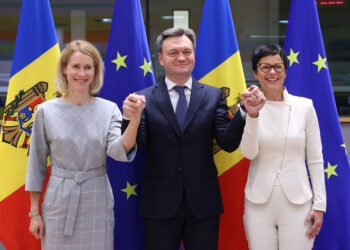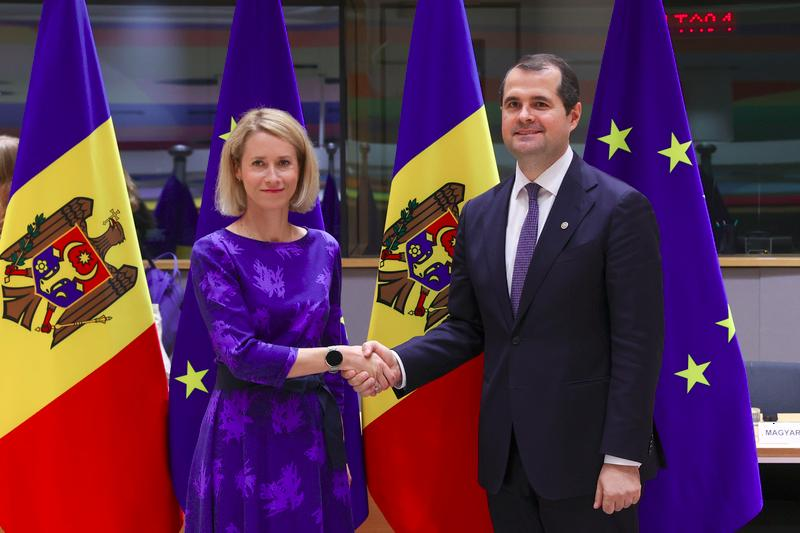
Brussels – Moldova in the EU, complete with reunification with Transnistria. In Brussels and Chișinău, people are discussing the future with conviction – and perhaps a touch of levity. Because there is a territory claimed by Russia, a factor that was not taken into account at all at the end of the 10th meeting of the EU-Moldova Association Council. The press conference turns into a display of good intentions: the European Commission congratulates its eastern partner on the progress made on the path to accession, while the Moldovan Prime Minister, Vasile Tofan, even sets out his timetable for accession: “We are working to open the other negotiation chapters by the end of the year, and to close them all by 2028. It is an ambitious path, we know, but we are not afraid.”
It is in this context that Kaja Kallas comes into the picture. The EU High Representative for Foreign Affairs and Security Policy states that “Transnistria will not be an obstacle to Moldova’s accession path.” For the record, Kallas initially stumbles and says it will be, then corrects herself, adds the missing negative, and reiterates it. Although she acknowledges that there is an issue on the horizon, as “Transnistria remains fragile, with an unsustainable economic model,” and therefore economic restructuring will need to be funded.
This is the crux of the matter. Moldova is being compared to Germany. The current German federation is the result of the reunification of the two Germanys: the Euro-Atlantic West and the pro-Soviet East. The reconstruction of East Germany, almost forty years after reunification, has also given rise to frustrations that have led to the rejection of traditional parties in favour of extremist ones, demonstrating that reunifying a country is no small matter, but is, on the contrary, a long and costly process in economic, political and social terms.
In the case of Moldova, however, there is no prospect of reunification with Transnistria, a ‘de facto’ independent republic but under Russian control. An area that has now become a hotspot because Moscow has an outpost there between Ukraine and Moldova. Yet in Brussels and Chișinău, the assumption is that the territory is already Moldovan, simply awaiting reconversion.
English version by the Translation Service of Withub