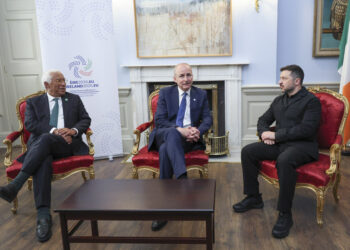
Brussels – The European Union’s multiannual budget is not merely an accounting exercise, but the instrument through which Brussels funds its priorities and translates them into concrete actions on the ground. This is the message put forward by the President of the European Committee of the Regions, Kata Tüttő, and the mayors of 20 European capital cities plus The Hague in an open letter – which Eunews has seen – addressed to the Irish Prime Minister Micheál Martin and the President of the European Council António Costa, ahead of the negotiations on the Multiannual Financial Framework (MFF) 2028–2034.
The letter is signed by the mayors of Athens, Bratislava, Brussels, Bucharest, Budapest, Dublin, Lisbon, Luxembourg, Madrid, Nicosia, Paris, Riga, Rome, Sofia, Tallinn, The Hague, Valletta, Vienna, Vilnius, Warsaw and Zagreb. These are cities from 21 EU Member States.
Local leaders warn that any cuts to EU funding would directly undermine the EU’s ability to tackle the continent’s major challenges. Administrators are concerned about the stance taken by six Member States, which have proposed to reduce the total amount proposed by the European Commission – amounting to €2,000 billion – by several hundred billion.
A cut which, according to the signatories, would risk further widening the gap between the Union’s ambitions and the resources needed to achieve them. This also refers to Draghi’s report on competitiveness, which states that the EU would need an additional €750–800 billion in investment each year by 2030 to meet the targets already set for the green transition, security, and digitalisation.
This is why the capitals are calling for “maximum transparency” regarding the regional impact of any potential budget cuts. This request comes, in particular, in the run-up to the negotiations on the next MFF, which will set out the allocation of European resources for the period 2028–2034 and thus determine the funding capacity for numerous common policies.
Central to the letter is also the defence of cohesion policy, which the signatories argue “cannot be regarded as a mere mechanism for redistribution” between Member States and regions. On the contrary, the mayors argue, investment in cohesion helps to strengthen the Single Market and the competitiveness of the EU as a whole, by supporting growth and the investment capacity of local areas.
The signatories also call for cities and regions to retain a direct role in the governance of European programmes. The simplification of procedures, the letter states, should not result in the centralisation of decision-making or a reduction in investment allocated to local areas.
The fear among national capitals is that the drive for greater administrative efficiency will ultimately weaken the very local level, which is called upon to manage some of the key challenges facing Europe today. From the housing crisis to infrastructure and demographic changes, mayors are therefore calling for a role in defining and implementing the priorities of the next European budget.
English version by the Translation Service of Withub