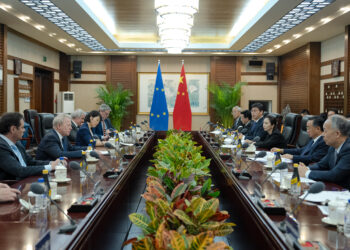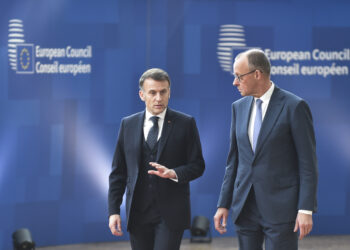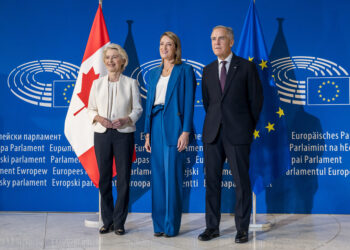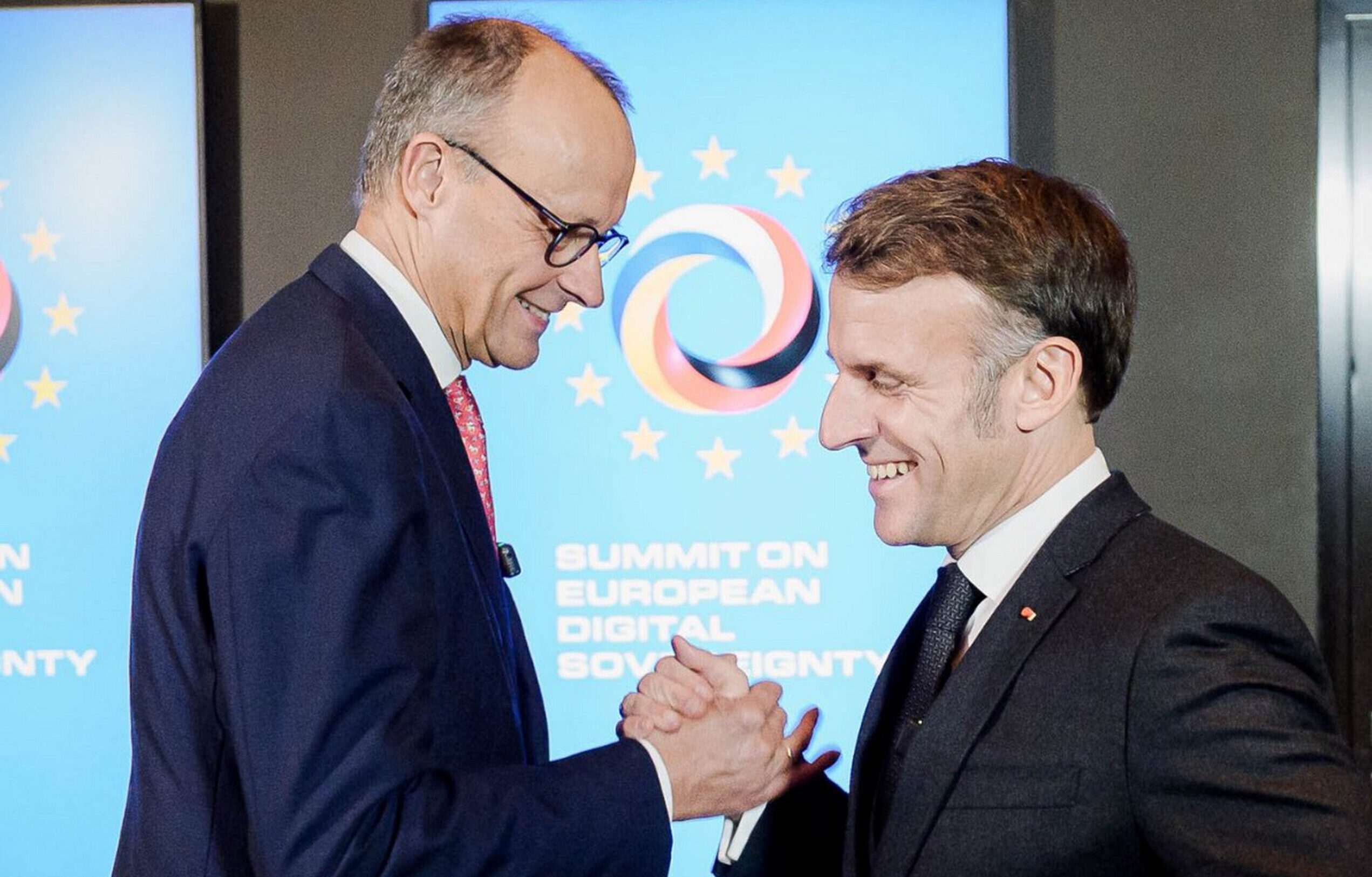
Up on the thirteenth floor of the Berlaymont, I imagine, nobody was surprised and nobody cheered. The President’s cabinet read a letter whose broad lines it already knew, and at once made a shield of it. Šefčovič’s people uncorked something, but quietly: the Commissioner, on his mission to Beijing, will thus have one more instrument, and a new one. The lawyers of the Legal Service opened the Treaty at Article 207 and stopped smiling. The free trade commissioners asked, under their breath, against whom. The official line is Olof Gill’s, the Commission’s deputy chief spokesman and a career official, a son of Clare Island in Clew Bay, a test for sailing yachtsmen and a source of vistas straight out of illustrations of tumultuous eighteenth century storms at sea: ‘with great favour’, he said. The rest is said in the corridors and, in the corridors, not everything is favourable.
Two letterheads side by side. On the left ‘Le Président de la République’, on the right ‘Bundesrepublik Deutschland, Der Bundeskanzler’. Below, the date: ‘Berlin, Paris, October 2026’. The day is missing. In Brussels everyone knows that the days left unwritten weigh more than those written.
The letter is in English. Neither French nor German: the language of neither of the two, the only one in which neither has to yield to the other. It opens with ‘Dear Madam President’ and closes with ‘the assurances of our highest consideration’, a calque of the French assurance de ma haute considération, but also of the very formal Hochachtungsvoll of German correspondence at the highest level. Above the signatures there are two handwritten greetings. Macron’s is a line in French that loses itself in the stroke of a ‘Bien cordialement’. Merz’s reads ‘Sehr herzlich!’, with an exclamation mark, which in a German chancellor is decidedly an effusion.
It left on Monday 5 October with a French and German non-paper attached. WirtschaftsWoche saw it first, and Giulia Torbidoni reported it on EUnews. The European Council discusses it on 15 and 16 October. One can read it for what it declares, or for what it keeps quiet about. The second reading is the more useful and the more uncomfortable.
What the letter says. A polite ultimatum in four movements. The diagnosis: the open trading system is ‘massively affected’ by the weaponization of trade, by systematic distortions, by global imbalances. The courtesy: the two ‘welcome’ the Commission’s work and its commitment to use every instrument, from anti-dumping duties to the anti-coercion ‘bazooka’ of 2023, never once wielded in three years. The hinge: ‘But this does not suffice any more’. Then the requests, ‘in a lean and non-bureaucratic way’: a diversification instrument against dependencies and, above all, a second instrument, in the hands of the Commission, triggered by reverse qualified majority, able to go as far as ‘an immediate cut-off from the internal market’. Reverse qualified majority is precisely that, an ‘inverted’ voting mechanism in which a proposal from the European Commission is deemed automatically approved by the Council of the EU unless the Council itself votes by qualified majority to reject it. According to the letter, the instrument has to be country-agnostic. It ends with a list of grievances and defects to be put right as soon as possible: non-tariff barriers, non-compliant goods, undervalued exchange rates, an industrial base to be strengthened.
There follow a number of ‘implicits’, the unsaid and the unwritten, which it pays not only to list but to weigh with care in order to appreciate the overall scenario.
The addressee is not only her, UvdL. The text speaks to Beijing, three days before Šefčovič’s trip; to Washington, because weaponization and agnostic apply to American tariffs too; to the other 25 capitals, to whom Paris and Berlin make it known that they are the ones setting the terms of the game. The Commission replied within hours, in words that smell of choreography agreed in advance. The letter carries two signatures, but the operation is decidedly a three hander.
The doctrine of the second strike. Zweitschlagswaffe appears in the headlines, reports and commentary of the German press, while an official in Berlin speaks of a weapon ‘of the second blow’. It is nuclear vocabulary. The Union, a normative power by vocation, declares that trade is now a field of deterrence. A slow weapon does not deter, and the anti-coercion instrument requires months of investigation and a vote of the Council: that is why nobody has ever used it, and nobody has ever feared it.
Power changes address. Under the French and German scheme the Commission proposes and the measures pass, unless a qualified majority stops them. The burden of proof is turned upside down. France and Germany together weigh a third of the Union’s population: as long as they do not vote against, the 65 per cent threshold needed to block is almost out of reach. The instrument is born already guaranteed by the two who want it. The paradox is that they should delegate to Brussels, they of all people, the historic defenders of the primacy of governments: it dissolves once one looks at who presides over the Commission, a German woman from Merz’s party. There is also a hidden advantage, anonymity. After the duties on electric cars Beijing struck at brandy, pork and dairy, that is, at the supply chains of individual countries. Under the reverse procedure no government has to show its face behind a yes.
Berlin has changed religion. In October 2024 Germany voted against the duties on Chinese cars. Today the Chancellor signs up to their exclusion from the market. Despair, rather than conversion: the AfD took 43.8 per cent in Saxony-Anhalt on 6 September and two weeks later, on the 20th, the CDU fell below the minimum threshold in Mecklenburg: Christian Democrats out of a regional parliament for the first time; a poll (by Insa Consulere, Germany’s answer to Italy’s Pagnoncelli) puts at 14 per cent the Germans who still want him as Chancellor. Trade protection as a bulwark against populism, in a country that for half a century made ‘freedom to export’ its own doctrine.
A weapon does not choose who wields it. The French presidential elections are on 18 April and 2 May 2027. Bardella stands between 32 and 36 per cent in the first round and would beat even Philippe by a nose. A mechanism able to sever a market of 450 million consumers is the weapon a nationalist dreams of. It is being designed today with Beijing in mind. In five years’ time someone will read it with Brussels in mind.
The barter. In December Merz and von der Leyen tried to force through Mercosur and the frozen Russian assets together; Meloni stopped them. In January Mercosur went through anyway, despite Paris. The letter is the landing point: Berlin opens the great doors elsewhere, Paris puts the dogs at the service entrance. ‘Diversification’ beside ‘level playing field’ is the clause of the exchange.
Explicit turn or tacit? Tacit in substance, explicit in one line: the one on reverse majority, which touches the principle of who decides when the Union hurts. The rest is a shift in attitude, already under way: from the Brussels effect to a power that arms itself. Among the states the turn is a directorate of two, two governments that agree the text and hand it to the Council as a starting point. The Paris and Berlin engine restarts when both pilots are at the end of the run, with an instrument that outlives them. The obstacles remain: the ordinary procedure with the European Parliament, the WTO’s security exceptions, the oversight of the Court. It will not see the Official Journal before 2027 is well under way.
For the states that sign up the advantages are concrete. Here they are. 1) Deterrence in itself: Šefčovič is a different negotiator with that card in his pocket. 2) Scale: 27 parallel policies amount to surrender, a single one holds the market together. 3) Cover against retaliation. A voice with Washington. And diversification, which opens the way to joint purchasing and strategic stocks.
The costs fall entirely on consumers, on industries that depend on Chinese magnets and components, on those who export to Beijing, and on cohesion between those who host Chinese investment and those who fear American tariffs.
But is this a double self candidacy? A methodological note. Macron will not be pensioned off by any election: he leaves because of a constitutional limit, on 14 May 2027. Merz does not face the voters until 2029, but he has already lost the regional ones and is in the middle of a Kanzlerkrise. They arrive at the exit by different roads.
For Macron the calendar is an invitation. Costa’s term at the European Council ends on 31 May 2027, seventeen days after his own. In April in Nicosia he said that after the Élysée he will not do politics: ‘I did not do it before, I shall not do it afterwards’. Those who follow him know that the denial of an ambition is often its prelude. For Merz the hypothesis is fragile: in 2029 he would be 73, Germany has already had two Commission presidents in 68 years, and a Kanzlertausch, a changeover, is now in the air. A fall produces retirements, not candidacies.
The more credible reading is another: to put one’s name on the process of renewal, on the architecture, before leaving the stage. If the weapon works, the paternity is theirs; if not, the failure will belong to whoever uses it. For Macron it is a testament with the signatures already affixed. For Merz it is an insurance policy: to reach the internal reckoning with a first joint success and not merely with the photograph of a Europe that at home no longer votes for him. 2027 is the year of appointments: January the Parliament, May the European Council, then the ECB. Whoever holds the text on trade also holds a significant part of the bank in the game of jobs.
The debate, and Rome. Four fractures and a fifth. Free traders against protectionists, with the Netherlands, the Nordics and Ireland lukewarm. Big against small: nobody pronounces the word directorate willingly. Commission against Council, over the balance of the Treaties. Business against business, cars and chemicals on one side, steel and solar on the other. The fifth is China against Washington, and the letter hides it behind the adjective agnostic. It will not hold: at the first concrete discussion someone will ask: ‘against whom?’.
Italy has not signed, but the qualified majority of 2027 runs through it. It will accept the principle and fight over the details, because a government that has made its relationship with Washington its European card does not want a weapon that could be pointed there too. Putin at Valdai, on its splendid, literary lake and some ten five star hotels, said he considers Italy a Eurasian partner. Wedges are driven in like that, one at a time.
Is it enough for Russia and Ukraine? No. The letter does not name Moscow, or defence, or munitions. On the ground the American negotiations are stalled, Washington has Iran and Hormuz on its hands, Putin calls Trump’s proposals ‘difficult’ and demands the neutrality of Kyiv while the raids continue. Merz went to Kyiv on 4 October with the Economy Minister, not with the Defence Minister: a signal about reconstruction and industry. The Ukrainians know that the Bundesrepublik has already had some experience of restarts and reconstructions: Poland, the Czech Republic, Slovakia.
The link with Moscow, then, exists, but is indirect. Russia depends on China more than it admits; Putin was in Beijing in May and invited Xi for 2027. A trade instrument by qualified majority gets round, by a side road, the veto of Budapest or Bratislava on sanctions, as has already happened with the duties on Russian fertilisers. One day it could strike the Chinese firms that supply the war. Vetoes are overcome by changing the legal basis, not by persuading the vetoers themselves.
An economic weapon, however, does not stop a war of attrition within twelve months, the Chinese response is predictable (the rare earths of 2025 are instructive) and Putin watches Europe more shrewdly than Europe reads itself. The ballot boxes are enough for him: the Rassemblement national ahead in France, a Chancellor who no longer truly governs. What is needed is common money, arms on an industrial scale, a deterrent that does not depend on the mood in Washington. The letter’s closing line, ‘industrial policy, simplification as well as public and private investment’, is the Draghi report in one line. The verb is missing: to finance. No common debt. The German red line on eurobonds still holds.
Economics, finance, money. The ECB raised rates on 10 September, taking the deposit rate to 2.50 per cent, the second rise after the one of 11 June. August inflation at 3.3, energy at 14.3, growth below one, swaps price a third rise by the end of the year; the decision comes on 29 October. Within this picture an irony: June’s Economic Bulletin noted that the fall in Chinese export prices, minus 3.3 per cent, had acted as a cushion for inflation in industrial goods. Disinflation imported from China has been a silent subsidy to European consumers. Closing that market switches off the last shock absorber while everything else burns. One may decide the price is worth paying, but it must be said.
Then the exchange rate. The letter denounces the undervaluation of others’ real exchange rates: for the first time, as far as I recall, two heads of government of the euro area put this in writing in a document addressed to the Commission and not to the ECB. Article 219 of the Treaty allows the Council to set orientations on the exchange rate, without prejudice to price stability; it has never happened. Frankfurt will not like it, and will like the contradiction even less: asking others to revalue while one’s own central bank raises rates and strengthens the euro.
Lagarde’s term ends in October 2027 and she does not rule out leaving ‘a few months’ earlier; her memoir comes out at the end of January and the World Economic Forum is courting her. The team is emptying out: Boris Vujčić, the well known Croatian economist and banker who holds the office of Vice President of the European Central Bank, a role assumed on 1 June in succession to Luis de Guindos. Schnabel goes to the International Monetary Fund and frees her seat from January; Philip Lane, chief economist and member of the Executive Board of the European Central Bank, leaves in 2027. For the presidency the names in circulation are Pablo Hernández de Cos, director general of the Bank for International Settlements (BIS) and former governor of the Bank of Spain, Klaas Knot, former governor of the Dutch central bank and previously a member of the ECB Governing Council; by contrast Joachim Nagel, President of the Bundesbank (the German central bank) and member of the ECB Governing Council, seems to be slipping, with Berlin using its weight to reach an agreement.
In February the Financial Times wrote that her early exit would allow Macron and Merz to choose the successor. Letter and ECB have the same players, the same table, almost the same calendar. If Bardella wins in May and Frankfurt changes president, the test bench is the transmission protection instrument, created in 2022 for unjustified spreads. Nobody wants to run it with a central bank in transition.
The missing chapter is money. No capital markets union, no digital euro, no international role for the currency. A power that arms itself needs a currency that withstands pressure. On trade one decides in months, on money in decades. The letter handles the first file and forgets the second, the one on which their credibility will be measured.
But back to the beginning: two letterheads side by side, at the foot two signatures. A letter written by two men whose clock is about to stop, addressed to a woman whose clock runs to 2029, and meant for those who will come after. On paper it is the request for a weapon. Beneath the paper it is a handover. Merz’s blue ink belongs to a Chancellor who stays today out of obstinacy. Macron’s black ink to a president who will no longer be there in May. What will remain, if Brussels so wishes, are the most explicit lines, witnesses to an indication of change and to a propulsive idea waiting to be tested.
* Network resources were used to validate sequences of dates, to certify figures against public and corporate sources, to check acts and people or companies, and to ensure the formal correctness and format of the text. The starting point is a series of personal notes and a narrative originally drafted by, and exclusively by, the author.