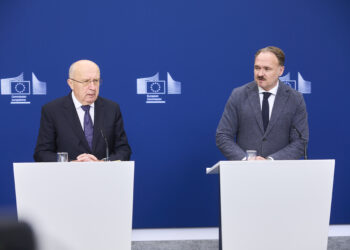
Brussels – Greater diversification of gas suppliers to tackle what is set to be a difficult winter and fewer European constraints on energy targets after 2030. This is the line taken by the Minister for the Environment and Energy Security, Gilberto Pichetto Fratin, at the EU Energy Council, who attended a meeting today (29 October) in Luxembourg.
The issue of security of supply is closely linked to that of prices and the difficulties households face in meeting their energy bills. This morning, the European Commissioner for Energy, Dan Jørgensen, warned that over 50 million Europeans are unable to heat their homes adequately. Against this backdrop lie the crisis in the Middle East and the risks associated with Russia’s war against Ukraine. According to Pichetto, “the current geopolitical tensions have highlighted the need for a more comprehensive approach, particularly with regard to the gas market, aimed at a broad diversification of LNG routes.”
According to the minister, the solution lies in greater European coordination and greater flexibility in supply. Rome is calling for a joint response, including through long-term contracts with other energy exporters and the relaxation of certain restrictions under EU legislation.
For Italy, there are three key elements. The first is that “diversification remains the main security tool,” the minister emphasised, pointing out that “Italy has diversified its gas supply portfolio substantially.” Secondly, the fact that “market transparency and coordination strengthen resilience” because “constant monitoring of markets and flows enables a faster and more effective response to disruptions.” Thirdly, “infrastructure flexibility is crucial” because “LNG terminals, interconnectors, gas storage facilities and reverse-flow capabilities have proved essential for managing supply risks.” Finally, should it prove necessary, “under normal conditions, voluntary demand reduction should remain the preferred option.”
On the energy transition front, however, Italy is calling on Brussels not to impose any new binding targets after 2030. The minister pointed out that energy consumption also depends on factors such as GDP, population, climate trends, and the growth of data centres. For this reason, Pichetto called for “adequate consideration to be given to the different starting points of Member States” and for avoiding “penalising Member States that have already made significant progress in the past or are historically more efficient.” However, the minister clarified that Rome nevertheless supports the development of electrification and the strengthening of interconnections to integrate renewables, provided that these are “further developed, taking into account national specificities, as a fundamental pillar of decarbonisation.”
English version by the Translation Service of Withub