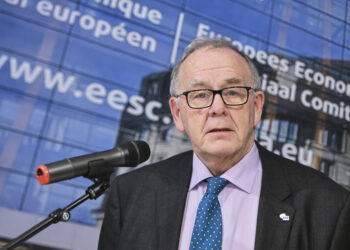
Brussels – Decarbonisation begins at local level. This is the key message that emerged from a conference which took place in Brussels on 27 October and was organised by the Transport, Energy, Infrastructure and Information Society (TEN) Section of the European Economic and Social Committee (EESC), which stated that “towns and regions must be provided with the appropriate tools to accelerate the EU’s energy transition, while ensuring energy security and energy self-sufficiency at local level.”
The European Economic and Social Committee (EESC) emphasises that “the EU will only be able to achieve its climate neutrality targets by enabling local actors to translate climate ambitions into concrete action on the ground.” This is because, on the one hand, towns are responsible for the majority of greenhouse gas emissions; on the other hand, local authorities are tasked with implementing the bulk of climate adaptation measures. “It is therefore essential that the EU strengthens the role of local authorities if it is to achieve its climate neutrality objectives and increase its strategic energy autonomy,” the EESC emphasises.
The event, entitled “Decarbonisation starts at local level: empowering towns and regions for Europe’s energy transition”, brought together representatives from the European Commission, local authorities, trade unions, civil society and the clean energy sector, outlining practical pathways towards an energy transition that is accessible and community-led. Emphasising that the energy transition will only succeed if citizens perceive it as an opportunity to access clean, safer, and affordable energy – rather than as an additional burden – Thomas Kattnig, Chair of the EESC’s Standing Group on Energy, emphasised that “the energy transition will not be decided solely in Brussels,” but “in our towns and regions”, which “form the backbone of our energy transition.” Furthermore, “the green transition can only succeed if it is supported by an appropriate regulatory framework, financing and the creation of high-quality jobs.”
Cities account for 71–76 per cent of global greenhouse gas emissions and, in the EESC’s view, this means that while they contribute to the problem, they can also be part of the solution. Furthermore, “while the EU and national governments set the strategic direction, it is local and regional authorities, together with their citizens, who are responsible for implementing 90 per cent of EU climate adaptation policies on the ground.” Furthermore, “the energy transition must be implemented closer to households and businesses,” the EESC points out. “The future of clean energy in Europe begins in our communities, where local and regional leaders give citizens the tools to turn renewable energy into shared prosperity, lower bills, and greater resilience,” added Alejandro Ulzurrun de Asanza y Muñoz of the European Commission, responsible for just transition, consumers, energy efficiency and innovation.
Finally, the conference made it clear that it is possible to build local energy sovereignty through decentralised renewable energy systems, smart grids, energy storage systems, and innovative clean technologies. “Decentralised energy systems are becoming a cornerstone of resilient and sustainable cities. Local authorities can accelerate the roll-out of locally managed renewable energy sources, including solar, wind and geothermal energy, as well as heat pumps. Emerging solutions also play an important role: biofuels, hydrogen and waste-to-energy technologies, together with smart grids, energy storage and district energy systems, can strengthen local energy security, reduce emissions and bring energy production closer to consumers,” notes the EESC, emphasising once again that “the top priority must be to bring about a clean energy transition that is community-led and accessible to all” and that, “to achieve this objective, citizens must be empowered to participate actively in the energy transition, through inclusive governance, forms of community ownership and clean, affordable energy solutions.”
“The European Union cannot, on the one hand, draw up ambitious climate strategies in Brussels and, on the other, tie the hands of local authorities with complex procedures and debt limits,” observes Hanna Zdanowska, mayor of Łódź and member of the European Committee of the Regions. “Around 90 per cent of renewable energy capacity is located in rural areas. We can only gain local support by involving citizens and ensuring they share in the benefits,” explains Davide Sabbadin, policy officer at the European Environmental Bureau (EEB). Meanwhile, Pauline Dulongcourty, policy officer for public services at the European Federation of Public Service Unions (EPSU), emphasises: “Energy is an essential service for everyone. No one can live without heating, light, or power. Energy cannot be treated as a simple commodity or a financial asset designed to give stable returns to investors. The issue is not how much we invest, but who will make the decisions, who will carry the risks and who will benefit.”
English version by the Translation Service of Withub