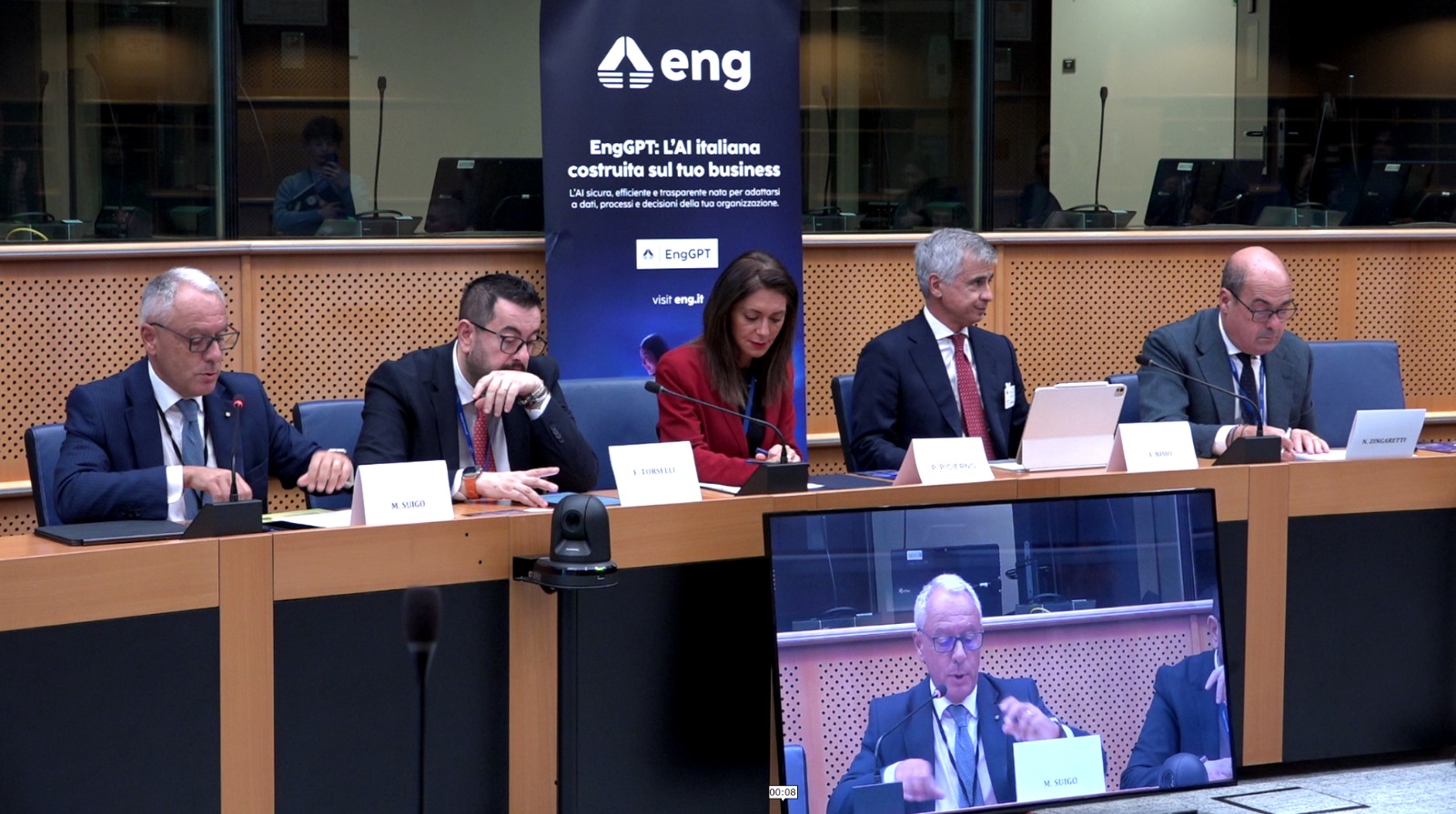
Brussels – Developing sovereign, secure, and governable artificial intelligence (AI) that enables businesses and public administrations to utilise the best available technologies, while retaining control over the data, infrastructure, models, and body of knowledge generated through their use: This is the central theme of the event “Sovereign AI for Europe: IS-IA, Engineering Group’s Italian digital architecture”, organised by Engineering and co-hosted by the Vice-Presidents of the European Parliament Pina Picierno (Spazio Pubblico – Renew Europe) and Antonella Sberna (FdI–ECR).
The meeting, moderated by Michelangelo Suigo, Group Chief Public Affairs, Corporate Communication & Sustainability Officer at Engineering, brought together representatives from the European Commission, the European Parliament and the Permanent Representation of Italy to the EU for a discussion on European technological sovereignty and the role of Artificial Intelligence in the Union’s economic, industrial, and social development. In this context, sovereignty does not mean isolation or technological autarky, but rather the ability to choose solutions and suppliers without creating excessive dependencies and without relinquishing one’s operational and decision-making autonomy. “Sovereignty goes hand in hand with governability, that is, being in control of the systems and free to choose what guarantees to offer to data owners,” explained Aldo Bisio, CEO of Engineering Group, at a press briefing on the sidelines of the event, specifying that “sovereign AI must not be confused with autarky.” According to the CEO, it makes “more sense to invest in more flexible AI agent models that easily maintain control over data, rather than pouring vast sums into funding new ‘cutting-edge’ models.”
During the event, Bisio presented IS-IA, Italy’s Sovereign Intelligence Architecture, the architectural approach developed by Engineering on its proprietary private GenAI platform EngGPT 2. The aim is to enable organisations to utilise Artificial Intelligence while retaining control over data, models, and knowledge, and keeping them within secure, controllable and transparent boundaries. Bisio then presented EngSure, the new agent-based cybersecurity platform that uses Artificial Intelligence to strengthen the defence of organisations’ digital assets and protect the AI ecosystem throughout its entire lifecycle. “The race towards ever-larger and more complex Artificial Intelligence models is not necessarily the path Europe should follow,” emphasised Bisio. “This is the approach we have taken in developing IS-IA, an open and modular architecture that allows users to select and orchestrate different models according to specific needs, and EngGPT 2, our generative AI model. This is where I see a great opportunity for Europe: to invest in AI specialisation, in the skills and data architectures needed to integrate it into production processes and institutions effectively,” he added.
“Talking about artificial intelligence means addressing the European Union’s sovereignty not only at a technological level but also at a political one,” pointed out the Vice-President of the European Parliament and leader of Spazio Pubblico, Pina Picierno. “It is an issue we deal with every day. Recent events have shown us just how vulnerable we are as a continent: we have seen this with attacks in EU airspace or on the healthcare system; even blood bags used to save lives have been targeted,” she recalled, adding that “addressing the issue of AI means being able to defend ourselves and reduce our vulnerability.” On this issue, however, “we are lagging by a huge margin, but we are also paying the price for a lack of public and private investment in the sector.”
Speaking on the subject of investment was the MEP for Fratelli d’Italia (ECR), Francesco Torselli. “We need to understand what rules need to be established, because we also have to take resources into account,” he said. “In the digital transition, including AI, Europe plans to invest nearly 69 billion over seven years under the next MFF (Multiannual Financial Framework, the EU’s long-term budget, ed.). The United States invests 735 billion a year. Google alone invests 200, Amazon 220, Meta 140: what is the aim? Should we be chasing the Big Tech companies? In my view, no. In my view, we must strengthen what we already have, starting with infrastructure and communications networks, improve them even further, excel in cyber security, and invest in technologies where we are strong, such as edge computing and quantum technologies. “As we have fewer resources than others, we need to work out which direction to take,” he continued.
“Digital sovereignty is not autarky – it does not mean turning our backs on technologies developed in America or other countries around the world – but rather the ability and opportunity to choose the best one,” observed the head of the PD (S&D) delegation to the European Parliament, Nicola Zingaretti. “What we must combat is the risk of non-European monopolies and oligopolies which, in the end – as has always been the case – influence the market and even democracy,” he emphasised. “In the past, there were rules – plenty of them – and thankfully so, because they protected citizens and businesses;” however, “a new phase has now begun,” namely that of “building the European digital ecosystem,” he recalled. “The issue is who owns these platforms and technologies, and how many owners there are.” Now, “we need to build a European dimension, and I believe this should also involve a leading role for the state, the public sector. Because when we built our democracies in the post-war period, public services were protected by market rules and a public presence. The fact that, today, all digital AI technology is in the hands of a small group of private companies is not right,” he emphasised.
English version by the Translation Service of Withub