Russia is pressing NATO to reconsider demands it rejected before the full-scale invasion of Ukraine, despite Moscow’s failure to secure a decisive military victory.
At US-brokered talks in Abu Dhabi on 10–11 November, Moscow returned to proposals first presented to the US and NATO in December 2021. According to The Washington Post, Russia wants NATO to withdraw troops and military infrastructure from countries that joined the alliance after 1997.
That would affect 16 members, including Poland, the Baltic states, Finland and Sweden. The restrictions would roll back NATO’s military presence along its eastern flank, limiting its ability to deter Russia and reinforce allied territory in a crisis.
A Russian delegation source told Reuters that a new European security framework was a priority for Moscow, with Ukraine forming part of the wider negotiations.
The New York Times reported that Moscow has floated elements of a Cold War-style security arrangement in which Washington and Moscow would have a greater say over Europe’s security. Such an arrangement would strengthen Russia’s influence over neighbouring countries and challenge their freedom to determine their own security policies.
The contrast with 2021 is striking. Then, Russia had troops massed near Ukraine’s borders and the threat of invasion to back its demands. Today, its forces are making incremental gains at heavy cost, while economic and political pressures, coupled with Ukrainian strikes on Russian energy infrastructure, add to the strain.
The diplomatic circumstances, however, have shifted. Washington is negotiating directly with Moscow, while European governments are seeking a role in discussions that could affect their own security. The Kremlin may believe this offers an opportunity to secure concessions that military pressure has failed to deliver.
Reading the political landscape
The Kremlin may see more opportunity in Western divisions than in its own military strength.
The Trump administration’s willingness to discuss European security alongside a settlement in Ukraine has given Moscow an opening to revive demands NATO previously rejected.
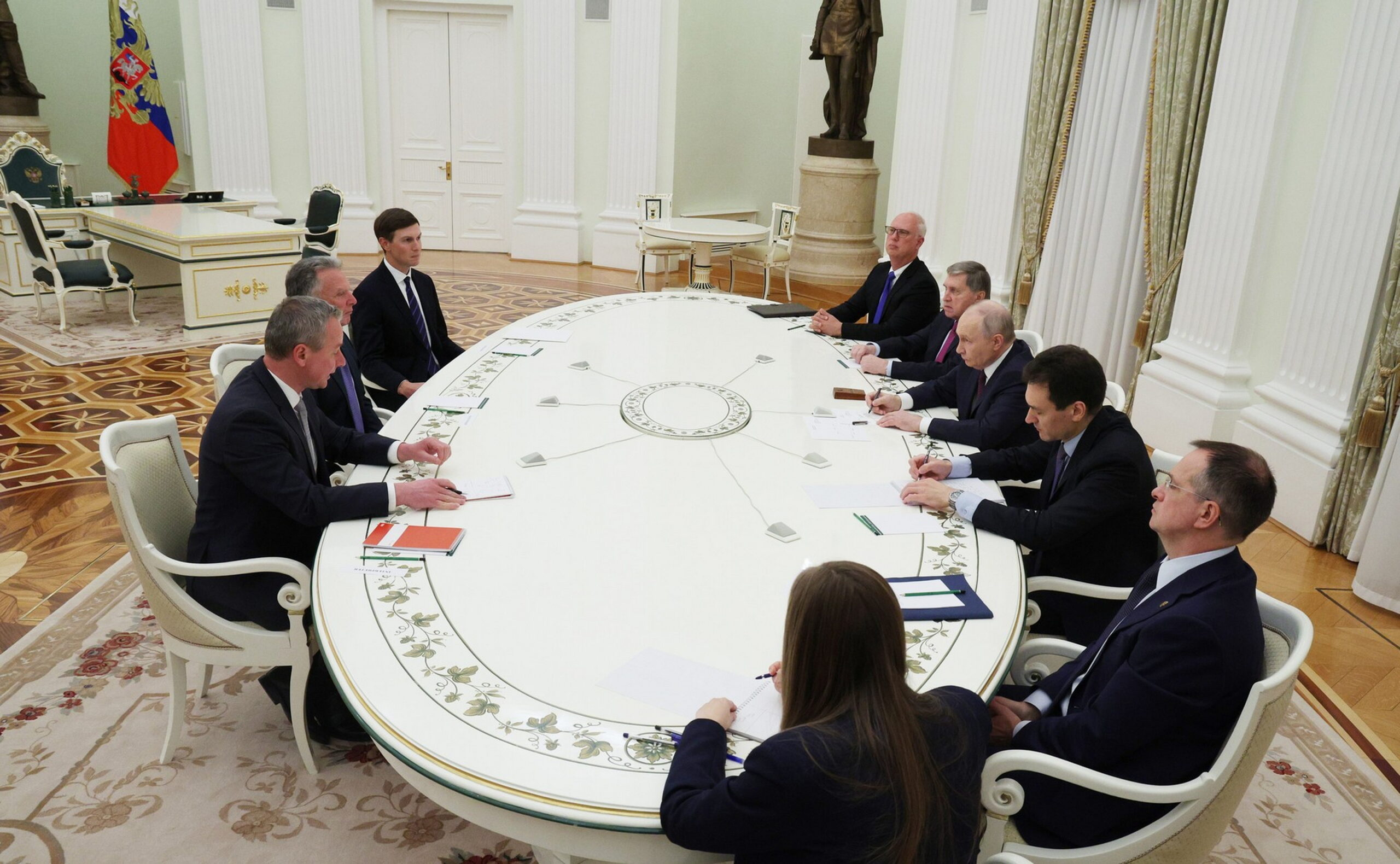
Trump’s criticism of NATO and uncertainty over Washington’s commitment to European defence may have encouraged Moscow to question whether Western governments can maintain a common position. Direct talks between Putin and US envoys Steve Witkoff and Jared Kushner have also given the Kremlin a channel to press its demands.
The negotiations now extend beyond territory and ceasefire terms. On 14 November, Zelenskyy said US negotiators had raised the possibility of Ukraine withdrawing from the remaining Ukrainian-controlled areas of Donbas in exchange for NATO membership. No formal proposal has been confirmed, but his account suggests that Ukraine’s territorial future and its relationship with NATO are being discussed together.
Europe faces political pressures of its own. German Chancellor Friedrich Merz is contending with the rise of the far-right Alternative for Germany, while France approaches its 2027 presidential election amid political uncertainty.
Moscow may calculate that these pressures, combined with differences over defence spending and support for Ukraine, will make it harder for Western governments to agree on a negotiating position.
Europe’s answer
The EU’s top diplomat, Kaja Kallas, has called Russia’s push for a new security architecture a “trap” intended to shift attention away from a ceasefire. She wants a ceasefire first, followed by a peace agreement, before any wider discussion of Europe’s security arrangements.
The sequence matters. Russia wants its broader security demands considered alongside a settlement in Ukraine. Kallas argues that this risks allowing Moscow to turn negotiations over the war into talks about NATO’s military presence in Europe.
European leaders have agreed on a negotiating group that includes Britain, France, Germany, Italy and Poland, alongside EU institutions. Its participation in the next round has yet to be confirmed by all parties.
Moscow is already applying pressure. Kremlin spokesman Dmitry Peskov has warned that Russia would pursue its objectives by force if negotiations failed to produce an acceptable agreement. He also said European representatives had not yet approached Moscow.
His warning suggests that Russia intends to maintain military pressure during negotiations. It does not establish an explicit threat to attack NATO territory.
Europe now faces the task of securing a meaningful role in the talks while resisting Russian efforts to make NATO’s eastern deployments part of a settlement over Ukraine.
Raising the demands may be the point
Moscow could gain leverage even if NATO rejects its proposals.
In an analysis by The European, Roberts Rasums argues that Moscow is using hybrid operations, military intimidation, and diplomatic pressure to weaken NATO’s political unity.
The negotiations offer another opportunity to test that unity. Discussions over NATO’s eastern deployments could expose differences among allies over deterrence, military commitments and the risks of confrontation with Russia.
Even without an agreement, prolonged debate could create uncertainty about arrangements NATO members have spent years strengthening.
Moscow can also present its demands as conditions for ending the war, increasing pressure on Western governments to consider proposals they previously rejected.
At stake are principles central to Europe’s security order: the right of states to choose their alliances and NATO’s ability to deploy forces across allied territory.
The wider stakes
Russia and Ukraine remain divided over territory, security guarantees and ceasefire terms. The latest talks have done little to narrow those differences.
For Europe, withdrawing allied forces would weaken the arrangements built to defend NATO’s eastern flank.
The negotiations carry a wider risk. Bringing NATO’s existing commitments into discussions over Ukraine could expose disagreements among allies and create uncertainty over military arrangements that underpin European deterrence.
Moscow appears to be testing whether divisions among Western governments can deliver concessions that its military campaign has failed to secure. The outcome will depend in part on whether European states can defend a common position and secure a meaningful role in negotiations over their own security.