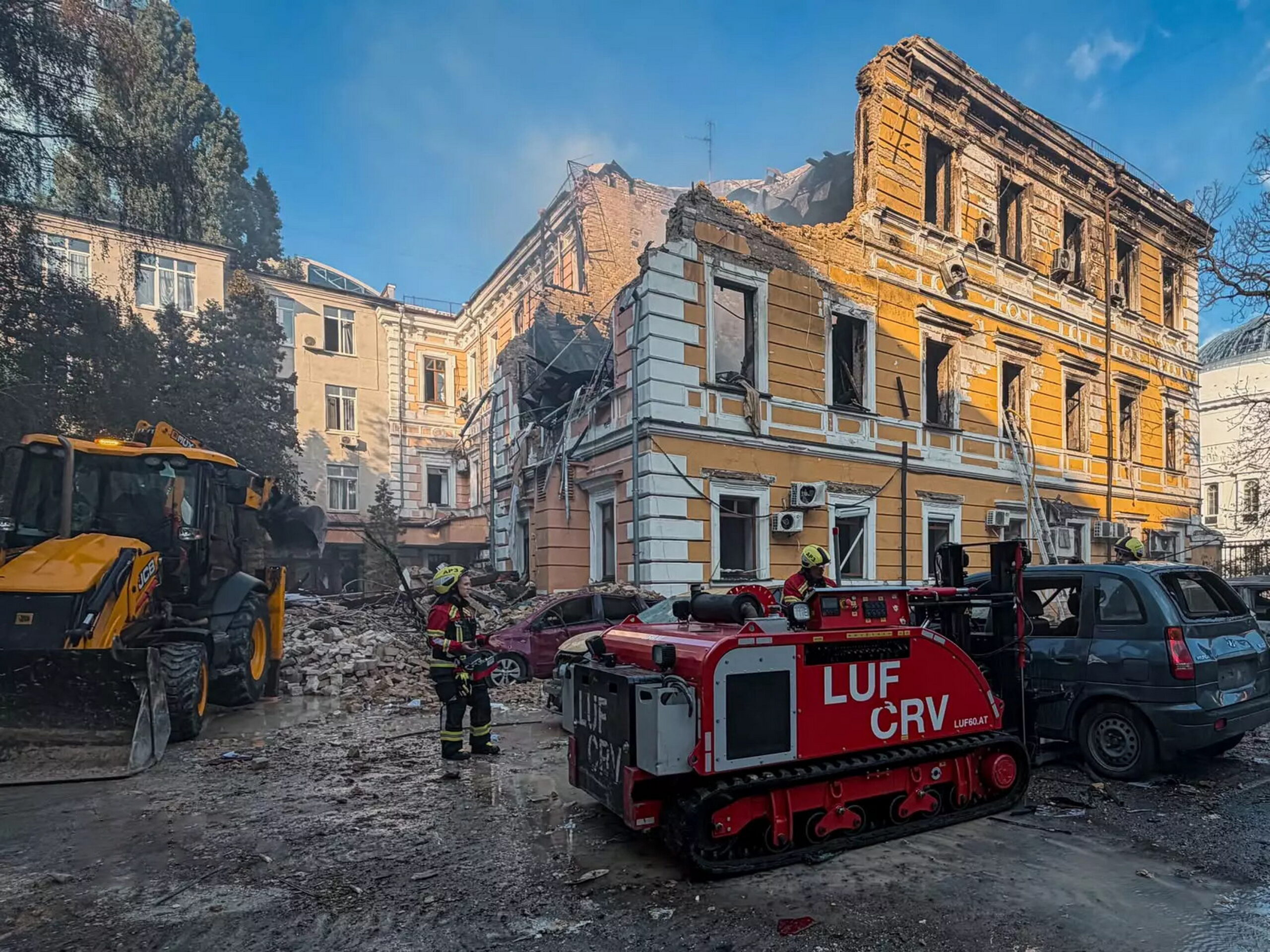
This weekend, the war increasingly became a contest over what each side can keep running.
Russia intensified attacks on Kyiv’s transport infrastructure, striking the capital’s Northern Bridge during German Chancellor Friedrich Merz’s visit after several consecutive days of attacks on crossings over the Dnipro. Moscow is simultaneously maintaining pressure on Ukraine’s energy and industrial infrastructure as winter approaches.
Ukraine, meanwhile, says it will increase attacks on Russian oil refineries and other infrastructure supporting Moscow’s war effort.
But the most important development this weekend may have come from Germany.
Berlin announced €1 billion in additional military assistance and €350 million for Ukraine’s energy sector, alongside a much broader set of German-Ukrainian defence-industrial agreements. The military support spans long-range weapons, combat drones, air defence and satellite technology, while Germany will also finance Ukrainian production of interceptors designed to counter Russia’s new jet-powered attack drones.
The distinction between supporting Ukraine’s battlefield and supporting the system that keeps the battlefield supplied is becoming increasingly difficult to make.
The Big Story: Germany moves from supplying Ukraine to building with it
Germany’s latest package is interesting because of what it combines.
Ukraine needs more air defence. But it also needs weapons capable of striking Russian launch sites, drones capable of intercepting cheaper Russian threats, satellite capability to find targets, and functioning energy infrastructure to sustain the country through winter.
Berlin is now supporting all of them.
During Merz’s visit, Germany and Ukraine announced a series of agreements covering weapons production and wider security cooperation. German companies are also involved in supplying additional air-defence missiles, radar equipment and counter-drone technology.
That points towards a broader change in European military assistance.
For much of the war, support for Ukraine could be measured relatively easily: tanks transferred, artillery shells delivered, Patriot batteries supplied.
The model is becoming more complicated.
European governments are increasingly financing Ukrainian production, establishing joint ventures, integrating European components into Ukrainian weapons and investing directly in Ukraine’s defence-industrial capacity.
Germany’s latest package takes that logic further.
Long-range weapons allow Ukraine to attack the infrastructure and launch sites supporting Russian strikes. Air-defence missiles protect against incoming weapons. Ukrainian-produced interceptors provide a cheaper defensive layer against drones. Satellite systems contribute to intelligence and targeting. Energy assistance helps repair what Russian strikes destroy.
It is, in effect, support for the entire strike–defend–regenerate cycle.
And that may be a more useful way of understanding the next phase of European support for Ukraine than counting individual weapons deliveries.
Ukraine has fired its own ballistic missile. Now it has to build them
There was another very important development last week.
On 1 October, President Volodymyr Zelenskyy confirmed the first combat use of Ukraine’s domestically produced FP-7 tactical ballistic missile.
His announcement was remarkably short: first combat use; result achieved; “Next — production.”
That last point matters most.
Developing a ballistic missile is technologically significant. Producing enough of them to create sustained military effect is an industrial problem.
Ukraine has spent much of the war demonstrating an ability to develop weapons quickly: long-range drones, missile-drones, cruise missiles and now tactical ballistic missiles.
The challenge is increasingly moving from invention to scale.
FP-7 therefore fits into the same pattern we saw in Ukraine’s large September strike package.
The important question is not simply whether Ukraine possesses a particular weapon. It is how quickly Ukrainian industry can manufacture it, modify it following battlefield experience and produce enough to sustain operations.
There is also a defensive dimension.
Meanwhile, Russia continues to use ballistic missiles against Ukrainian targets, while Ukraine has relatively few systems capable of reliably intercepting them. Fire Point, the company behind FP-7, is simultaneously involved in the European Freyja ballistic-missile defence programme.
Ukraine is therefore trying to expand both sides of the missile equation: developing its own ballistic strike capability while helping build a European-backed system intended eventually to intercept Russia’s.
The industrial war is becoming an economic war
There is, however, a harder constraint underneath all of this. Money.
Reuters reported on Monday that Ukraine requires $56 billion for essential expenditure this year, including $27 billion for defence, while continued Russian attacks are weakening the industrial activity and tax revenues from which Kyiv finances the war.
That puts the attacks on Ukrainian infrastructure into a wider context.
Destroying a factory does not simply remove today’s production. It can reduce future output, tax receipts and Ukraine’s ability to finance replacement equipment.
The same logic sits behind Ukraine’s refinery campaign against Russia.
Kyiv does not necessarily need to destroy Russia’s oil industry. Keeping facilities offline, forcing repeated repairs and increasing the cost of protecting industrial infrastructure can itself create cumulative pressure.
Russia appears increasingly interested in imposing a similar regeneration burden on Ukraine.
Transport networks, electricity infrastructure and industrial facilities therefore sit somewhere between military and economic targets: they determine how quickly a country can recover from what was destroyed yesterday.
The industrial war is consequently becoming a contest not simply over production, but over regeneration.
The financing problem remains
Europe can help Ukraine manufacture more weapons.
But somebody still has to pay for them.
According to Reuters, the EU and Ukraine said last week that financing had been identified to cover Ukraine’s 2026 budget and defence requirements, including through the EU’s €90 billion loan package for 2026–27.
Yet the scale of Ukraine’s requirements illustrates why weapons production cannot be separated from European fiscal policy.
A Ukrainian factory may possess the design, workforce and production line needed to manufacture a missile or drone. That does not automatically mean Ukraine can finance production at the scale required for a prolonged war.
The constraint therefore keeps moving.
First, Ukraine needed weapons.
Then it needed the ability to manufacture them.
Increasingly, the question is whether Ukraine and Europe can finance, manufacture and regenerate military capability faster than Russia can destroy it.
That may ultimately matter more than any individual weapons system.
![[credits: Dietmar Rabich / Wikimedia Commons / “Münster, Stadtweinhaus, Beflaggung Ukraine und EU -- 2022 -- 0219” / CC BY-SA 4.0]](https://www.eunews.it/wp-content/uploads/2026/03/ue-ucraina-350x250.jpg)


![Il ministro dei Trasporti, Matteo Salvini [Bruxelles, 5 dicembre 2024. Foto: Emanuele Bonini per Eunews]](https://www.eunews.it/wp-content/uploads/2024/12/salvini241205-120x86.jpeg)