21 September 2026
This weekend, the long-range conflict intensified.
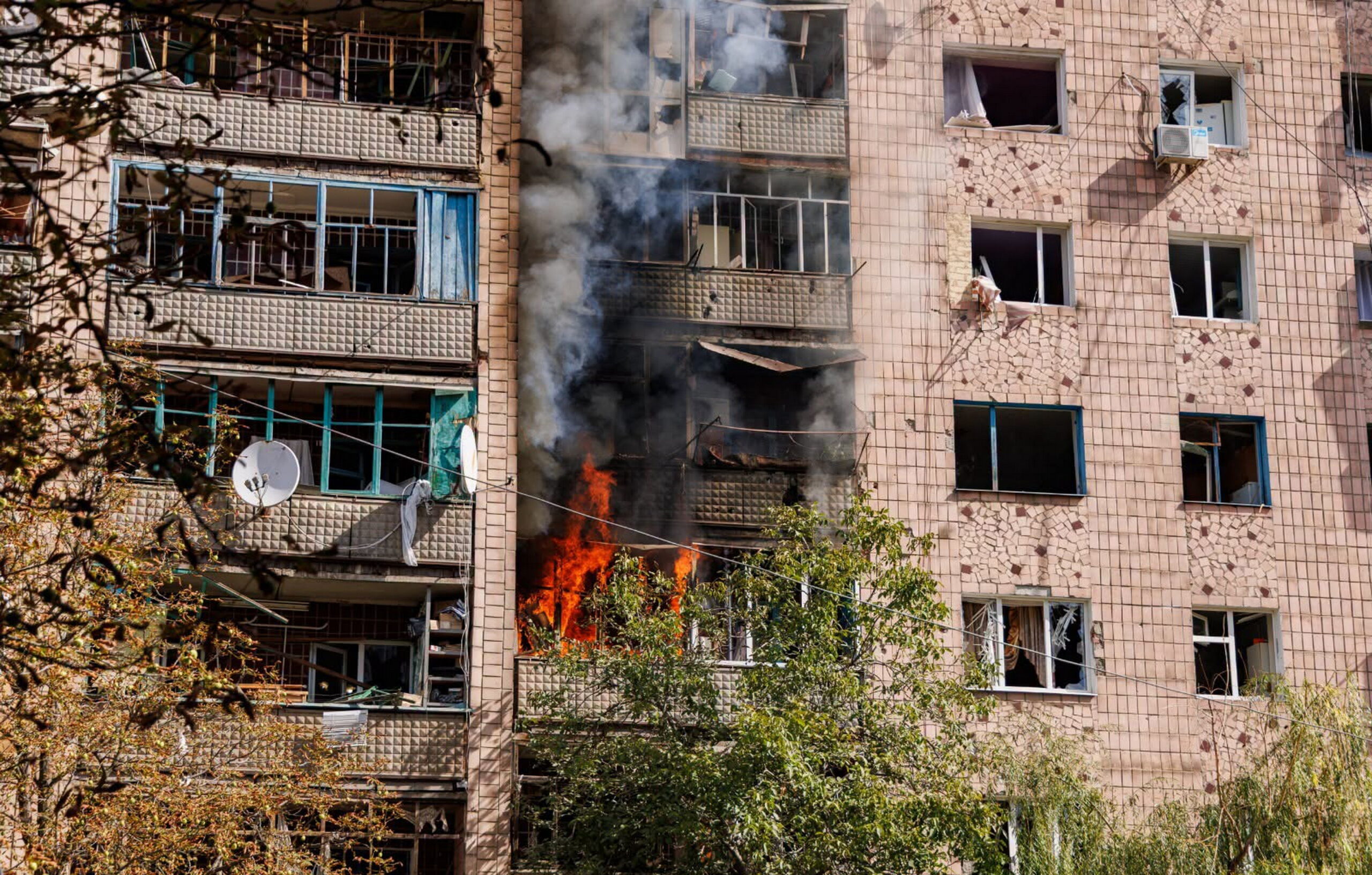
Ukraine launched its largest drone attack yet on Russia, with Russian authorities reporting more than 1,600 drones intercepted since Saturday. Hundreds headed towards the capital, damaging Moscow’s oil refinery, as the Kremlin concluded the third and final day of parliamentary elections.
Kyiv says the operation also involved an unusually broad range of domestically produced long-range weapons. At the same time, Russia continues attacking Ukrainian cities and industry, with strikes reportedly forcing plants responsible for roughly 90% of Ukraine’s steel production to stop operating.
The pattern on both sides is becoming clearer: the targets are not simply military forces, but the industrial systems that allow those forces to keep fighting.
The Big Story: Ukraine shifts its deep-strike tactics
The scale of Ukraine’s attack was significant.
Moscow Mayor Sergei Sobyanin said more than 1,600 drones had been intercepted since Saturday, including 450 heading towards the capital. Russian authorities said three people were killed.
But what flew alongside the drones may matter more.
In a statement, President Volodymyr Zelenskyy said Ukraine used a broad range of domestically produced long-range weapons, including FP-1, RZ-100, MICH-2000, Palyanytsia, Vendetta, Liutyi, Bars, Flamingo, Sichen and Pelican. The Kapotnya refinery in Moscow was among the facilities damaged.
The attack points towards an important evolution in Ukraine’s deep-strike campaign.
Until now, Kyiv has relied heavily on large waves of long-range drones. It now appears to be moving towards mixed strike packages: combining different weapons in the same operation rather than relying overwhelmingly on one type.
That matters because different weapons present different interception problems.
Large numbers of relatively slow drones can consume the attention and resources of Russian air defences, while other weapons approach with different speeds, trajectories and signatures.
Air-defence systems have limited radars, launchers, interceptors, and reaction time.
The goal is now to make attacks more complex, not just to overwhelm defences with numbers.
There is still some confusion about Pelican. Early reports said it was Ukraine’s new FP-7 ballistic missile, but later Ukrainian sources said the Pelican used in this attack was an aircraft-type drone. Zelenskyy confirmed it was used but did not say exactly what kind of weapon it was.
This uncertainty does not affect the overall importance of the attack.
Ukraine is no longer simply trying to put more weapons into Russian airspace. It is trying to give Russian air defence more problems to solve at once.
The industrial war becomes explicit
Some of Russia’s most important attacks this week may not have hit military targets.
The Financial Times reported that Russian strikes have reportedly halted Ukraine’s three principal steelworks, including after two ballistic-missile strikes against the Zaporizhzhia plant. Together, the facilities produced roughly 90% of Ukraine’s steel.
Steel supports construction, infrastructure and manufacturing. Oil performs a similarly fundamental role for Russia.
Ukraine is targeting Russian refineries and supply facilities, while Russia is hitting Ukrainian steel plants, transport systems, and energy sites.
Ukrainian news agency RBC-Ukraine estimates that Russia lost 4 per cent of oil refining capacity after the latest attack on Moscow. That remains a Ukrainian assessment, but it points towards the real objective of the refinery campaign.
Ukraine does not need to destroy Russia’s refining industry permanently. It needs to keep enough capacity under repair at any given moment to create sustained pressure on fuel supplies, logistics and revenues.
The important metric is therefore becoming downtime, not explosions.
So, is the logic becoming symmetrical? Attack the system that sustains the army, not simply the army itself.
A refinery hundreds of kilometres inside Russia or a steel plant far behind Ukrainian lines can therefore matter to the war almost as much as individual positions at the front.
The Patriot problem remains
Ukraine’s growing offensive capability does not change its defensive problem.
Kyiv has seen a surge in Russian attacks, which its air defences have struggled to repel amid ammunition shortages. In response, the US on Friday approved a potential $2.68 billion air-defence sale to Ukraine, covering missiles, launchers, counter-drone radars and associated equipment.
But approval is not availability.
Last month, AP reported that US Patriot inventories in Europe had been described as “beyond critical” following heavy use during the war in Iran.
That makes the central constraint industrial as much as financial.
Europe can provide money. Washington can approve sales. Ukraine can request missiles. But none immediately creates additional interceptors.
There are signs that Washington is beginning to tackle the production bottleneck further down the supply chain. Last week, Northrop Grumman qualified its own solid rocket motor for the PAC-3 MSE and is preparing to become a second source alongside the existing supplier.
That matters because expanding final assembly achieves little if additional missiles still depend on the same constrained suppliers underneath it.
Production does.
Russia continues launching ballistic missiles that Ukraine has few reliable methods of defeating without Patriot.
The question is no longer simply whether Ukraine’s allies are willing to buy more interceptors, but whether enough physically exist — and how quickly industry can manufacture more.
English version by the Translation Service of Withub


![[credits: Dietmar Rabich / Wikimedia Commons / “Münster, Stadtweinhaus, Beflaggung Ukraine und EU -- 2022 -- 0219” / CC BY-SA 4.0]](https://www.eunews.it/wp-content/uploads/2026/03/ue-ucraina-350x250.jpg)


![[Copyright: European Union]](https://www.eunews.it/wp-content/uploads/2026/10/euco-261015-120x86.png)