Participating in COPs (Conference of the Parties) is always an engaging experience, yet at the same time, it is all-encompassing—and often confusing. You find yourself thrown into a whirlwind of initiatives, cultures, and sessions, where navigating your way around is complex, if not nearly impossible. Nevertheless, the insights gained are the very heart of this global event, leaving one feeling enriched and stimulated: it is normal, on the way back home, to recap these hectic days, focusing on the key points that remain after each COP.
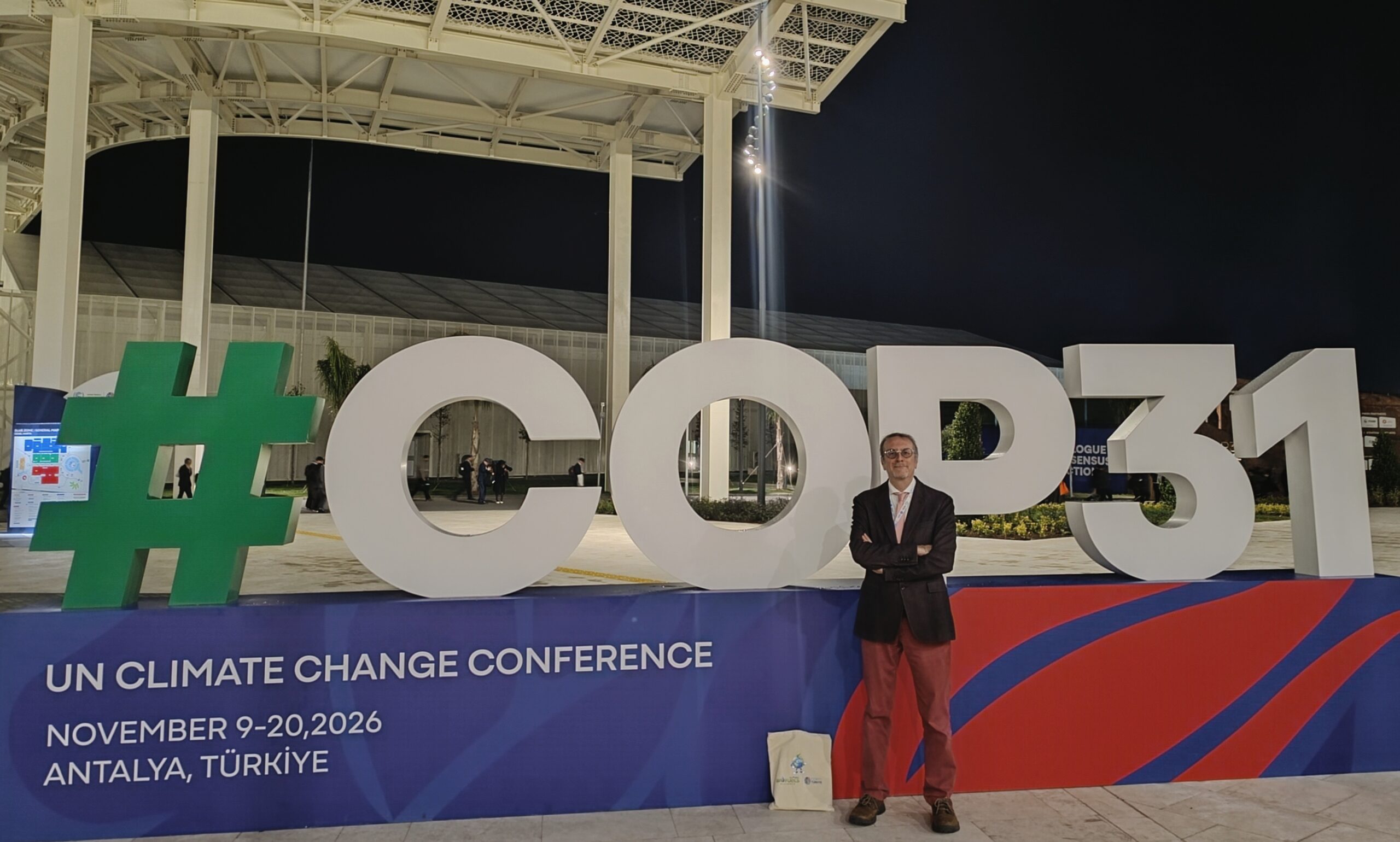
The ongoing COP31 in Antalya has been titled as the “Implementation COP” Impleme(a)ntalya), meaning that it aims at addressing the actual execution of climate action.
Nevertheless, as often stated by many sources in the past, while there’s a good agreement on targets, there’s less agreement on how to get there.
Beyond political intentions, announcements of goals, growing ambition, and the absolute urgency to act now to limit the growth of global temperature on the planet, the debate then goes on to how to put “steel on the ground”. Here come the troubles, one could say.
The green transition is a groundbreaking step for all the economic activities, such as the industrial and agricultural sectors, but also for society itself.
In fact, such a truly disruptive change in industrial processes, technologies and value chains can only happen if it is well designed, i.e. balanced with the actual time technically needed to achieve a radical transformation of the system, including the related infrastructures.
Matching supply and demand, such as setting mandates while at the same time building capacity and innovating, is key to avoiding the unintended consequences of an inaccurately balanced transition: this is further complicated by the urgent need to act, due to the fast-growing climate change impacts (while the 1.5 °C Paris goal is already seen as a missed target by the scientific community).
If targets and penalties for stakeholders are set without carefully aligning the goals with what can actually be delivered by the industry and the economic operators along the journey to the climate targets, i.e. the “roadmap”, the possible failure to achieve the change will result in financial and social penalties, that in turn will be rejected not only by those supposed to implement the change, in particular the industry, but also by society itself. This situation will generate loss of confidence, and extremisms will be fed with arguments. The effect is that neither the climate nor society will benefit, despite the good intentions.
The consequences of badly shaped regulations will therefore depress the transition, rather than stimulating innovation, creating a socio-economic resistance to change, which can happen only if consensus is achieved in society, if value chains and industry are not disrupted, if the transition is seen as an economic opportunity by the operators.
The problem is thus the following: how to build resilient and robust roadmaps, that do not disrupt the economic systems but disrupt the existing fossil-based economy?
A few principles, in our opinion, should drive the design of the route towards a climate-friendly society:
- Recognise the urgency to act. There is no more time to further delay the intervention. All – policymakers, industry, society – should agree on this as a common background.
- Understand and comprehend the complexity of the problem, avoiding unrealistic single-bullet solutions.
- Solutions that could work in a specific socio-economic and climate context will not necessarily perform the same and fit another one: adapt solutions on a case-by-case basis, with the common goal of defossilisation and sustainability.
- At the same time, embrace this complexity as an opportunity: promote integration among the different options and routes, deploy all possibilities without arbitrary pre-selection of one solution versus another. Keep a technology-open approach. Fight deindustrialisation with ad-hoc regulations.
- Believe in science. Utilise a scientific approach as the sole criterion to design policies and regulations, for the benefit of future generations, and GHG accounting as the main metric. Discuss only on the basis of evidence-based peer-reviewed analysis.
- Create value with climate measures, so as to achieve consensus, rather than creating penalties.
- Finance innovation with the right economic instruments for the considered TRL (Technology Readiness Level). Drive the market towards the adoption of the best option at each specific moment of time, supporting innovation in lower-TRL value chains with the revenues from those routes that can be implemented – without penalising these and creating long-term business opportunities. Be realistic: a change of the whole economy in all sectors at the same time is not likely to happen or be accepted by society**.**
- Elaborate roadmaps where the implementation is adapted along a clear route to the targets, balancing these paths on the basis of the TRL across the entire value chain. Adjusting the selection of technologies in due course of the implementation: support the transition with innovation, but do not utilise low-TRL systems as if they were commercial, as this will not create consensus and absorb a lot of available financial resources.
- Implement continuous monitoring to check, revise and adapt the strategy to the actual industrial maturity of the technologies and the whole systems.
- Elaborate a communication strategy to transfer to the whole society why this effort is necessary, what the benefits of the action are, and the role of each stakeholder in the implementation of the programme.
If these principles are to be implemented, a truly interdisciplinary approach is needed: no single field has the necessary competences to design the measures alone.
In concrete terms, it means that experts such as socio-economists, industrial and energy engineers, agronomists and foresters, biologists, etc. will have to closely co-operate in shaping the policies and roadmaps, with an open-minded approach.
In our opinion, this was and still is probably one of the most relevant limitations in policy shaping, and a key barrier that impacted more on the implementation of the green transition so far. This is what created opposition in society, and rejection of unbalanced policies.
There is an urgent need to create multidisciplinary authoritative groups, that can support the policymakers with transparent, evidence-based, informed and updated analysis.
* Prof. David Chiaramonti, Chair of the Clean Energy Ministerial Biofuture Platform, Full Professor of Energy Economics, and Bioeconomy for MED and Third Countries “Galileo Ferraris” Energy Department (DENERG), Politecnico di Torino