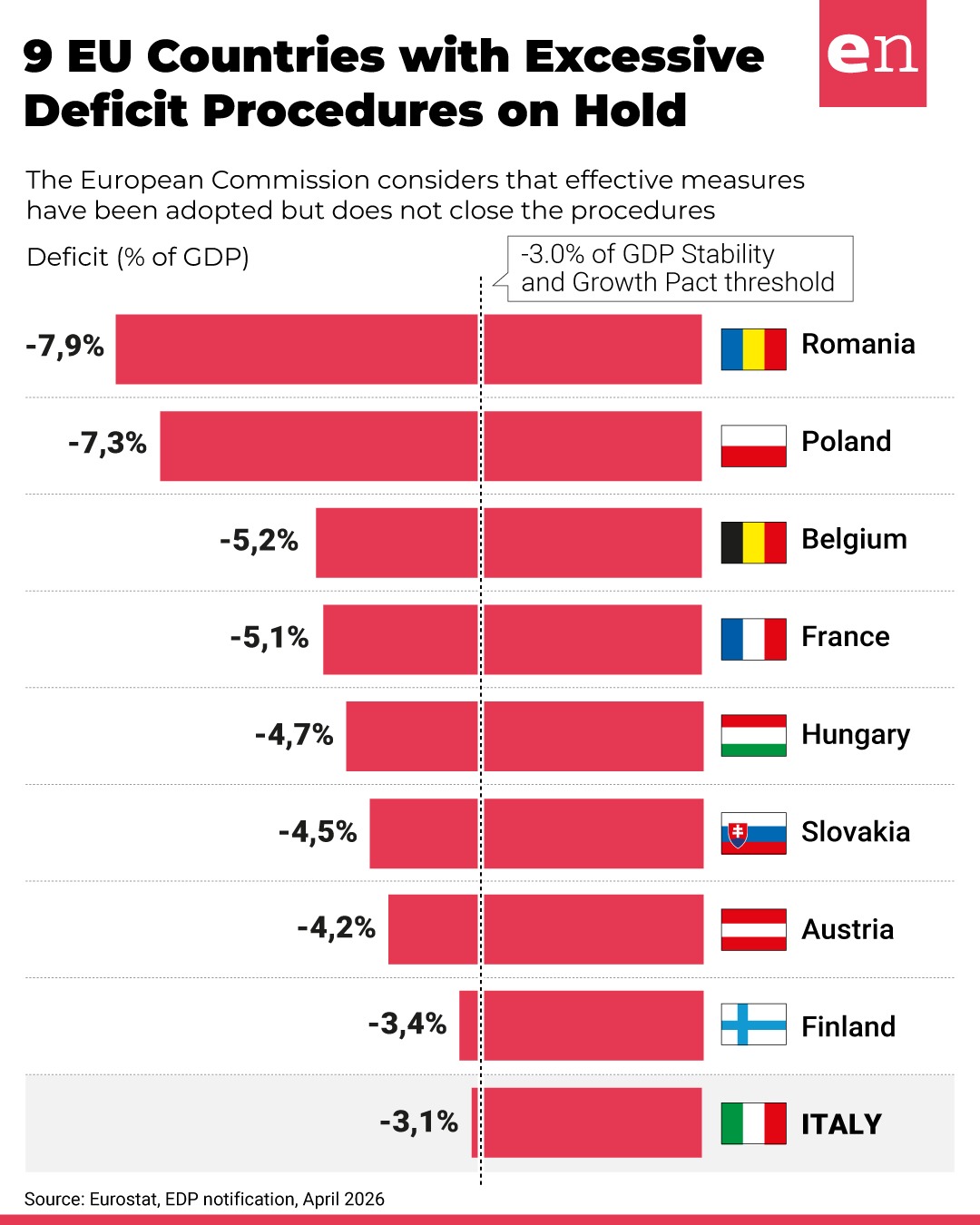
Brussels – The excessive deficit procedure for Italy remains open. The European Commission takes note of the measures taken and acknowledges the relevant merits, but the case is not closed. This is probably the main surprise of the European Semester package, the EU’s economic policy cycle and the coordination of Member States’ measures in this area with the relevant decisions. Following the economic forecasts that do not favour Giorgia Meloni’s Italy, the government faces another cold shower, perhaps an even harsher one, given that within the majority many thought that bringing the deficit-to-GDP ratio back within the 3 per cent threshold would automatically mean a return to normal conditions. Which is not the case.
“The Commission is today recommending that the Council repeal the excessive deficit procedure for Malta”, reads the accompanying note to the documents produced in Brussels. “For Austria, Belgium, Finland, France, Hungary, Italy, Poland, Romania, and Slovakia,the Commission considered that effective action has been taken towards correcting the excessive deficit. Therefore, no further steps need to be taken under the EDP at this stage.” More precisely: “The excessive deficit procedure for Italy is suspended.” Not closed. A clarification that sounds like a warning: the government will have to be careful how it proceeds, as it may find itself under scrutiny once again and subject to compulsory deficit correction.
All the government has managed to achieve is a tentative opening on energy policy. Meloni had personally campaigned to allow public support measures, and the Commission has granted an extension to the national suspension clause of the internal stability pact specifically to address rising energy prices. Specifically, the flexibility provides that, for additional defence expenditure under the national safeguard clause, there is a specific annual ceiling for the period 2026–2028 (0.3 per cent of GDP) and a cumulative ceiling (0.6 per cent of GDP) for the same period, specifically allocated to energy resilience measures.
The move towards greater flexibility follows “a request from Member States,” explains the Commissioner for the Economy, Valdis Dombrovskis, at a press conference. It is therefore a concession to governments, including the Italian government. The additional flexibility of 0.3 per cent per year on the deficit level “applies to expenditure incurred from February 2026, i.e., from the start of the war in Iran,” Dombrovskis clarifies, and public support such as “subsidies for solar panels, energy efficiency, and the replacement of heating systems, such as the switch to heat pumps,” may be permitted.
The extension of the national safeguard clause “represents a concrete response to the challenges of the current moment,” Executive Vice‑President Raffaele Fitto added. These are “resources intended to support households,” which will be rewarded through stronger energy networks, greater storage capacity, and increased clean energy production. “Flexibility is not an exception to the rules,” Fitto stressed. On the contrary, “flexibility is Europe’s ability to use its own instruments to respond to new challenges, while protecting citizens, businesses and territories.”
The Minister for the Economy, Giancarlo Giorgetti, said he was pleased: “I am satisfied because the Commission, something that would have been unthinkable just a few months ago, has taken on board our proposals, the result of a long, serious, and confidential process.” In light of these developments, “the Ministry of the Economy reserves the right to put forward proposals specifically aimed at protecting businesses and households.”
For the Treasury Minister, “naturally, the assessment must be made in its entirety and must also take into account the indicators contained in the Commission’s recommendations, which bear witness to the effort and seriousness with which Italian public finances are managed.”
However, there is more bad news for the government, as the European Commission has also published a country report on social convergence, namely the reduction of inequalities and disparities between citizens and regions. In Italy’s case, it emerges that “despite existing support, many people remain at risk of poverty.” This means that the government has done little, or at least not enough, and must therefore do more.
English version by the Translation Service of Withub![Il ministro dell'Economia, Giancarlo Giorgetti (destra), con il commissario per l'Econonia, Valdis Dombrovskis [Bruxelles, 9 marzo 2026. Foto: European Council]](https://www.eunews.it/wp-content/uploads/2026/03/giorgetti-dombrovskis-350x250.jpg)
![I partner dell'Ue chiedono meno debito. Posizioni che riaccendono il dibattito sulla riforma del patto di stabilità [foto: imagoeconomica]](https://www.eunews.it/wp-content/uploads/2023/02/Imagoeconomica_1556290-scaled.jpg)
![Il ministro dell'Economia, Giancarlo Giorgetti, torna a Roma con i compiti per il governo impartiti dall'Ue [Bruxelles, 21 gennaio 2025. Foto: European Council]](https://www.eunews.it/wp-content/uploads/2025/01/giorgetti-250121-350x250.jpg)