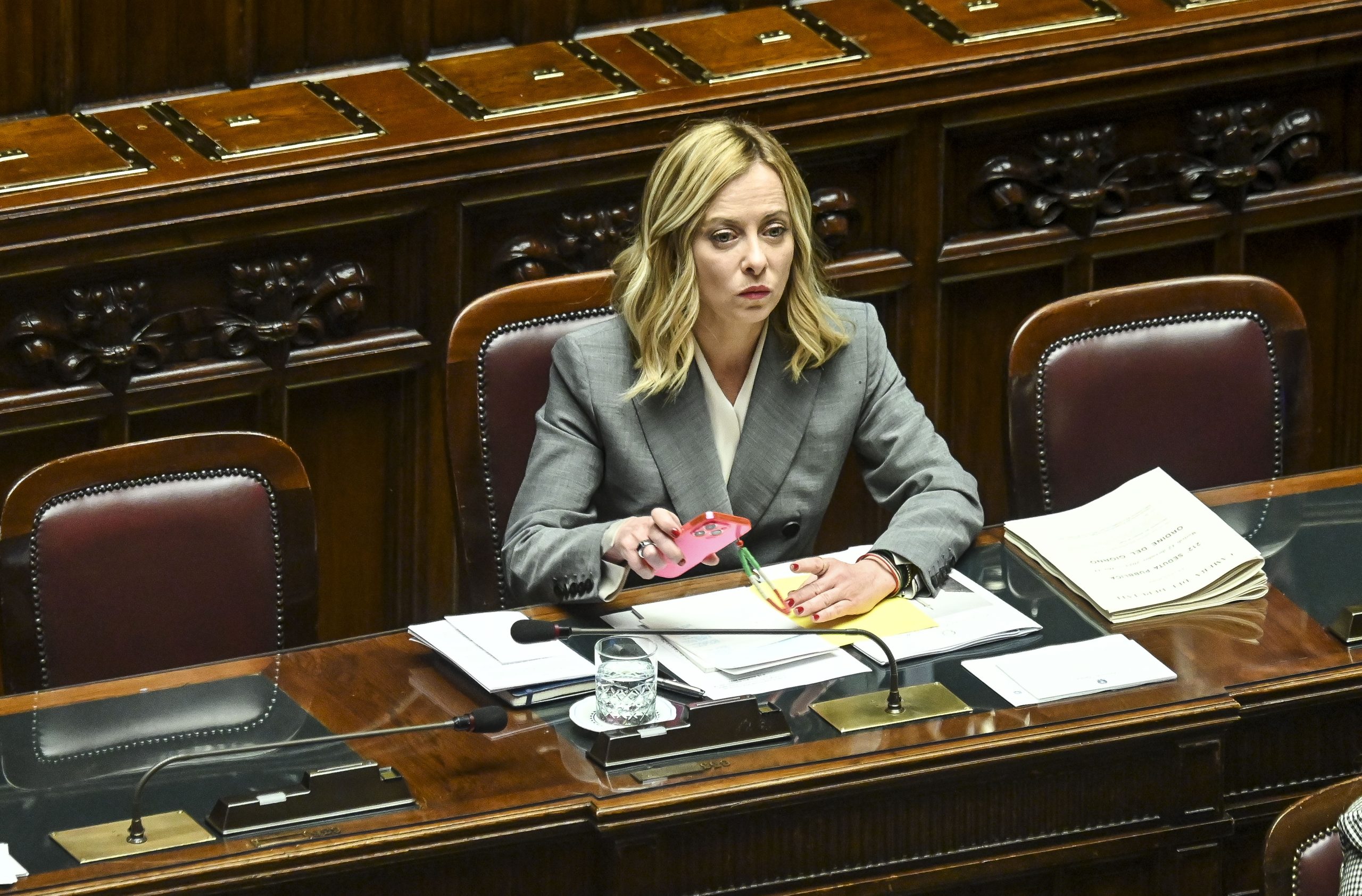
Rome – Although the Stability Pact is not on the agenda of the December 14 and 15 European Council for Italy, it remains at the heart of the debate. “I would be lacking intellectual honesty if I did not address first the issue that Italy is most engaged in right now and that will have very important repercussions on the credibility and future of the Union,” Prime Minister Giorgia Meloni tells (12 Dec.) the Lower House of the Italian Parliament.
She stressed that Rome has been working on reform for months, negotiating in conditions that are “not easy.” The approach is “constructive and pragmatic,” to balance the soundness of national budgets and the sustainability of public debts, without forgetting growth and support for investments. Today, Italy’s position is “credible and serious,” Meloni says in particular “thanks to the work of Minister Giorgetti.” And it is precisely thanks to newfound international credibility that “despite very complex negotiations, we are still in the game,” she says. The final agreement has been delayed to a new Ecofin meeting, to be convened in the days following the European Council with a mandate to close the deal within the year.
“In Brussels, they have understood that the government’s position is not the classic ‘let’s just drag our feet’ but it a serious and rigorous budget policy that even today I want to claim,” Meloni insists. The changes that Italy requested are not to “squander resources without control” but the context is “exceptional” and requires appropriate governance.
Among the Union’s new challenges is enlargement to the Balkans. It is one item that is on the agenda: “We will discuss the path of reforms that the European Union will be called upon to undertake to be ready to welcome new members in the coming years, particularly those with greater demographic and economic weight,” she says. There will be work to be done on updating how policies work. Meloni is thinking in particular of the CAP and Cohesion, “so that they can continue to represent added value for all member states.”
It will then be necessary to reason about the budget and ways to fund EU policies, as well as the effectiveness of the European decision-making processes in a context that would see more than 30 member states: “In this regard, Italy is actively participating in the debate on the definition of the EU Strategic Agenda 2024-29 that the European Council will be called upon to adopt next June to indicate the areas in which the Union will focus its efforts in the years to come,” the premier says. On Nov. 16, Meloni attended a first restricted dinner organized in Zagreb by President Charles Michel and, she assures, “we will not fail to make our contribution in the coming months as well.” The Italian focus, she says, “will be on the big issues rather than on what European nations can best regulate at the local level, respecting the principle of subsidiarity.”
English version by the Translation Service of Withub



![[Copyright: European Union]](https://www.eunews.it/wp-content/uploads/2026/10/euco-261015-120x86.png)