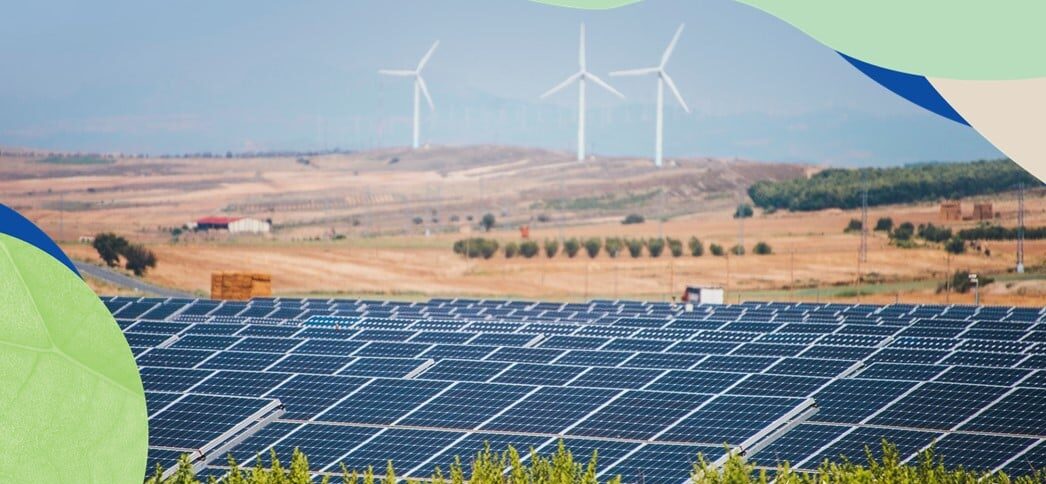
Brussels – Europe has enough land to expand solar and wind power without compromising food production or nature, a study released by the European Environmental Bureau, the European Network of Environmental NGOs, showed. Only half of the land deemed suitable for renewable energy — excluding natural reserves and high-value agricultural areas — is needed to decarbonize the EU by 2040. The report is based on preliminary spatial analysis by the EU’s Joint Research Center (JRC), which identified land suitable for renewable energy projects excluding natural protected areas and high-value agricultural land, focusing instead on built-up areas and degraded land with limited agricultural prospects.
Specifically: 47.9 percent of the Union’s territory is agricultural land, 18.6 percent is covered by protected areas, 5.2 percent is the share suitable for renewable energy projects, and 2.2 percent is the percentage needed for solar and wind projects to achieve climate neutrality by 2040. “Only 2.2% of the EU’s total land will be required by current and future solar and wind projects to achieve climate neutrality by 2040, phasing out both fossil and nuclear generation in the process,” the report states. “According to the JRC, 5.2% of EU land can be considered ‘suitable’ for solar and wind development, based on strict agricultural, environmental and technical criteria for hosting onshore wind and solar projects,” it points out.
The EEB analysis shows that “the majority of suitable land for sustainable renewable deployment is in rural areas, with 78% for ground-mounted solar PV and 83% for onshore wind.” In this context, however, “rooftops are not enough” – the EEB points out – because “urban and industrial areas alone can’t meet all solar capacity needs. However, there is plenty of degraded agricultural land available to expand solar energy without disrupting rural economies. This can be done in synergy with food production and soil health restoration.” The EEB also said that “Integrating solar power with existing agricultural activities is possible through dual-use standards like agri-PV,” — agri-photovoltaics — which aims to produce renewable energy on farmland without taking away productive space for agriculture and livestock. Also, “with robust mitigation measures, EU countries can meet both renewable energy and nature restoration goals—requiring 16.7% of land beyond current protected areas—while ensuring synergy between the two.”
Finally, European solidarity is needed. “Germany and Italy lack enough suitable land for renewables if natural reserves and productive agricultural areas are excluded. In contrast, Spain and Romania have an abundance well above their energy needs. A European “Supergrid” is essential to connect resources, balance energy distribution, and achieve EU-wide decarbonization through cooperation and reduced waste,” according to the analysis.
As for our country, Italy must allocate 1.7 percent of its total land area by 2030 (and 2.7 percent by 2040) to renewable energy if it wants to achieve a 100 percent renewables-based system dominated by solar photovoltaic (228 GW) and onshore wind (39 GW) generation capacity by 2040. This is all according to the Paris Agreement Compatible (PAC) scenario: a Europe-wide energy hypothesis developed by civil society to demonstrate that Europe can achieve climate neutrality by 2040, or 10 years earlier than agreed by EU governments, and which has as its main goals a 65 percent reduction in greenhouse gas emissions by 2030; zero emissions by 2040; and 100 percent renewable energy by 2040 in all sectors.
The EEB used this scenario to compile the report. It shows that by 2040, solar PV and onshore wind will contribute about 68 percent to Italy’s electricity production and satisfy about 41 percent of the country’s final energy demand by the same year. “To host those capacities, we estimate that Italy will need around 1.7% of its total land by 2030 and 2.7% by 2040,” the report says.
Agricultural land in Italy accounts for about 56 percent of the total surface, but a significant portion (23 percent, or 13 percent of the total land) faces high or very high degradation. Nearly 19 percent of Italy’s land is in Natura 2000 sites, including more than a third of its forests. A further 12 percent of territory will be needed to meet the goals of the EU Nature Restoration Act, based on EU projections. The JRC estimated that 0.91% of Italy’s land is suitable for ground-mounted solar PV development, 0.46% for onshore wind, and 0.25% for rooftop solar photovoltaic. For both wind and solar, around 10% of that suitable land is located in cities, 42-46% in towns and suburbs, and 43-48% in rural areas.
“Based on the PAC scenario capacity results, we estimate that by 2040 Italy will need 0.47% of its territory to host the required ground-mounted solar capacity (78 GW). Based on the JRC’s estimates, this means that there’s almost twice as much land available in Italy than is needed to accommodate ground-mounted PV systems without impacting on nature reserves, other biodiversity-rich sites or valuable farmland. Rooftop PV in Italy will require around 0,25% of the country’s surface by 2040 (for 150 GW capacity), almost exactly corresponding to the JRC’s estimated suitable sites, which are mainly located in cities,” the report says.
The deployment of the required capacity (39 GW) of onshore wind energy is a different story as it could pose some land availability issues if only suitable areas, in line with the JRC’s suitability estimates, are considered. “In fact, Italy would need 1.32% of its land to host the needed onshore wind installations, posing the need to identify additional suitable sites.” Therefore, “onshore wind projects can be ideal candidates for dual-use applications, including potentially on high-value agricultural land, if the right measures are in place and all existing environmental assessments under EU law are implemented.” Furthermore, to achieve strategic and effective spatial planning for renewable energy in Italy it is crucial to clearly identify Renewable Acceleration Areas (RAA)and ensure that their designation remains effective even if the required grid connection works extend beyond these areas; and to minimize bureaucratic and speculative barriers by discouraging speculative land markets, and ensuring that national regulations override conflicting regional and local land use restrictions.
English version by the Translation Service of Withub

![[foto: Mattia Calaprice/imagoeconomica]](https://www.eunews.it/wp-content/uploads/2026/10/ue-energia-350x250.png)

![Da sinistra: il presidente del Consiglio europeo, Antonio Costa; il presidente dell'Ucraina, Volodymir Zelensky: la presidente della Commissione europea, Ursula von der Leyen [Bruxelles, 18 giugno 2024. Foto: European Council]](https://www.eunews.it/wp-content/uploads/2026/06/euco_ua260618-120x86.jpg)
![[foto: Saverio De Giglio/imagoeconomica]](https://www.eunews.it/wp-content/uploads/2026/10/cpt-120x86.png)