Brussels – The future of German politics will depend on the ability of the head of the executive, Social Democrat Olaf Scholz, to reach an agreement with Friedrich Merz, leader of the opposition and president of the center-right Christian Democratic Union (CDU), favored in polls to lead the next government. The current chancellor has opened up to the request from the opposition to appear in Parliament for a vote of confidence before the Christmas vacation. However, in exchange, he wants his opponents’ votes at the Bundestag to secure the last pieces of legislation before elections.
How the confidence vote works
On Nov. 6, the so-called traffic-light coalition in power in Berlin since 2021 (Social Democrats of the SPD, Greens, and Liberals of the FDP) collapsed, leaving Scholz at the helm of a minority government that must rely on parliamentary oppositions to get laws passed. The SPD leader initially planned to appear before the House for a vote of confidence in mid-January: this is a formal step necessary for the President of the Republic, Frank-Walter Steinmeier, to call early elections, which could then take place between late March and early April.
This is because, according to the principle of constructive vote of no confidence (introduced by the 1949 Constitution to avert the political instability typical of the Weimar Republic, which opened the door to Hitler’s National Socialism), the hemicycle can only withdraw support from the incumbent chancellor if it has the numbers to support an alternative majority, as happened in 1982 with the transition from the government of the Social Democrat Helmut Schmidt to that of the conservative Helmut Kohl. The problem is that, for now, the numbers for this are lacking at the Bundestag. So, the vote of confidence–which Scholz will surely lose–can only be put on the agenda by the chancellor himself.

In the last few hours, therefore, pressures mounted on Scholz from the opposition, especially those from the CDU (the party formerly led by Angela Merkel and from which Ursula von der Leyen also comes, and which the polls consistently show has over 30 percent support), so that he anticipates the appointment with the hemicycle. For Friedrich Merz, the leader of the Christian Democrats, who is shifting the Union (i.e., the CDU and its Bavarian sister party, the CSU) to the right, this vote should take place as early as next Wednesday (Nov. 13), to enable President Steinmeier to dissolve Parliament and call citizens to the polls as early as January.
The elections to renew the Bundestag were to be held on Sept. 28 next year, when the current legislature expires. According to German constitutional rules, the president has 21 days to dissolve the House after the result of the no-confidence vote, and another 60 days to call early elections from the date of the dissolution of the chamber.
Tests of dialogue with the opposition
Speaking from Budapest, where he was for an informal EU summit, the chancellor said he was open to negotiating with the opposition the date for the vote of (no) confidence but on the condition that parties outside his minority executive (except the ultra-right AfD) also support some of the outgoing government’s important legislative measures, which otherwise could not see the light of day.
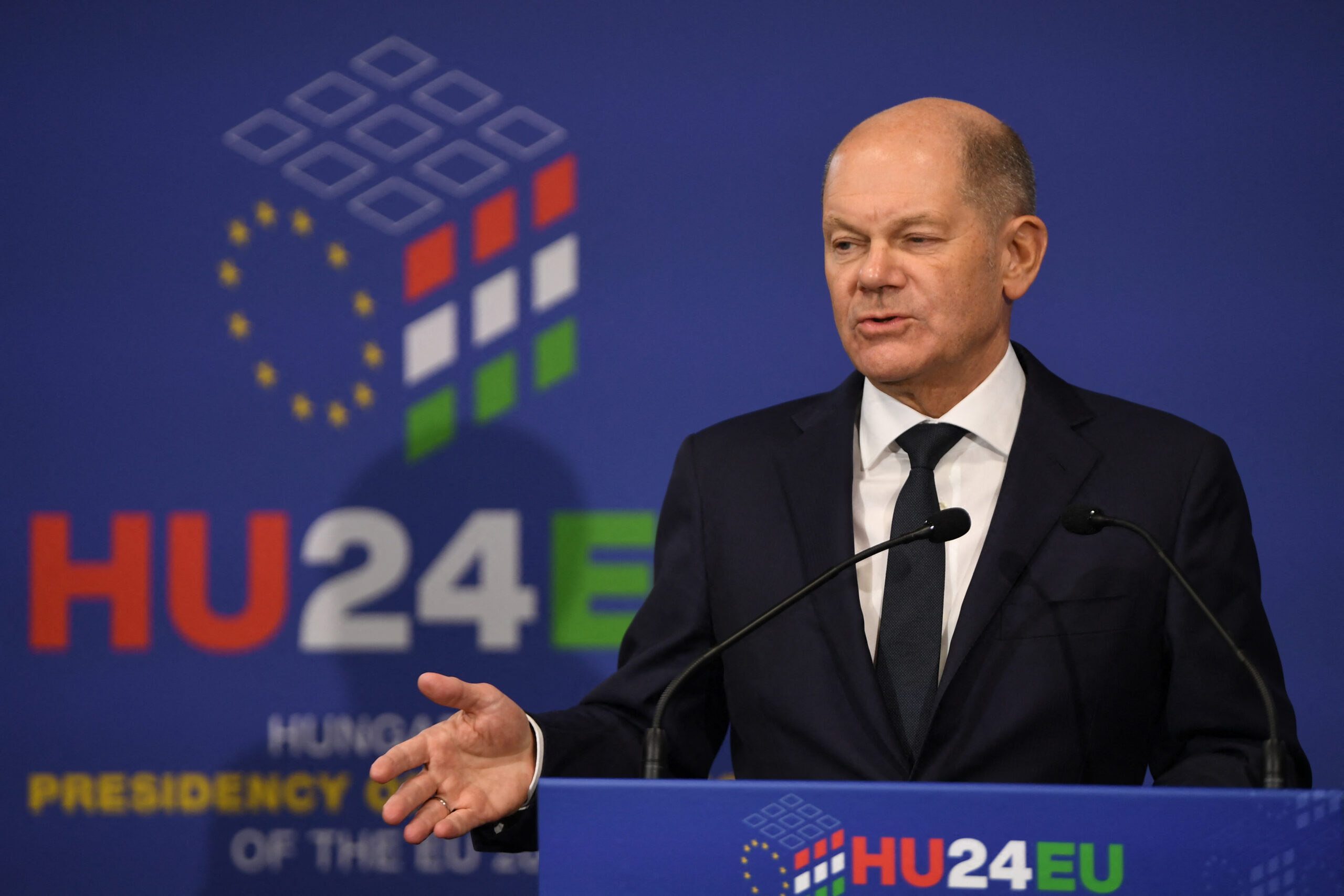
Scholz’s proposal calls for agreement among the political forces concerned to put down on paper a list of laws to pass and a date for a confidence vote plus another, at least indicative, date for early elections. On the other hand, Merz would like first to vote on Scholz’s fate and, only then, agree on the parliamentary work of the last months of the legislature.
At the moment, neither the Chancellor nor his environmentalist partners have indicated which legislative issues would take priority under such a deal. However, they would likely include the national implementation of the new EU Pact on Migration and Asylum, the draft of which Scholz’s cabinet recently approved. Other files could be the controversial reintroduction of compulsory military conscription, the pension system reform, and measures to rescue the domestic auto industry in severe distress. The real elephant in the room is the approval of the federal budget for 2025 (including military aid to Ukraine), one of the issues on which the traffic-light coalition split.
English version by the Translation Service of Withub



![[Copyright: European Union]](https://www.eunews.it/wp-content/uploads/2026/10/euco-261015-120x86.png)