Brussels – After months of ambiguity, the European Commission is taking the opportunity of the new government in Serbia to set the record straight and set some red lines: what the EU is demanding of the longtime candidate country is “closely in line with the demands of the protesting citizens,” said Enlargement Commissioner Marta Kos, addressing the newly elected prime minister Djuro Macut and a delegation of students who have been fueling since November the wave of protests against authoritarian President Aleksandar Vučić.
In her first visit to the Balkan country since Vučić handed the executive into the hands of 61-year-old doctor and university professor Macut—who has no political experience and is not a member of any party, but has supported the president’s Serbian Progressive Party (SNS) in the past—Kos wanted to send a message. After institutional meetings in Belgrade with Vučić and Macut, she went to Novi Sad Station to lay a bouquet of roses at the site of the accident in which 15 people lost their lives last November 1. She met with civil society organisations, students, professors, and delegations from opposition parties.

In a post on X addressed to the “students of Novi Sad,” he said, “I understand you. I want to reiterate that what the EU is asking of Serbia is strictly in line with the demands of the protesting citizens. But the most important thing is that you, the younger generation, can benefit from the many opportunities the EU has to offer.” An offer presented by Kos herself to the premier and reiterated for the cameras, “Our offer to the Serbian people is as follows,” the commissioner said, “Work with us on the reforms necessary to make your accession to the EU possible, work with us to establish an independent and corruption-fighting judicial system, work with us to put in place laws and institutions that guarantee the freedom and independence of your media, work with us to establish an electoral framework that ensures that it is the will of the Serbian people and only their will that decides majorities.”
One hand stretched toward the students, the other toward Macut’s government, whose energy Kos “feels to cooperate with us,” in an effort to reconcile a country in danger of missing a train that passes “once in a generation,” the one to “complete the unification of Europe.” In a decisive speech, Kos stressed that “many candidate countries have realised this and are implementing reforms faster than ever.” The same cannot be said for Belgrade, mired in an increasingly unpopular and authoritarian regime, as well as misaligned with Brussels on foreign policy. “I would like the same to happen in Serbia,” he added. “Without these changes, Serbia cannot progress on its path to the EU.”

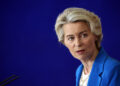
Marta Kos and, to her right, the new Serbian Prime Minister Djuro Macut, 29/04/25
Conversely, she has no more hands to reach out to Vučić, the man who has been in power since 2014 and is chiefly responsible for Serbia’s removal from the European path. The nationalist leader, who has strengthened ties with Vladimir Putin in recent years, is expected in Moscow on May 9 to attend Victory Day celebrations, the anniversary of the defeat of Nazism and the end of World War II. According to a European Commission spokesman, Kos conveyed to the pro-Russian president “a message also shared by many member states,” namely that his possible participation in the May 9 parade “will affect Serbia’s path to the EU.”
On the other hand, Vučić has described the meeting with Kos as “a good conversation about the key challenges and opportunities of our European journey,” and stressed their “full readiness to accelerate reforms, not because of bureaucratic requirements, but because we believe they will bring a better life to our citizens.” Perhaps Vučić was not referring to those 47 citizens who took the case to the European Court of Human Rights, denouncing the alleged use of a sonic cannon—illegal in Serbia—to disperse demonstrators at the huge protest last March 15 in Belgrade. Today the ECHR, noting that up to 4,000 people reported the incident, partially granted the plaintiffs’ claims and indicated an interim measure to the Serbian government: “Until further notice, any use of sonic devices for crowd control purposes must be prevented in the future.”
English version by the Translation Service of WithubTo the students of Novi Sad: I hear you.
I want to reiterate that what the EU asks from Serbia closely aligns with the demands of the citizens protesting.
Most importantly, I want you, the young generation to benefit from the many opportunities the EU has to offer. pic.twitter.com/Ff6FiQcA6J
– Marta Kos (@MartaKosEU) April 30, 2025