- Europe, like you've never read before -
Monday, 27 April 2026
No Result
View All Result
  • it ITA
  • en ENG
Eunews
  • Politics
  • World
  • Business
  • News
  • Defence
  • Health
  • Agrifood
  • Other sections
    • Culture
    • Diritti
    • Energy
    • Green Economy
    • Finance & Insurance
    • Industry & Markets
    • Media
    • Mobility & Logistics
    • Net & Tech
    • Sports
  • Newsletter
  • European 2024
    Eunews
    • Politics
    • World
    • Business
    • News
    • Defence
    • Health
    • Agrifood
    • Other sections
      • Culture
      • Diritti
      • Energy
      • Green Economy
      • Finance & Insurance
      • Industry & Markets
      • Media
      • Mobility & Logistics
      • Net & Tech
      • Sports
    No Result
    View All Result
    Eunews
    No Result
    View All Result

    Home » Defence & Security » NATO towards consensus on new military expenditure target of 5 per cent of GDP

    NATO towards consensus on new military expenditure target of 5 per cent of GDP

    The defence ministers of the member states, meeting today in Brussels, are preparing the ground for the Hague summit at the end of the month. All agree on the need to increase military budgets, but remain divided on the timing

    Francesco Bortoletto</a> <a class="social twitter" href="https://twitter.com/bortoletto_f" target="_blank">bortoletto_f</a> by Francesco Bortoletto bortoletto_f
    5 June 2025
    in Defence & Security
    Mark Rutte

    MARK RUTTE SEGRETARIO GENERALE DELLA NATO

    Brussels – NATO is moving resolutely towards the 5 per cent target. The new goal of military spending as a proportion of GDP, unimaginable until before Russia’s large-scale invasion of Ukraine, is now almost a done deal, at least according to the Pentagon chief, Pete Hegseth, who is on his way to Brussels to meet his Alliance counterparts and prepare the ground for the summit in The Hague.

    A meeting of the defence chiefs of the 32 member states is taking place today (5 June) at NATO headquarters in Brussels. The US Pete Hegseth—who, in an eloquent signal to European allies yesterday, deserted the meeting of the Ukraine Defence Contact Group (also known as the Ramstein Group), held in the same building—said he was “very encouraged” by the discussions. “The countries present are well above 2 per cent and we believe that we are very close, almost at consensus, to a 5 per cent commitment,” he said. “There are some countries that are not yet fully in agreement,” he admitted, adding that “we will convince them.”
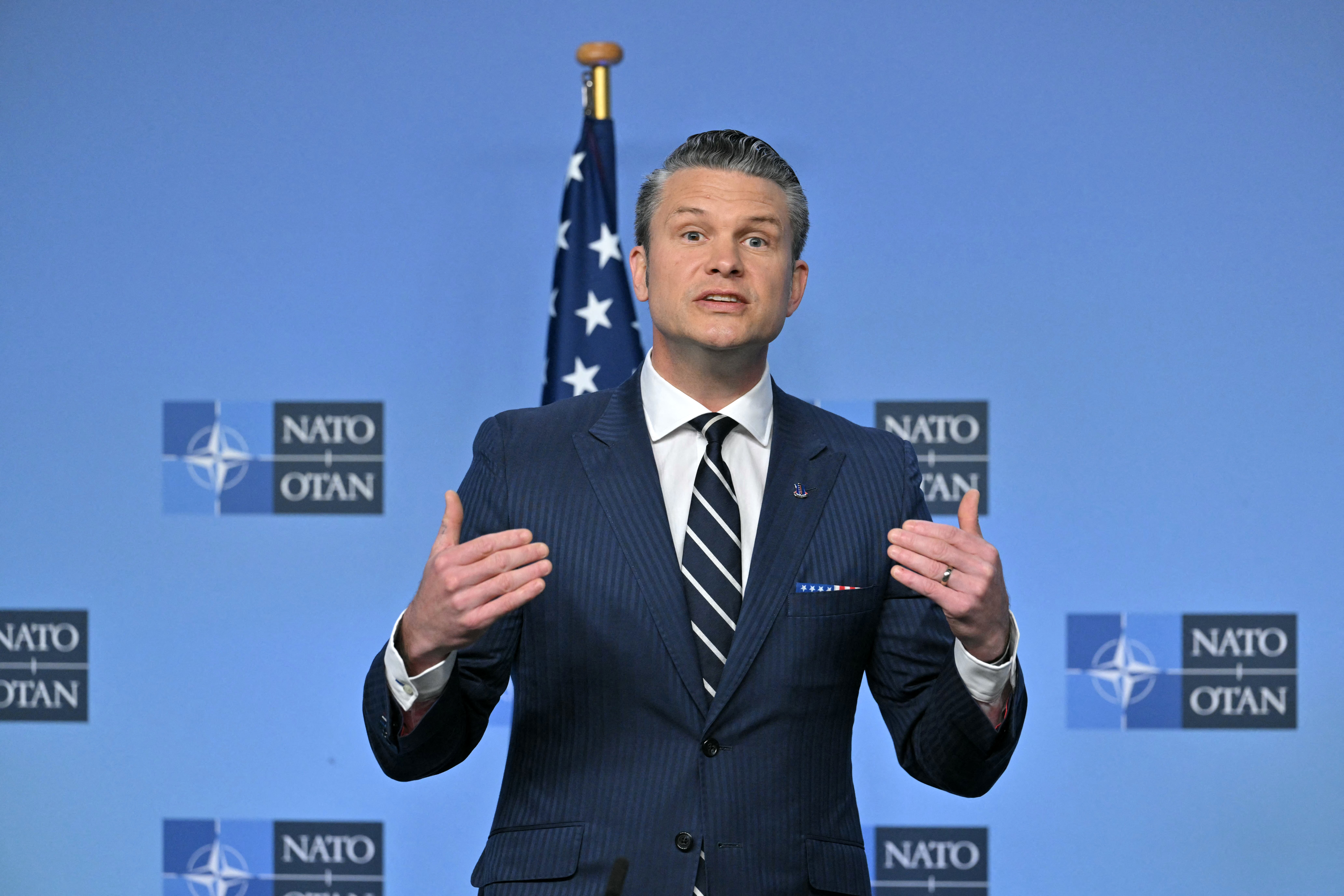
    Pete Hegseth
    US Secretary of Defence Pete Hegseth (photo: Nicolas Tucat/AFP)

    For several months now, the White House of Donald Trump has been pressuring the members of the North Atlantic Alliance to significantly increase their defence budgets. Technically, the current target is set at two per cent of GDP, but the tycoon is demanding more than double the commitment. The Secretary General of NATO himself, Mark Rutte, had confirmed shortly after taking office that the current spending targets are no longer appropriate to the changed international geopolitical environment, especially (but not only) due to the aggressiveness of Vladimir Putin‘s Russia.

    The summit of the heads of state and government of the organisation’s 32 member states, scheduled for 24–25 June in The Hague, will have to wait for the summit of the heads of state and government. Three weeks, therefore, remain to get all chancelleries to agree and change the minds of the most recalcitrant ones. Today’s ministerial meeting serves to prepare the ground at the technical level. “This will be a considerable additional investment,” said Rutte, also confident that, at the summit at the end of the month, “we will decide on a much higher spending target.”

    Actually, the maxi-target of 5 per cent is ‘composite’: the actual defence budget is to be increased to 3.5 per cent, plus an additional 1.5 per cent of GDP to be devoted to defence-related capacities and activities, including specific infrastructure projects of high strategic value. But the specific details will probably be discussed until the last minute before the summit.

    Mark Rutte
    NATO Secretary General Mark Rutte (photo via Imagoeconomica)

    Currently, virtually all NATO countries, especially the European ones, are significantly increasing their defence spending. A year ago, in June 2024, eight chancelleries remained below the 2 per cent threshold: Belgium, Canada, Croatia, Italy, Luxembourg, Portugal, Slovenia, and Spain. Then the ‘Trump cyclone‘ turned the tables. Amidst threats of disengagement and flirtations with the Kremlin, the tycoon has essentially transformed the increase in military budgets from a political choice into a strategic necessity.

    The Europeans have taken the hint: if they want to keep Uncle Sam involved in the Old Continent, they have to put their hands in their pockets. It is a paradigm shift of generational significance, albeit a belated one, at least according to some: Rutte himself recently sounded the alarm about the fact that Russia, which also has an economy 25 times smaller than that of the NATO countries combined, produces four times more ammunition.

    Updated official figures on spending as a proportion of national GDP have not yet been published. Still, all member states appear to be on the verge of hitting or even exceeding the 2 per cent target agreed upon back in 2014, following the outbreak of the Russian-Ukrainian crisis. Madrid, which had long been the Alliance’s tail end, announced last April that it intends to reach the benchmark target by the end of the year.

    Guido Crosetto
    Italian Defence Minister Guido Crosetto (photo: European Council)

    However, while there seems to be basic agreement on the need to increase military spending, national governments are divided on the timing. Rutte speaks of 2032: for some members (above all the Baltics and Scandinavians), this is a horizon too far away, while for others it is too close. Giorgia Meloni has promised that Rome will reach 2 per cent before The Hague Summit. Still, according to Defence Minister Guido Crosetto, the Italian government agrees with the British one in pointing to 2035 as the ideal date for 5 per cent.

    The minister also said that he “doesn’t know” whether his executive will request the activation of the safeguard clause of the Stability and Growth Pact, a possibility granted by the EU Commission as part of the ReArm Europe plan to allow the Twenty-Seven to take on debt in the defence sector without incurring infringement proceedings.

    According to Crosetto, the suspension of SGP rules should last for “twenty or thirty years” to “make sense”. However, he argues, allocating funds is not enough: the problem is that “there is no production capacity to support the investments that we will have to make in the next few years, because the defence industry is still the same as it was three years ago.”

    English version by the Translation Service of Withub
    Tags: borndefensedefense budgetguido crosettomark ruttepete hegsethpublic financestability and growth pact

    Related Posts

    Artiglieria ucraina
    Politics

    Growth in global (and European) military spending threatens climate goals

    29 May 2025
    safe
    Defence & Security

    Defence, final go-ahead for the SAFE fund. Von der Leyen: “Exceptional measures for exceptional times”

    27 May 2025
    kubilius difesa
    Non categorizzato

    Defence, Kubilius to Italy: “I hope you find a way to increase spending”

    26 May 2025
    map visualization
    Oslo, premio Nobel per la pace all'attivista Narges Mohammadi, imprigionata in Iran per aver condotto una campagna per i diritti delle donne e la democrazia. Ritirano il premio i figli.

    Iran, Metsola: “We call for the immediate release of Mohammadi and Sotoudeh”

    by Redazione eunewsit
    27 April 2026

    Brussels – The President of the European Parliament, Roberta Metsola, opened the plenary session of the European Parliament in Strasbourg...

    La riunione del Consiglio Agrifish a Lussemburgo, 27 aprile 2026. Fonte: Consiglio UE

    Italy and Germany deem EU agricultural policy inadequate, call for flexibility and oppose overly strict rules

    by Annachiara Magenta annacmag
    27 April 2026

    According to Italian Undersecretary La Pietra, "the application of degressivity mechanisms in the next CAP should be on a voluntary...

    LUNGOMARE  STARITA     SALPA DA BARI LA NAVE UMANITARIA GLOBAL SUMUD FLOTILLA PER LA MISSIONE SPRINGS 2026 BANDIERA PALESTINA

    The EU advises the Flotilla not to sail to Gaza: “People’s safety is at risk”

    by Emanuele Bonini emanuelebonini
    27 April 2026

    The EU Commission spokesperson said: "Humanitarian aid must be delivered in accordance with sound principles." However, there has been no...

    GIUSEPPE CAVO DRAGONE PRESIDENTE COMITATO MILITARE NATO

    EU and NATO military leaders on a solidarity visit to Ukraine

    by Perla Ressese
    27 April 2026

    General Seán Clancy, Chairman of the European Union Military Committee (EUMC), and Admiral Giuseppe Cavo Dragone, Chairman of the NATO...

    • Director’s Point of View
    • Opinions
    • About us
    • Contacts
    • Privacy Policy
    • Cookie policy

    Eunews is a registered newspaper
    Press Register of the Court of Turin n° 27


    Copyright © 2025 - WITHUB S.p.a., Via Rubens 19 - 20148 Milan
    VAT number: 10067080969 - ROC registration number n.30628
    Fully paid-up share capital 50.000,00€


    No Result
    View All Result
    • it ITA
    • en ENG
    • Politics
    • Newsletter
    • World politics
    • Business
    • General News
    • Defence & Security
    • Health
    • Agrifood
    • Altre sezioni
      • Culture
      • Diritti
      • Energy
      • Green Economy
      • Gallery
      • Finance & Insurance
      • Industry & Markets
      • Media
      • Mobility & Logistics
      • Net & Tech
      • News
      • Opinions
      • Sports
    • Director’s Point of View
    • Draghi Report
    • Eunews Newsletter

    No Result
    View All Result
    • it ITA
    • en ENG
    • Politics
    • Newsletter
    • World politics
    • Business
    • General News
    • Defence & Security
    • Health
    • Agrifood
    • Altre sezioni
      • Culture
      • Diritti
      • Energy
      • Green Economy
      • Gallery
      • Finance & Insurance
      • Industry & Markets
      • Media
      • Mobility & Logistics
      • Net & Tech
      • News
      • Opinions
      • Sports
    • Director’s Point of View
    • Draghi Report
    • Eunews Newsletter

    Attention