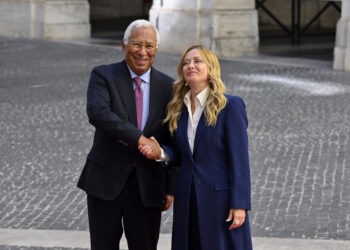
Rome – Agreements worth EUR 1.2 billion will help Africa grow and Europe with Africa. It is not just a “package of projects” that Giorgia Meloni and Ursula von der Leyen are bringing home today after a summit on the Mattei Plan and the Global Gateway at Villa Pamphilj in Rome. The Italian Prime Minister explains it is a “pact between free nations that choose to cooperate because they believe in the values of dignity, work, and freedom.” It also indicates that “when Europe acts with courage, when Italy puts in its share, with its vision, with its concreteness, there are results.”
Not only that. Rome and Brussels are working on an initiative to tackle the debt of African nations. This is a key issue for the continent’s development, which risks undermining the efforts of the two plans left unaddressed. The plan is to collect the entire debt burden for the least developed nations over the next ten years “according to the World Bank criteria,” the premier reports, and to reduce by 50 percent of the debt of lower middle-income nations. The operation over ten years will allow the conversion of approximately 235 million euros of debt into development projects, which will be implemented locally.
In Rome, Meloni and von der Leyen bring together African authorities from Angola, the Democratic Republic of Congo, Tanzania, and Zambia, and the heads of international financial institutions (the International Monetary Fund, the World Bank Group, the African Development Bank and the Africa Finance Corporation).
The watchwords are “sustainable growth, resilience, and mutually beneficial cooperation.” The European Commission and Italy are committed to mobilizing transformative investments along strategic economic corridors. With a particular focus on three: the Lobito Corridor, agriculture, and the Blue-Ranman cable.
The Lobito Corridor is not only a railway development project but a broader economic corridor connecting resource-rich, landlocked regions of southern Africa to global markets, including Europe. The intention is to accelerate investment in interconnected sectors, including transport infrastructure, energy systems, agricultural value chains, and trade facilitation, based on an approach that strengthens local economies and promotes ‘inclusive’ regional integration. Private sector involvement will be crucial, with scalable, climate-friendly, and commercially viable investments.
Promoting trilateral cooperation in sustainable agriculture is the second strategic point of the agreements, which focus on climate-resilient supply chains. A new initiative will strengthen the East African coffee sector through regional integration and the involvement of the Italian private sector. Promoted by the Italian Ministry of Foreign Affairs and supported by Unido, Cassa Depositi e Prestiti, and multilateral partners, the initiative will explore the possibility of introducing insurance schemes to strengthen resilience. The EU will then sign a guarantee with Cassa Depositi e Prestiti to accelerate the development of sustainable agri-food systems through capacity building and access to innovative financing in the TERRA (Transforming and Empowering Resilient and Responsible Agribusiness) initiative, with a contribution of EUR 109 million.
On the digital front, the Blue Raman submarine cable has strategic potential. Co-funded with a EUR 37 million contribution from the European Commission and supported by Sparkle, the digital interconnection will improve connectivity, stimulate research and innovation, and support technological convergence between Europe, Africa, and India. The project involves research and education networks, including GEANT for Europe and the UbuntuNet Alliance for Africa, and benefits from the technical expertise of the European Investment Bank.
There was also an agreement to mobilize private investment in key sectors such as digital connectivity, renewable energy, and transport in sub-Saharan Africa through the Cassa Depositi e Prestiti Renewable Infrastructure and Sustainable Energy (RISE) program with a contribution of EUR 137 million.
Also part of this scenario is the AI Hub for Sustainable Development, the initiative created as part of Italy’s G7 presidency last year in partnership with global industry leaders such as Microsoft and the operational support of the United Nations Development Program. “This morning, the AI Hub was inaugurated in Rome, which will involve hundreds of start-ups to apply artificial intelligence solutions to the priority sectors of the Mattei Plan, health agriculture, energy, water, and infrastructure formation,” Meloni recalls.
The understandings included signing a letter of intent on synergetic energy connectivity initiatives between Italy, the European Commission, and the World Bank Group on the African continent.
The progress of the strategic partnership will be reviewed at the Global Gateway Forum on October 9-10, 2025, in Brussels. “We believe that Africa is a continent where more than anywhere else our future is at stake; where we Italians, we Europeans are called upon to make a difference, we can make a difference,” the Prime Minister said. “Global Gateway and the Mattei Plan were born to be collective initiatives; they exist to address common challenges,” said von der Leyen, who is convinced that the untapped potential of the partnership is ‘great’ and Brussels, she confirms, is ready to invest. “Especially in these times of global uncertainty, you can count on Europe.”
English version by the Translation Service of Withub